Issue 14 -- Board Gets Update on Highly Capable Program
Two new highly capable cohorts are coming to West and South Seattle -- but so are changes to identification practices.
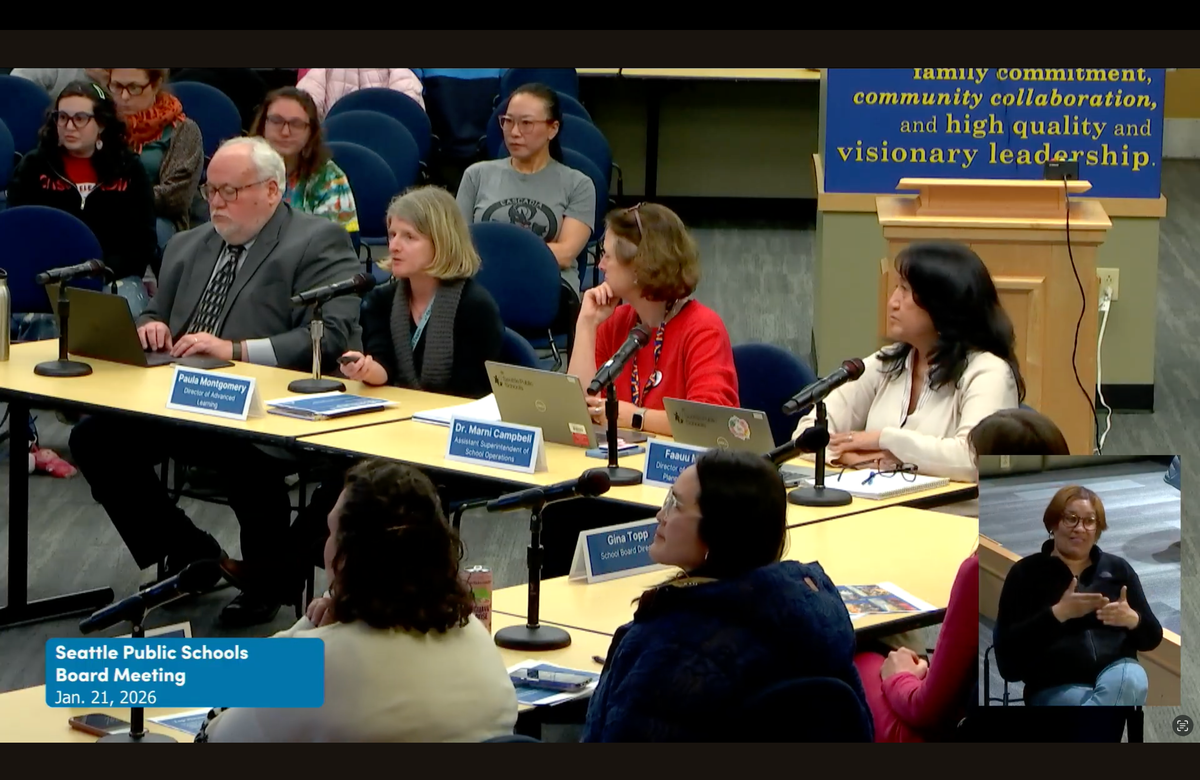
Watch: YouTube (video cues up at the part where the HC program is discussed)
Read: Transcript
Agenda & SPS presentation materials: (SPS website)
In this issue:
At Wednesday’s school board meeting, district staff updated the board on recent & proposed significant changes to the Highly Capable (HC) program. The most significant changes include the proposed establishment of two additional elementary schools supporting HC cohorts and a broadening of the criteria used to designate students as highly capable.
Proposed changes to the HC program are part of a broader set of changes to the way SPS assigns students to schools—a set of policies known as the Student Assignment Plan. The board periodically adopts changes to this plan and is expected to vote on February 11 on the changes proposed in this week’s meeting.
These proposals come on the heels of a community engagement campaign by Director of Highly Capable Services Dr. Paula Montgomery’s team. They held seven meetings across the city, gathering input from over 1,000 community members.
Proposed HC Program Changes
Two new highly capable cohort sites: Alki & Rainier View
Dr. Montgomery & Interim Superintendent Fred Podesta are proposing to establish two new elementary HC cohort sites: one at Rainier View Elementary, in the South End; and the other at Alki Elementary, in West Seattle. Both new sites would follow a hybrid model, hosting a mix of HC cohort and neighborhood students.
According to Podesta, these sites were selected based on site capacity and building condition. He did not mention intangibles like student transportation or boundary transitions, but presumably these geographical factors were also considered. Some HC students from South and West Seattle spend more than an hour on the bus to get to Thurgood Marshall each day.
The choice of Alki elementary makes sense: The school is currently being rebuilt, with the new building set to open in September 2026 with capacity for 542 students (Alki’s current enrollment is 265 students).
The choice of Rainier View is more difficult to understand. According to the most recent facilities master plan update, Rainier View is in “fair” condition, ranked 59th out of the 91 evaluated SPS sites. It has capacity for 200 total students, with a current enrollment of 168. That leaves capacity for only 32 students, though this could expand if neighborhood enrollment drops.
The minimal extra capacity at Rainier View leaves one to wonder: How small can a cohort be and still be considered an effective cohort? Director Rankin pressed staff on the suitability of Rainier View given its small size, asking them to provide a plan that reassures parents that the new HC programs won’t be moved or disrupted in a few years’ time. Podesta assured her that he believes a new HC program will fit at Rainier View, but he didn’t explain why he believes this.
Expanded HC identification criteria
Montgomery is proposing both expansions and reductions in the criteria used to assign HC designations.
Under the new criteria, HC cohort sizes are expected to change slightly, but not significantly, for the 2026-27 school year. According to the data presented, the overall designation rate is expected to go from 14.8% to 14.9%, a total increase of 30 students. Most of this increase comes from the Southeast and Southwest regions, where rates would increase by 0.6% (13 students) in each region.
Reductions: Staff piloted a screening process this year that limits universal HC screening to students in 1st and 4th grades only. Previously, students in every grade were automatically screened. Under the new process, parents or teachers can still refer a student in any grade for screening. Montgomery stated that reducing the number of students under review each year allows staff to look more deeply at each student’s case.
Expansions: The process used to evaluate each individual student was broadened under the pilot program. The MAP and RIT scores are still primary measures, with MAP having been most heavily used in the past. This year, staff also looked at student growth trajectories; WIDA scores for English language learners; and for special education students they looked at additional data as well. Montgomery said they had instructional staff and psychologists in the room for this process.
She shared regional breakdowns of HC designation statistics to explain the motivation behind the updated criteria:
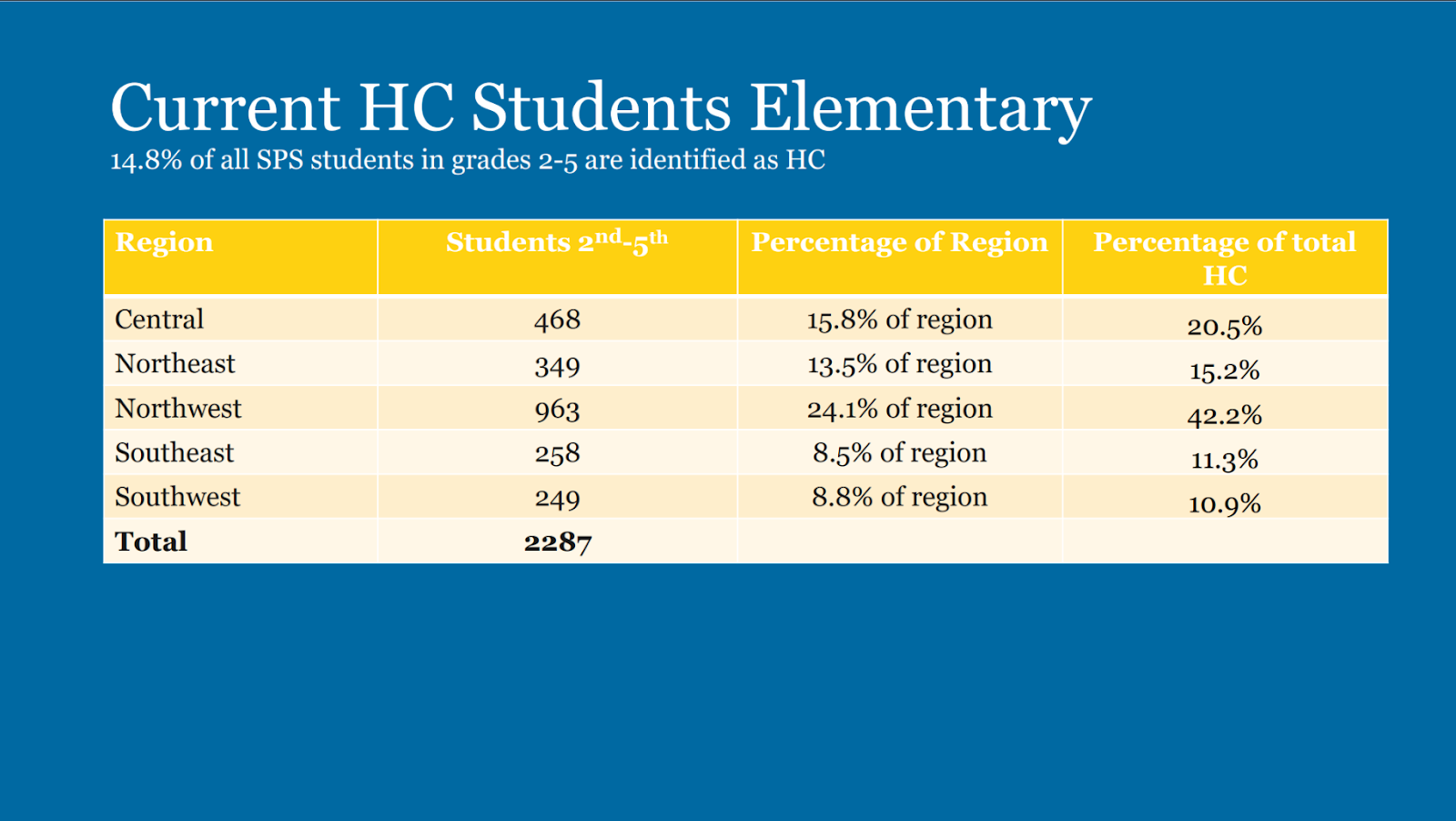
SPS slide showing the proportion of students in each geo zone who are currently identified as Highly Capable.
The clear underrepresentation of HC-designated students in the Central, Southeast, and Southwest regions was cited as the primary motivation for expanding HC identification criteria.
HC designations are significantly higher in the Northwest region (24.1% in the NW, compared to 15% of students districtwide). Montgomery acknowledged that the SPS’s qualification tools have historically been correlated with income and parent education levels, which are highest in that region.
Under the expanded identification criteria, HC designations in the Northwest are expected to drop only very slightly, from 24.1% this year to 22.3% next year using the new model. Designations in both the Southwest and Southeast are each expected to rise by 0.6%.
The district data also reveals that SPS identifies a high proportion of students—14.8%—as highly capable. Montgomery called this number “enormous.” For context, the percent of public school students identified as HC statewide is only 6.5% (as of the latest statewide report available, from 2018).
HC services: Cohorts vs. neighborhood schools
Lack of support at neighborhood schools was one of the core themes identified in the HC program’s community engagement sessions. Director Smith echoed this concern during Q&A, noting that the proposed changes to the HC program focus primarily on the cohort schools, with no increased support for HC services at neighborhood schools.
Indeed, the staff proposal did not include any concrete measures to improve HC support at neighborhood schools. The list of proposed changes included an item named, “Improved teacher support,” but when Montgomery expanded on this she cited work with teachers at Thurgood Marshall, an HC cohort site.
Community frustration about the lack of availability of HC services at neighborhood schools has been growing for years. In May 2021, the board voted to rename and amend School Board Policy No. 2190, which included an explicit plan to eliminate the HC cohort program by 2027-28, and to return HC services to neighborhood schools. (The only board member still serving from that time is Liza Rankin, who chaired the Student Services, Curriculum, and Instruction committee that developed the plan.)
Unfortunately, the district never developed any plans to offer HC services at neighborhood schools. Panic peaked as the sweeping closure proposals of 2024 targeted two of the three cohort schools for closure (Decatur and Thurgood Marshall were both on closure lists, with only Cascadia escaping the threat). After strong community pushback, the board last year voted to delay the decision to eliminate cohorts by at least three years. Still, many parents are frustrated by the uncertainty around the HC program’s future, and the fact that HC services can be reliably accessed only at specially designated school sites.