Issue 22 -- Board Debates Pros and Cons of a New K-5 ELA Curriculum
Directors raise concerns about the newness and digital components of the proposed materials, and the length of the contract.

In this issue:
- The District's Case for Emerge
- Directors Raise Several Concerns
- Superintendent's Response
- Next Steps
- Curriculum Can Be Contentious
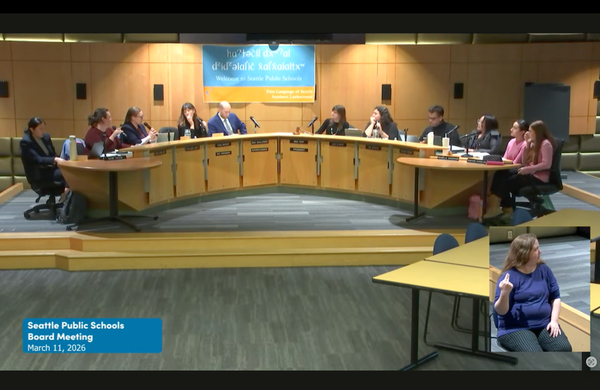
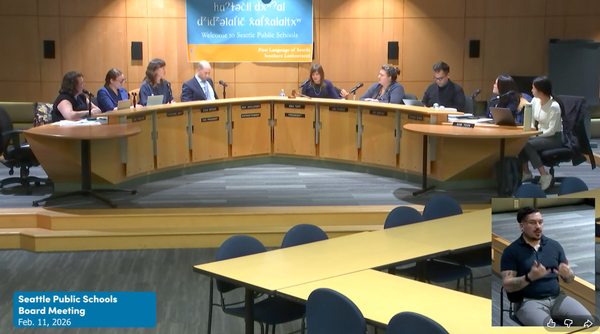
The Seattle School Board held an in-depth discussion Wednesday on adopting a new K-5 English language arts curriculum, with directors wrestling between urgency to improve reading instruction, concerns about the newness and digital components of the proposed materials, and the length of the contract.
After an 18-month selection process, an educator-led adoption committee recommended McGraw-Hill's Emerge curriculum to replace the district's current curriculum, from the Center for the Collaborative Classroom (CCC). The current curriculum is in its eighth year of use, and lacks alignment with the Science of Reading and the requirements of HB 1295, which was recently passed by the legislature.
To dive deep into the selection process, the district has posted the timeline, information about field testing, meeting minutes, and more at the Grades K-5 English Language Arts (ELA) Instructional Materials Adoption webpage.
Superintendent Ben Shuldiner opened the discussion by saying that he had no role in the selection process—and not just because he’s only been with SPS since February 1. By Washington state law, an instructional committee makes curriculum recommendations directly to the school board, effectively bypassing the superintendent.
The District’s Case for Emerge
Assistant Superintendent Mike Starosky, who leads curriculum and instruction, emphasized that approximately just 60% of SPS K-5 students currently read at or above grade level—"and we need to do better by them."
Kathleen Vasquez, the district's ELA and Social Studies Program Manager, detailed why the committee selected Emerge, highlighting its explicit phonics instruction taught to whole groups rather than small groups (as CCC did), multisensory routines that support students at risk of dyslexia, teacher corrective feedback, and built-in intervention supports.
"Students who are struggling need multiple exposures in order for the learning to just take hold," Vasquez explained. "Our old curriculum did not have that."
The curriculum also includes culturally responsive texts, knowledge-building content aligned with social studies, and embedded supports for multilingual learners.
During field testing, all 10 pilot teachers rated Emerge highest among the three finalists, despite it initially scoring lowest (74%) in the first feedback round. When asked about this by Director Joe Mizrahi, Vasquez attributed this to the fact that McGraw-Hill initially submitted only third-grade materials due to contradictory instructions in the district's request for proposal. SPS had left in language from an old contract that only asked for one grade level of materials. Because evaluators didn’t get the full materials until the very end of the evaluation period, Vasquez hypothesized that they scored Emerge low.
Directors Raise Several Concerns
Director Evan Briggs expressed concern about this being a “brand-new” curriculum. McGraw-Hill is piloting Emerge in 2025-26, and so 2026-27 will be the first year of implementation — for any district. That means it doesn’t have a track record yet and that it hasn’t been reviewed by educator-led organizations like EdReports.
Director Vivian Song asked if capital levy funds would pay for the $9 million purchase, which is only permitted if the curriculum has a digital component. Starosky and Executive Director of Curriculum and Instruction Cashel Toner said yes, and added it’s not the first curriculum that the district has paid for with capital levy funds. They saw an advantage to this because paying with BEX levy funds means the general fund, which is in a deficit, doesn’t have to pay for it. Toner said, “It's not ideal for a district to be using levy funds to purchase instructional material, that's sort of our reality right now.”
While Song understood why they chose to leverage capital levy funds for curriculum, she questioned the appropriateness of kindergarteners and first-graders learning on iPads.
Vasquez and Executive Director of Curriculum and Instruction Cashel Toner stated that the digital component is minimal for young learners. Students have access to physical materials—consumables, manipulatives, and anchor charts—for the vast majority of the two-hour literacy block. Vasquez didn’t explain the exact “consumables” that would be used for Emerge, but for other curricula, it can include things like workbooks and activity sheets.
The digital platform for Emerge would be used for about 20 minutes daily during small group time. Vasquez explained, “When a teacher is pulling small groups of students, other students are on the digital platform, which is an adaptive learning platform really designed to target the individual student’s needs at that time.”
District staff argued that the digital component benefits teachers because it provides real-time tracking of student progress and enables collaboration among staff.
Director Jen LaVallee echoed Song’s concern about a digital curriculum and asked if the Emerge curriculum is flexible enough so that teachers could use it even if later the school board or superintendent banned or limited technology in early elementary classrooms. Vasquez told LaVallee that teachers would still have all the physical materials—cards, visual aids, and workbooks. The only thing they'd lose is the adaptive learning software, or iPad time.
Directors Song and LaVallee also expressed concern about the length of the contract. Song questioned whether a 9-year contract is typical for curriculum adoptions and whether there's a systems reason it needs to be that long. She seemed skeptical about such a long commitment.
LaVallee worried that "a lot can change in nine years" and noted this is part of the current problem—the district adopted its existing CCC curriculum nearly a decade ago when "our knowledge of how we were teaching kids to read was fundamentally different than it is today." She wanted to know if there would be flexibility when teaching methods or understanding shifts, or whether the district would be "stuck with something that's out of date very quickly that we still are paying money for."
Staff responded that they've written contract language requiring McGraw-Hill to provide any curriculum updates or revisions at no cost (learning from mistakes with the previous adoption), which provides some protection against obsolescence.
That said, the Board Action Report includes a letter from McGraw-Hill stating that the balance of the contract is to be paid within the first three years of implementation, that is to say years one, two and three. So if SPS decided to switch curricula at any time after the first three years, there wouldn’t be any money saved, because the contract would already be fully paid.
Superintendent's Response
After board members pressed him for his opinion, Shuldiner offered both praise and concerns for Emerge.
Shuldiner cited the following as strengths: positive reviews from teachers testing the curriculum, science of reading alignment, McGraw-Hill's long track record, and the robust 18-month selection process.
Shuldiner’s concerns included the nine-year contract length ("not typical in education because the world changes really quickly"), lack of independent third-party review from EdReports (the "gold standard" for curriculum evaluation), questions about Spanish language materials still being piloted rather than proven, and whether the curriculum adequately serves highly capable students working above grade level.
"I have no indication this is not a good curriculum," Shuldiner said. "My concerns are there isn't necessarily this third-party validator that, in my experience, I would just always use."
He emphasized respecting the committee's work while acknowledging his responsibility to raise potential concerns: "You hired me as a superintendent to kind of almost be the person to point out what might be a problem."
Next Steps
Vice President Evan Briggs asked whether delaying adoption a year would allow time for more data from other districts using the curriculum.
Staff explained this would require restarting the entire 18-month process—pushing implementation back more than two years and asking the 30-plus committee members to begin again.
Director Kathleen Smith countered with parent urgency: "As a parent of a kindergartner, I definitely feel that urgency.” If there is a one-year delay, that would mean one more year without a better reading curriculum.
The board will take a final vote in April. That gives the district time to address concerns raised during the discussion, though the outcome remains uncertain. Shuldiner emphasized the urgency: "We have to make a decision for our children today, which is good for our children today."
Director Rankin requested Shuldiner confirm whether the curriculum aligns with the strategic plan goals before the vote.
Staff also indicated they could explore contract flexibility with McGraw-Hill before the April vote.
Curriculum Can Be Contentious
Curriculum adoption is one of the main tasks of an elected board of directors. In Seattle, it can sometimes get contentious, as the public and the board do not always agree with the committee’s recommendations. On occasion, the board has rejected the recommendation and chosen something else.
In 2014, a group of parents mobilized to successfully push the school board to reject the committee recommendation for a K-5 math curriculum and go with a different option. The committee had recommended enVision math, but critics assailed it for requiring too much reading and not having a good track record of helping students learn math.
Critics instead pushed the board to adopt Math in Focus, a “Singapore math” curriculum that had been in use at several SPS schools and was more focused on basic mathematical operations using numbers and pictures. In a 4-3 vote, the board did indeed choose Math in Focus.
However, parents and educators reported that the district did not fully support the Math in Focus adoption. In 2022, the school board voted to adopt a newer version of enVision Math for use in K-5 classrooms.
Another controversial curriculum adoption came in 2019 for K-5 science. The board voted 4-3 to adopt Amplify Science, despite widespread concerns about it being a primarily screen-based curriculum. Students would run simulations, or “sims,” on their school-issued device rather than use hands-on science kits as they had previously.
Amplify Science had received mixed reviews during testing at 18 schools. That testing itself was deeply controversial. Amplify Science was used in those schools via a district waiver. But an investigative report by KUOW found that “the board was unaware of the science waivers for months” and that they were paid for by an anonymous benefactor. The district staffer in charge of the adoption process was quoted in promotional materials for Amplify Science even before the adoption vote.
Ultimately the board did choose Amplify Science. Emily Cherkin, an SPS parent and The Screentime Consultant (as well as a Bulletin contributor), filed suit against the district for choosing Amplify Science, but lost that case.
Since then, many parents, students, and educators have expressed deep frustration with and dislike for the Amplify Science curriculum. It was adopted with a nine year contract, which means there will be a new K-5 science curriculum adoption two years from now.