Issue 23: SaferWatch Raises Privacy Concerns, Invites Intrusive Surveillance at SPS
The introduction of SaferWatch to the SPS community raises questions about privacy, law enforcement surveillance, security, and costs.
Last Monday, caregivers of students in Seattle Public Schools received an email introducing SaferWatch, “an innovative way for our schools to ensure the safety of all staff and students.” High school students received a similar email.
Caregivers and high school students were asked to download the SaferWatch app and to enable always-on location tracking in the process. They were directed to a district-hosted webpage that introduces the new system’s features, including anonymous reporting of suspicious behaviors via the app, law enforcement access to live video feeds inside schools, and a panic alerting system that enables instant school lockdowns.
The district’s page explaining SaferWatch raises more questions than it answers about the purpose, mechanics, benefits, and costs of SaferWatch at SPS. The district has a three year contract with SaferWatch, with optional extensions to five years. SaferWatch is not going away.
Many of the questions raised by district materials relate to student privacy and the involvement of law enforcement: Will SPS be using SaferWatch’s ability to give law enforcement access to live, in-school video feeds? What happens when students use the new anonymous reporting tool to harass other students? Why is the district encouraging students, staff, and caregivers to allow always-on location sharing with the SaferWatch app?
In the rest of this article, we explore the stated benefits and potential risks associated with SaferWatch’s rollout with SPS, including:
- What is SaferWatch?
- Big Brother comes to SPS
- Crisis management or security theater?
- Snitching to strangers vs. confiding in counselors
- Pricing and procurement
- Questions for the district
What is SaferWatch?
SaferWatch markets itself as an all-in-one solution for preventing violence–particularly gun violence–in schools. Their marketing highlights features that include:
- Anonymous tip reporting
- Panic alerts that let staff initiate immediate lockdowns
- Real-time access to school systems for law enforcement (e.g., allowing police to access live audio & video feeds inside schools)
- Mass notifications via the app in case of an emergency
It’s unclear how many elements of this system SPS has adopted, or is planning to implement in the coming years. SPS’s website introducing SaferWatch reads:
SaferWatch also provides mobile panic alert systems that comply with Alyssa’s Law, offering rapid, coordinated responses during on-campus emergencies. In the event of a police emergency, SaferWatch enables instant school lockdowns while simultaneously alerting law enforcement.
During medical incidents, SaferWatch notifies key campus personnel and automatically contacts emergency services—allowing staff to focus on the person in need. SaferWatch is proud to partner with Seattle Public Schools in advancing their mission to ensure a safe, secure learning environment for every student, staff member and visitor.
SaferWatch also positions itself as a way for school districts to comply with Alyssa’s Law. Washington state passed the law, formally RCW 28A.320.126, in 2025, and it became effective in July of that year. It requires every school district in Washington state to adopt at least one piece of technology “to expedite the response and arrival of law enforcement in the event of a threat or emergency at a school.”
Big Brother comes to SPS
The surveillance capabilities of SaferWatch are many: The app supports always-on, real-time location tracking, and SPS’s installation guide encourages users to enable this feature.
SaferWatch is capable of connecting law enforcement to live video & audio feeds from surveillance already set up inside schools.
SaferWatch’s database collects all of the reports and concerns submitted by the community via their reporting app, which enables anonymous reports.
Big Brother has a name at SPS, and that name is SaferWatch.
Let’s start with location tracking: Real-time location tracking is enabled and indeed encouraged within the SaferWatch app. The app uses location tracking to pinpoint individuals in an emergency, to share their location details when they report a concern, and to disable panic button features when users are off campus.
The SPS+SaferWatch installation guide, linked from the district’s website, directs users to allow SaferWatch always-on access to their real-time location:
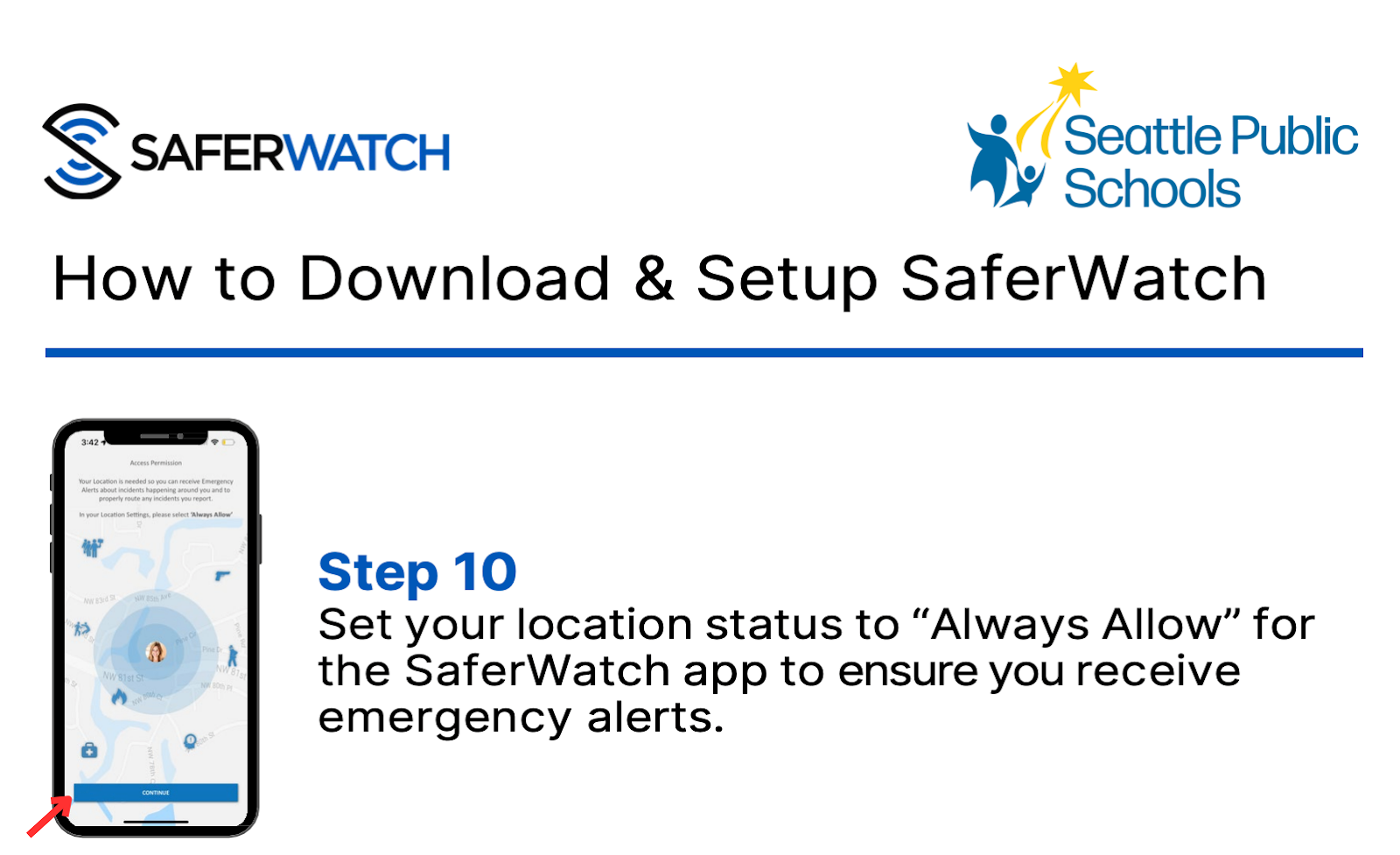
Common-sense online safety guidelines, on the other hand, encourage users to limit location sharing with apps. Even the NSA recently issued guidance that reads: “Apps should be given as few permissions as possible: Set privacy settings to ensure apps are not using or sharing location data…Location settings for such apps should be set to either not allow location data usage or, at most, allow location data usage only while using the app.”
Even if SaferWatch is a trusted party, the risk still exists that its databases and real-time monitoring can be compromised, exposing location and account information to malicious third parties.
In fact, malice is not even required. In 2025, a SaferWatch deployment in Cook County, Florida accidentally exposed users’ names, email addresses, phone numbers, and real-time locations. SaferWatch later released a statement that apologized for the multiple notifications users received, but did not apologize for the actual data or privacy breach.
Real-time location tracking of SPS staff and students raises a lot of questions:
- Can the feature be used by law enforcement to track individual students outside of an emergency context?
- What happens when an anonymous tip points to a student whose immediate location can be pinpointed via the SaferWatch app?
- Who has access to that location, and under what circumstances?
- Who decides how that information can be used?
- Can SaferWatch volunteer–or be compelled by subpoena–to turn location information over to law enforcement, or immigration authorities?
Furthermore, in light of last week’s email to families: Why is SPS encouraging caregivers and parents to enable always-on location tracking on our own phones?
In addition to its location tracking, the SaferWatch system allows law enforcement to peek inside SPS schools. SaferWatch provides real-time access to live video and audio feeds inside schools, a feature highlighted on the district’s SaferWatch website.
Again, this surveillance capability raises questions not answered by the rollout documentation:
- Under what conditions does law enforcement get to peer into SPS schools?
- What protections are in place to enforce these conditions and prevent malicious or abusive access?
- How does this capability interface with law enforcement’s duty to execute arrest warrants, or ICE’s mandate to deport undocumented students?
Finally, there’s the question of how SaferWatch stores, protects, and uses all of its SPS-related data. Before the SaferWatch rollout, SPS hosted its own tip line where suspicious behavior or concerns could be reported. Now, that tipline is routed to SaferWatch. The web-based form for reporting concerns is hosted by SaferWatch. Any reports submitted through the app come through SaferWatch.
Thus, SaferWatch—a private company who is not SPS and not a state agency—has a growing database full of behavioral concerns expressed about SPS students.
- What are the safeguards protecting this data?
- What happens when an individual is named in a report?
- How long are the reports stored?
- What is SaferWatch allowed to do with them?
- Can they be compelled to turn them over to law enforcement? Under what conditions?
Crisis management or security theater?
SaferWatch’s marketing highlights its ability to reduce response times and better coordinate first responders in an emergency, and to facilitate mass communications during and after an incident.
Alerting & first response
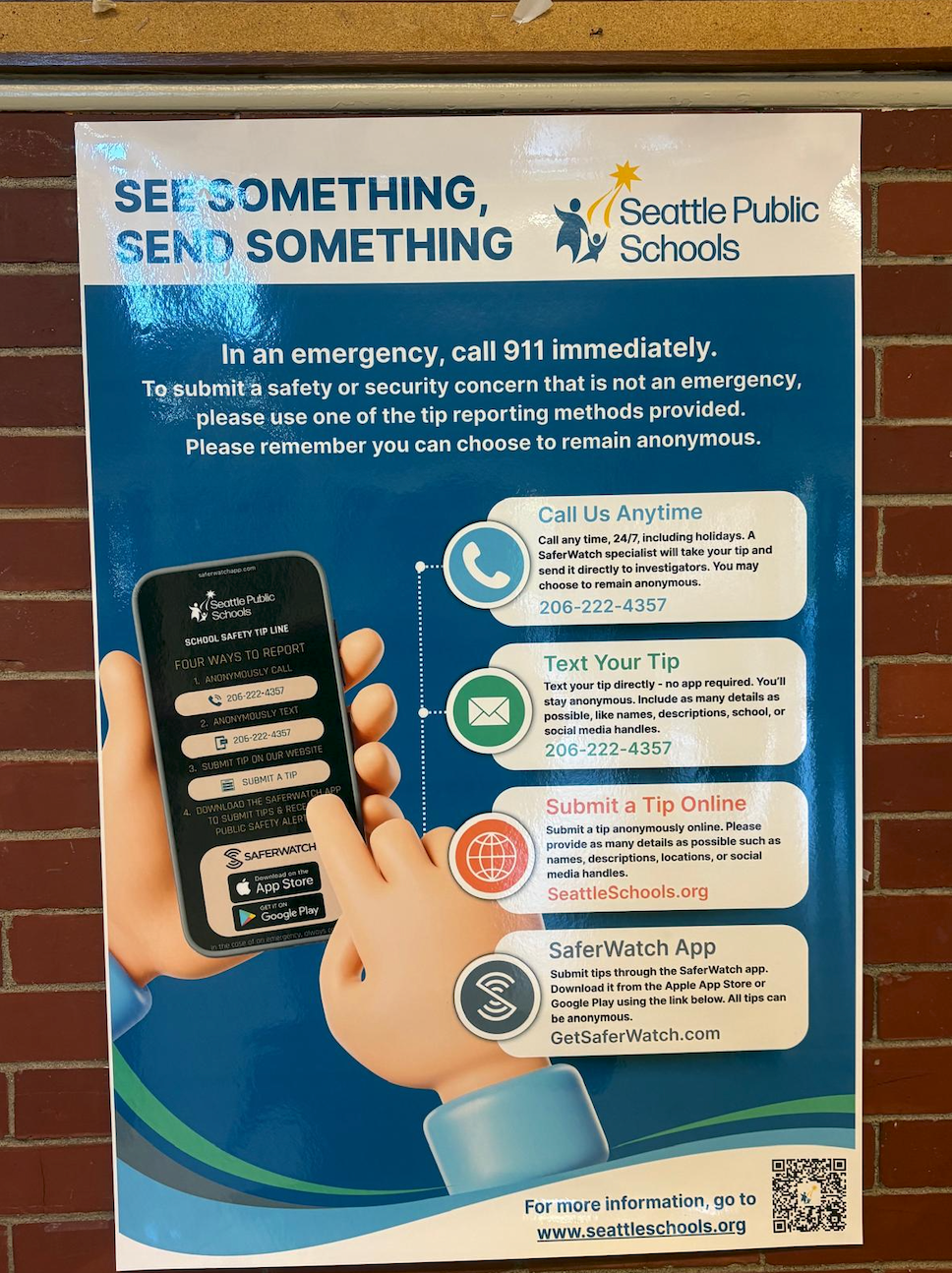
In an emergency situation, SaferWatch promises to reduce the time required to get first responders involved. However, the district website asks the community to use 911 in any emergency situation, as opposed to the SaferWatch app. Printed SaferWatch posters in SPS hallways reinforce the primacy of 911 for emergencies at SPS.
It’s unclear from the district’s website whether any of the other SaferWatch features relevant during an emergency are or will be implemented at SPS. Do staff have physical or app-based panic buttons that send alerts directly to law enforcement? Does the SPS integration give the Seattle Police Department the capability to view live footage and audio from inside school buildings?
Security experts are divided on the efficacy of solutions like SaferWatch for crisis response. SaferWatch’s reporting and panic buttons were already implemented at Apalachee High School in Georgia when a shooter killed four people there in 2024. SaferWatch claims the incident would have been worse without their system; skeptics note that the incident was not prevented by behavioral reporting ahead of time, and that four lives were still lost.
An Education Week article discussing the Apalachee shooting noted:
“Ken Trump, who runs an Ohio-based school security consulting firm, described the quick adoption of such technology as “security theater” and part of a scramble by schools to show that they’re doing something. He told the Associated Press in 2022 that efforts like training staff are most effective, but the public tends to feel most comforted by tangible things like panic buttons.”
Closer to home, some Washington state school districts have been providing law enforcement access to live video feeds since at least 2019. One such district, in Rockford, WA, adopted the live video technology after a shooting that left one student dead at Freeman High. According to the KIRO 7 article on the adoption:
“[District Superintendent Dr. Randy] Russell and [undersherriff Dave] Ellis believe the surveillance camera partnership is simply a better way for the district and Sheriff’s Office to work together. However, when asked by KIRO 7, both admitted that having immediate access to school cameras most likely would not have prevented the deadly 2017 shooting at Freeman High.”
The same article also cites ACLU opposition to the technology:
“Another concern voiced by the ACLU’s Washington chapter is that the cameras will be used to turn school discipline issues – such as fights between students – into criminal justice issues. “The more you involve police in schools, the bigger the opportunity is to criminalize a child’s behavior” [said Youth Policy Counsel for the American Civil Liberties Union, Kendrick Washington].”
SPS has dealt with tragic gun violence in recent years, including three fatal incidents since 2022, at Ingraham, Garfield, and Rainier Beach high schools. It is natural that parents, staff, administrators, and students themselves want safety improvements.
The gun violence that has recently affected SPS has not followed the template of violence that SaferWatch’s marketing materials focus on: premeditated, indiscriminate violence like that seen in the Parkland and Uvalde shootings. SPS gun violence incidents have largely been opportunistic, targeted tragedies that arose from interpersonal disagreements. Many have occurred off campus or outdoors.
It would be useful to hear directly from SPS about how they envision SaferWatch improving safety at the specific SPS sites that are most urgently asking for safety upgrades, and how SaferWatch might have led to better outcomes in the gun violence incidents of recent years.
Mass communications
SaferWatch highlights its ability to facilitate mass communications during and following a crisis via their app. Of course, app-based communications require staff, students, and families to have installed the app before an emergency.
A 2022 rollout of SaferWatch at Marjory Stoneman Douglas High School, the site of the 2018 Parkland shootings, saw more than a third of teachers decline to download the app. Only 6,000 of the district’s 35,000 employees set up the SaferWatch app. Many cited privacy concerns. The rollout of a similar app in Little Rock, Arkansas schools was abandoned after only 20% of staff downloaded it.
Student reporting at Marjory Stoneman Douglas at the time of their SaferWatch rollout quoted a teacher:
“I don’t trust security apps not to bury programming on my device…I know most apps are tracking our non-app activity in one way or another, but apps that have clear links to law enforcement or my employer are ones [I‘d] rather not further invite onto my phone.”
Meanwhile, here in Seattle, caregivers have expressed ignorance and confusion over the SaferWatch app.
Several parents I spoke with refused to download it because of privacy concerns. Others downloaded it because they felt they had to, on the assumption that the app is where all emergency-related SPS communications about their children will now be routed. Still other parents missed or ignored the district’s email without even reading it, and thus didn’t know what SaferWatch was when I asked about it.
The district’s email asked caregivers to white list three new phone numbers that SPS will be using to send texts in an emergency, implying that they intend to continue text-based emergency messaging as well. That’s good, given that the app uptake is likely low.
However, all three of the new emergency communication numbers are prefixed with the 561 area code which is used for numbers in Palm Beach, Florida. While this is surely convenient for SaferWatch, which is based in Florida, it will just as surely be confusing for parents who didn’t see the district’s email and who will now receive emergency alerts about their Seattle-based children from a Florida-based number.
Students and parents are also confused over the interplay between emergency app-based communications and “Away for the Day” cell phone policies. The self-explanatory “Away for the Day” is the standard at some SPS middle and high schools, and at a recent school board meeting, directors expressed an interest in seeing the policy rolled out to all schools.
The first line of communication with students during a crisis should not be via an app. Not only are cell phones not universal, but phones that are in a school building may be out of reach in an emergency specifically because of district policies.
Snitching to strangers vs. confiding in counselors
In a non-emergency context, SaferWatch operates as a reporting tool featuring an option to report anonymously. The list of “incidents” that the SPS website encourages its community to report via SaferWatch reads:
- Bullying or harassment
- Cyberbullying
- Threats of violence
- Weapons or drugs on campus
- Mental health concerns (self-harm, suicide risk, etc.)
- Suspicious activity on or near school property
- Planned fights
Printed posters in SPS hallways titled, “See Something, Send Something,” give students four digital avenues for reporting such incidents to SaferWatch.
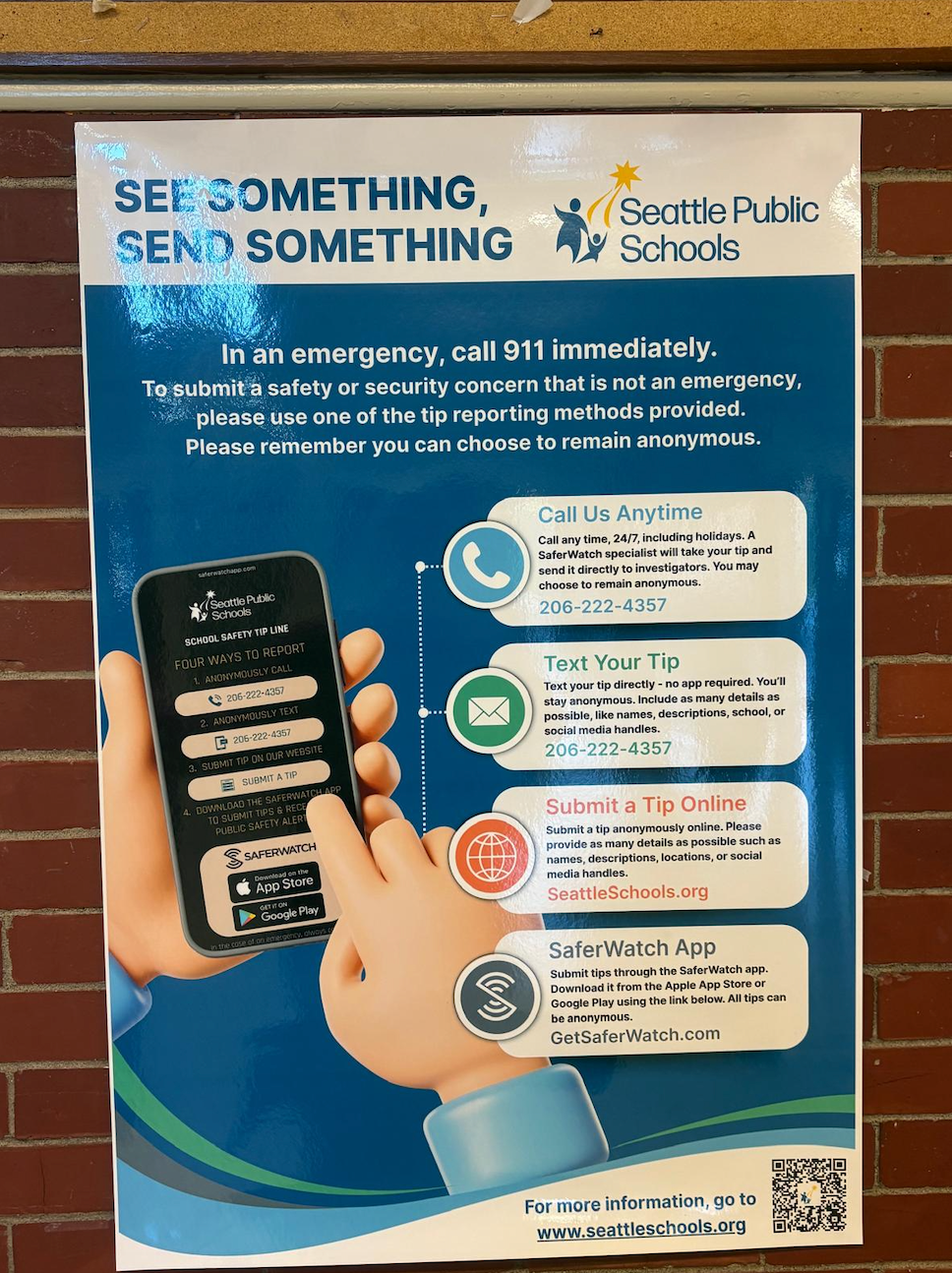
Notably absent from the posters or the district FAQ is the concept of talking to a trusted adult. Nowhere are students encouraged to contact a teacher, a counselor, or anyone else in the building who might have relationships with the involved parties, or the historical and social knowledge to contextualize a perceived threat, or the ability to ask follow-up questions in the moment.
Non-emergency concerns do not require instantaneous reporting. They do, however, require discernment in their handling, so that misunderstandings, jokes, and even harmful-but-redirectable behaviors do not wind up saddling a student with a police report or worse.
With the new SaferWatch-enabled ability to report anonymously, the lack of a human community member in the loop raises new questions. What happens when SaferWatch becomes a tool for retaliation or harassment, for example?
When a tip is submitted to SaferWatch, it’s unclear exactly where it ends up and who sees it along the way. The SPS SaferWatch page explains that tips go to a “24/7 Monitoring Center: A dedicated team monitors incoming tips in real time, coordinating with school officials and law enforcement as needed.” This aligns with SaferWatch marketing materials that advertise a team of SaferWatch employees who monitor incoming tips on behalf of customer institutions. If this is the case, the first point of contact with a report is a person who has no local context whatsoever.
Further down the same SPS website, though, is this: “Tips are immediately routed to the appropriate school safety team, and if necessary, to first responders.” It’s unclear who makes the decision about what is necessary to send to first responders: Is it the school security team? A SaferWatch employee?
Pricing and procurement
SPS messaging is extremely unclear about what money is being used to pay for SaferWatch. On the district’s FAQ, one answer says that SaferWatch is funded by a grant. The next answer says that SaferWatch is funded by BTA/BEX levy money.
In response to The Bulletin’s questions, the SPS grants department clarified that they have received a $63,600 grant for SaferWatch, expiring June 30, 2026. They noted that the grant doesn’t appear in the SPS grants inventory because it was an in-kind grant instead of a monetary one.
The district’s FAQ indicates that SPS has contracted with SaferWatch for three years, with two optional one-year contract extensions. The site doesn’t clarify whether the in-kind grant covers the entirety of the first-year expenses; whether the district has already put some of its own money toward SaferWatch; or whether additional grants are expected in future years.
SPS contract amounts are generally not made public by the district, unless they reach the threshold triggering a board vote (currently $500,000; lowered this March from $1 million). SaferWatch has not appeared on any school board agendas or votes in the past two years. Presumably, this means that any money SPS has already spent on SaferWatch is under one million dollars.
Because contracts between schools and SaferWatch are generally not made public, it is difficult to determine how much a SaferWatch implementation generally costs. The only publicly reported, school based adoption is a $7 million, 5-year deployment with Hawaii schools.
The procurement process that led to SPS’s adoption of SaferWatch is similarly opaque.
The grant used to fund at least some of SPS’s SaferWatch rollout came from an advocacy group called Stand With Parkland, formed by a group of parents who lost children in the 2018 Parkland school shooting who now advocate for school safety measures.
The SPS SaferWatch site acknowledges two parents from Stand With Parkland—Tony Montalto and April Schentrup—as instrumental in introducing the technology to SPS, though neither parent has children attending schools in the district.
Stand With Parkland’s primary sponsor is SaferWatch.
SaferWatch’s CEO, Geno Roefaro, was arrested in February on bribery charges related to attempts to get SaferWatch adopted in New York City schools for a reported contract value of $11 million. Roefaro has since resigned his CEO role.
The SPS media relations team did not respond to The Bulletin’s questions about the SaferWatch procurement process, its cost to SPS, and what alternatives were explored.
The Bulletin has submitted a public records request asking for all district documentation and communications related to the funding of SaferWatch, its interplay with federal and local law enforcement agencies, and protocols/processes for the review and sharing of tips reported through the app. The district has said it plans to respond by July 8.
Questions for the district
Families, staff, and students deserve to know what data is being collected about our community, and how it might be used. Here’s a list of questions that SPS could answer to make the SaferWatch partnership more transparent:
- Technologies adopted: Which of SaferWatch’s features is SPS adopting, and on what timeline?
- Who is asking for this: Which SPS school communities are eager for SaferWatch to be adopted in their buildings? What is the community reaction at SPS schools that have recently experienced gun violence?
- Privacy protections: What protections are in place to ensure that data collected by SaferWatch is only shared/searchable by third parties—SPD, ICE, etc.— with SPS consent? When would SPS give this consent, and who decides? Are there situations in which law enforcement can override SPS consent and search SaferWatch’s SPS data anyway? Are there situations in which SPS personnel such as guidance counselors are allowed to search SaferWatch’s database of reported SPS concerns?
- Data expiration: How long does SaferWatch hold each reported concern before deleting it? What happens to reports by or about a student when the student leaves SPS?
- Emergency law enforcement access: When can law enforcement agencies access student locations and/or live video and audio feeds from schools? How are limitations enforced, and what protections prevent abuse of this access? If access is emergency only, what constitutes an emergency, and who decides this?
- Crisis mass communications: What is SPS’s emergency communication plan for students, staff, and the community during an emergency? How will messaging work for students and caregivers who do not have the SaferWatch app and/or screen Florida-based numbers as spam? If the SaferWatch app and text numbers will be central to future emergency communication plans, how will SPS achieve sufficient levels of awareness and compliance in the community to make this effective?
- Procurement process: What was the SaferWatch procurement process like at SPS? Who decided to adopt it here? What alternatives did SPS explore
- Cost: What is the expected cost to SPS for SaferWatch, for each of the next 3-5 years? What budget(s) is this money coming from?