Issue 24 -- Seattle Parents Mobilize Against Harmful Digital Device Use In Class
The intentional tech movement argues it's not just the smartphones causing problems for student learning — it's also the internet-enabled iPads and laptops assigned to each student.
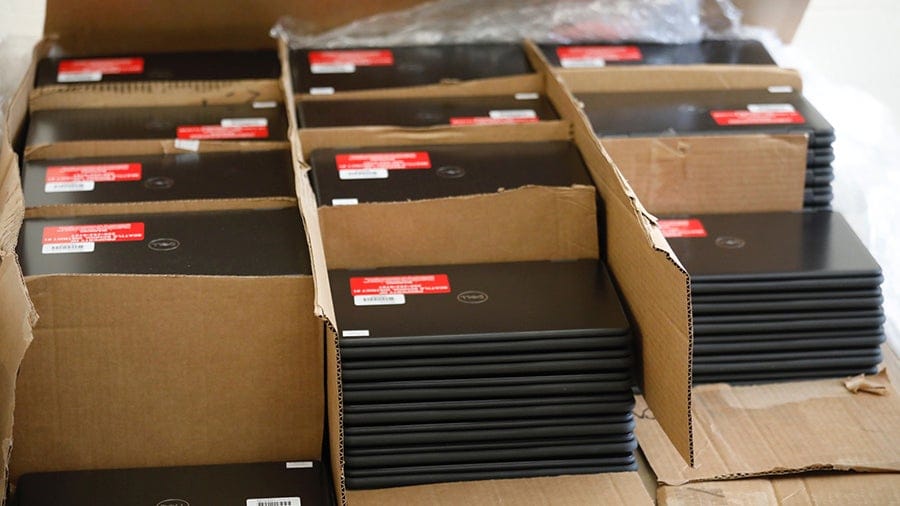
Most schools in Seattle Public Schools have adopted "away for the day" policies to limit or prohibit student use of smartphones out of a concern for the impact of those devices on student learning and health.
But those policies have a loophole: the iPads and laptops handed out to students as part of their education. Attention around the country and here in Seattle is shifting toward the pervasive use of those devices — and how they can distract from learning and harm students.
For years, SPS has followed educational trends around the country of moving more and more instruction to digital devices such as laptops, Chromebooks, and iPads. Students as young as kindergarteners are issued their own device. Doing so is considered necessary to engage with district curriculum that is increasingly delivered entirely or largely online. This is often called a “1:1 device policy” as a shorthand.
Years of pressure by corporate education reformers, educational technology professionals, and the impact of the pandemic have all combined to create a situation where students are distracted by their assigned devices, engaging in unsafe practices, and experiencing health issues — even when their smartphones are put away. This is fueling a growing clamor for reform.
Seattle parents have shared numerous reports of dangerous student misuse of assigned devices, as well as larger concerns about the impact of screen time on student learning. Now they are organizing to demand SPS adopt "intentional tech" policies.
In this issue we take a look at the growing intentional tech movement in Seattle. The Bulletin interviewed the two SPS parents who started an organization called Seattle Families for Intentional Tech (SFIT) for this article and you can scroll down to hear directly from them.
The goal of the intentional tech movement is to reorient the use of technology in the classroom toward a model in which students use tech in specific, limited ways as part of a larger, holistic curriculum. Some in that movement are also calling for an end to the 1:1 device policy entirely, though that is not something SFIT is asking of SPS.
It’s not just parents who are raising the alarm. SPS’s new superintendent signaled he shares concerns about student use of screens in the classroom, ahead of the April 22 school board meeting when parents plan to present a petition and demand action.
In this issue:
- What’s Happening in the Classroom
- What Does the Research Show?
- The Intentional Tech Movement
- Parents Mobilize for Intentional Tech
- Finding the Right Balance
- Seattle Should Be Intentional About Tech
What’s Happening in the Classroom
Usually when the New York Times covers an issue, it’s a good sign it’s become a topic of national conversation. Last Sunday, the Times ran an article titled Chromebook Remorse: Tech Backlash at Schools Extends Beyond Phones, a look at a middle school in Kansas that had begun limiting use of digital devices in the classroom in response to student misuse of the technology:
“Some students became so hooked on playing video games on their Chromebooks that teachers had difficulty getting them to concentrate on their schoolwork, administrators and teachers said.
Students also sent mean Gmail messages or set up shared Google Docs to bully classmates with comments. Hundreds of children logged on to Zoom meetings where they made fun of their peers, teachers and students said.”
It’s not just Kansas. California Governor Gavin Newsom recently commented that “one of his school-age sons had watched YouTube videos of manosphere podcasters on his school laptop.”
It’s also a big problem here in Seattle.
I have had many conversations with parents in recent months who have described similar experiences with their own students with SPS-assigned devices. They’ve told me that students have found ways around the district’s software blocking websites and are often gaming during class time or bullying fellow students via Google Forms.
While this is particularly endemic among middle and high school students, parents report it’s also a problem in the elementary grades. I’ve heard about K-5 students who were playing Minecraft, chatting on Discord with strangers, or sending taunting emails using their school devices when they should have been paying attention during class time. Some students have told their parents they’re guessing randomly to quickly complete tests on their laptops so they can spend more time playing games or use URL redirectors to watch videos on YouTube.
SPS's own guidelines acknowledge the risk and their inability to fully protect students using these devices. District 1:1 laptop policies state that “Parents/guardians need to be aware that web filtering is “best effort” and doesn’t prevent access to ALL inappropriate sites.”
Superintendent Ben Shuldiner himself has noticed the problem. In his Sunday, March 29 message to the SPS community, he included as one of the “not-so-good” things he saw in his school tours “less time on task and too much screen time for students.”
How did this happen? The overuse and misuse of educational technology in the classroom appears to be a combination of boosterism by companies selling devices and curriculum, and the shift toward online learning that accelerated during the Covid-19 pandemic.
Companies that specialize in online curriculum and devices for the classroom – “ed tech” for short – come with big marketing budgets and strong pressure on school districts to buy their products. They have powerful allies, including the Seattle-based Gates Foundation, which seeks to “reform” public education along corporate lines, emphasizing digital learning instead of the human connection of a skilled and qualified teacher. The Gates Foundation, and Bill Gates himself, have championed digital instruction.
Big Tech is also a key player, as the New York Times explained in last weekend’s article:
“For years, giants like Apple, Google and Microsoft have fiercely competed to capture the classroom and train schoolchildren on their tech products in the hopes of hooking students as lifelong customers. Now Google and Microsoft, along with newcomers like OpenAI, are vying to spread their artificial intelligence chatbots in schools.”
Ed tech has been at the heart of Seattle’s most controversial curriculum adoptions in recent years. In Issue 22, we covered the debate over a new K-5 ELA curriculum and concerns about its digital component. In that article we mentioned the 2019 fight over Amplify Science, a curriculum that replaced hands-on science kits with digital simulations of scientific experiments.
One year later, the Covid-19 pandemic struck. Schools had to close to save lives and protect public health. In response, student use of screens soared. Like most school districts, SPS attempted to provide remote instruction using screen-based learning over Microsoft Teams, with students using their internet-enabled devices. When students returned to the classroom in the spring and fall of 2021, safeguards against overuse of technology were effectively gone.
All of this is enough to create problems for student learning. We now have to contend with the use of generative artificial intelligence, which is causing huge problems for educators at all levels, from K-12 to college. Under SPS’s previous superintendent, Dr. Brent Jones, teachers and students were encouraged to use AI in the classroom.
What Does the Research Show?
Researchers have begun examining the impact of screens, digital curricula, and internet-enabled devices on student learning. Their initial findings do suggest the impact is harmful to student learning.
A 2022 National Library of Medicine study found that “daily use of digital devices was negatively related to scores on a reading comprehension test.” A 2024 article reported that “digital readers exhibit a tendency towards more shallow or superficial text processing and less metacognitive regulation.”
The widespread adoption of ed tech and 1:1 internet-enabled devices comes at the same time as student test scores have collapsed and barely recovered from pandemic lows.
Finally, a 2025 study found that as of 2023, 25% of U.S. teenagers were using ChatGPT to do their schoolwork. That number has likely risen since then.
The Intentional Tech Movement
The stories and data have fueled a movement to achieve what many are calling “intentional tech” — the use of digital devices in the classroom for specific purposes, rather than as a free-for-all. Participants in this movement are not looking to ban screens and devices from the classroom entirely. Rather, they want limits and guardrails put around their use.
Seattle’s own Emily Cherkin is a key leader in this movement. She’s also a contributor to The Bulletin, having written one of our first articles last November, “It's Time for SPS To Lead on Limiting Screens in the Classroom.”
Cherkin, who spent 12 years as a middle school teacher, works as The Screentime Consultant and publishes a newsletter titled First Fish Chronicles. She’s testified before the US Congress and the UK Parliament on ed tech and its impact on students.
She also was party to a lawsuit to block SPS’s adoption of the Amplify Science curriculum in 2019. (That lawsuit did not succeed, and Amplify Science continues to be used in SPS elementary and middle school science classes.) She's also the lead plaintiff in a class action lawsuit against PowerSchool, parent company of Naviance and Schoology which are both widely used in SPS.
On Thursday, Cherkin described how she had refused a Chromebook for her student at an SPS middle school, sharing many of the same concerns raised by Governor Newsom and in the New York Times article.
Cherkin is not anti-screen or anti-tech. She has written about how her children use devices with intentional limits. She explained her approach to tech in the classroom:
My approach has always been about being tech-intentional. And my definition for this approach is grounded in three simple ideas:
1) Less is more.
2) Later is better.
3) Relationships and skills before screens.
In her public presentations and advocacy, Cherkin calls for Four Norms of Ed Tech:
- No internet-connected 1:1 devices in K-12 schools. Bell-to-bell phone policies for students and adults.
- Tech Ed, not ed tech.
- More paper, more handwriting, more relationships.
- No AI use in K-12.
“Tech Ed, not ed tech” is a good shorthand for the idea that students should certainly be taught how technology works and how to use it responsibly — but that they do not need to be bombarded with ed tech programs, or handed their own internet connected device to keep and freely use, in order to obtain those technological skills.
Cherkin has also been presenting to PTAs across Seattle in recent months, including last Tuesday at Salmon Bay K-8. She’s found very receptive audiences eager to hear what she has to say. And she’s also inspired parents to act.
Parents Mobilize for Intentional Tech
Seattle parents have begun to fight back against over- and misuse of technology in the classroom, in response to their own experiences with tech in SPS, and push for adoption of intentional tech policies.
SPS parents Erica Shutes-David and Hilary Patterson recently launched a new organization, Seattle Families for Intentional Tech. They also launched a petition for intentional tech limits that’s already gathered more than 650 signatures. Their petition makes the following asks of SPS leaders:
- Revise or create a new Technology Advisory Committee
- Parental consent for data-collecting products
- Access to information and ongoing transparency and accountability
- Screen time limits by grade
- Pause on student-facing Generative AI
- Allow teachers and students to use paper-based alternatives
Their petition provides more detail about each of these six requests, which they plan to present to the Superintendent and school board at the April 22 board meeting.
The SFIT petition does not call for an outright end to the 1:1 device policy, instead focusing on stronger protections and accountability. It does call for limits on device usage that would vary by grade level.
In interviews with The Bulletin, Shutes-David and Patterson explained how they came to launch this effort. They met at one of Cherkin’s recent presentations at a school PTA meeting and found they shared a concern about what was happening in the classroom — and a desire to take action.
Their stories echo Cherkin’s and those of so many other SPS parents: they believed that SPS was using tech in the classroom sensibly and responsibly, were surprised to find that wasn’t the case, and were disappointed that SPS was unresponsive to their questions and concerns.
“Although my son's teacher initially reassured me the [digital] programs were a harmless rotation, allowing her to have small group time, a conversation with another parent who works at the district alerted me to the fact that these programs weren't being chosen with the care I would expect,” said Shutes-David, a mental health therapist with specialization in ADHD. “My school administrator was uninterested in engaging in any kind of conversation about the topic.”
Similarly, Patterson said she had concerns about “a device that they assumed was only for learning, but could also take pictures, play games and from what I understood, Google anything. I emailed the admin at my school about it and never heard back.”
Patterson, a middle school teacher and former SPS high school teacher, provided an educator’s perspective on intentional tech in the classroom:
“I started teaching at a STEM school in 2012 and tech was always pushed as something we should try to integrate. Then during the pandemic, it was all we could use, and knowing Ed Tech tools became something I wanted on my resume (and have!). I promised I would bring some of those tools from the pandemic into in-person teaching because I really thought they were helpful. I have done ‘tech Tuesdays’ in my middle school math classroom the past 2.5 years as a way to add variety to the way kids receive and interact with content.
I have looked at every online tool/lesson I would have used on a Tuesday and realized they all would be more effective on paper, or by just showing kids the tech part (such as a slider that shows how a graph changes with different slope) on the smart board. I no longer do tech Tuesday, and I want more teachers to just take a step back and ask themselves why they use the tech tools they use and also whether or not they actually think their students are learning MORE from having activities on devices.”
They’ve found a receptive audience among SPS parents. “The overwhelming response to this work has been relief at finding other caregivers who are asking these same questions and wanting more transparency from schools and the district,” said Shutes-David.
“Mostly everyone I talk to has been grateful for our work and very much wanting to help the movement to less tech in classrooms,” said Patterson.
Finding the Right Balance
Not every SPS parent is on board with the intentional tech effort. I have heard from some parents with students who have had largely positive experiences with tech in the classroom. They are concerned about possible harms that could be caused by limiting access to tech or eliminating it entirely in the classroom and want to explore other ways to prevent student misuse of these devices.
One parent credited a digital curriculum with improving their child’s literacy. Another parent noted that currently one of the few ways SPS provides differentiation in the classroom is through curriculum on the iPad or laptop. They worry this effort could lead to good uses of tech being thrown out with the bad.
But that is not what the intentional tech movement actually seeks. Those forms of digital instruction could still be available to students, just with stricter controls and guidelines. Even if SPS were to end the 1:1 device policy, students would still continue to use tech in the classroom.
Shutes-David and Patterson have heard these concerns too. Their response is to emphasize that their goal is indeed “intentional tech” — appropriate use of tech in the classroom, for specific and limited purposes.
Shutes-David said:
“I think kids should absolutely be learning [tech] skills at developmentally appropriate ages when those skills are needed and after analog skills have been solidified. As Emily Cherkin says, we need to pivot from Ed Tech to technology education, things like typing, deciphering reliable and unreliable sources, maybe building out a website when they're in middle or high school. I also think that there are kids who benefit from technology as accommodations for learning disorders.”
Patterson agreed:
“The goal is not to remove technology and we aren't anti-tech! What we would love to see is more tech education, and less Ed Tech (I'm going to credit Emily Cherkin here). That means students being explicitly taught how to use applications, type, organize files, as well as things like the ethics of AI, how to research and know what's credible, media literacy and online safety. Ideally this would all be done in a technology class. Many folks in our coalition would like to see computers in a lab or just in carts for occasional, intentional use.”
Seattle Should Be Intentional About Tech
We’ve come a long way from the days when tech education involved the entire class going off to the computer lab to learn how to use a command line prompt to play Oregon Trail on Commodore 64s.
Tech has become a dominant presence in all our lives. Even the plumber coming to work on your pipes carries an iPad. Perhaps as a result of this pervasive presence of tech, more and more Americans have begun to question its impact and seek healthier limits that return tech to being a useful tool rather than an all-consuming leviathan.
It’s clear from the experiences of our students that tech is being misused in SPS classrooms. Students are using their school-issued devices during class time to watch YouTube, play video games, harass their peers, and otherwise get around SPS's barriers. Students are being harmed as a result.
The “intentional tech” movement is a welcome effort to fix this and ensure that our students are getting a good education that includes familiarity with technology, but in ways that are healthy for them and improves their learning.
As with any movement in its early stages, there are still specific questions for all of us to consider, including:
- When should tech be introduced to students?
- Should SPS end the 1:1 device policy, or just reform it?
- Is there any value to using AI in the classroom?
Some parents and educators will naturally fall on the more restrictive side of the spectrum and some will fall on the more permissive side of these questions.
What the intentional tech movement seeks is not just intentionality about how tech is used in the day-to-day classroom, but also intentionality about how we as a community come together to discuss issues and make decisions.
There’s nothing intentional about leaving these decisions up to ed tech vendors and their marketing budgets, and just stumbling ahead with tech-heavy trends that took root during the pandemic.
Seattle has an opportunity to lead the country in developing sensible tech policies for the classroom. Let’s take that opportunity.
If you’re on board with intentional tech, you can sign the Petition for Intentional EdTech Limits in Seattle Public Schools. You can learn more about Seattle Families for Intentional Tech and attend their petition delivery event at the April 22 school board meeting. And you can subscribe to Emily Cherkin’s newsletter.