Issue 27 -- Lincoln High School Athletic Fields: Three Proposals, Many Opinions
Seattle Public Schools staff presented three options for an athletic field, instead of two, reviving an old plan that had previously been cut from consideration.
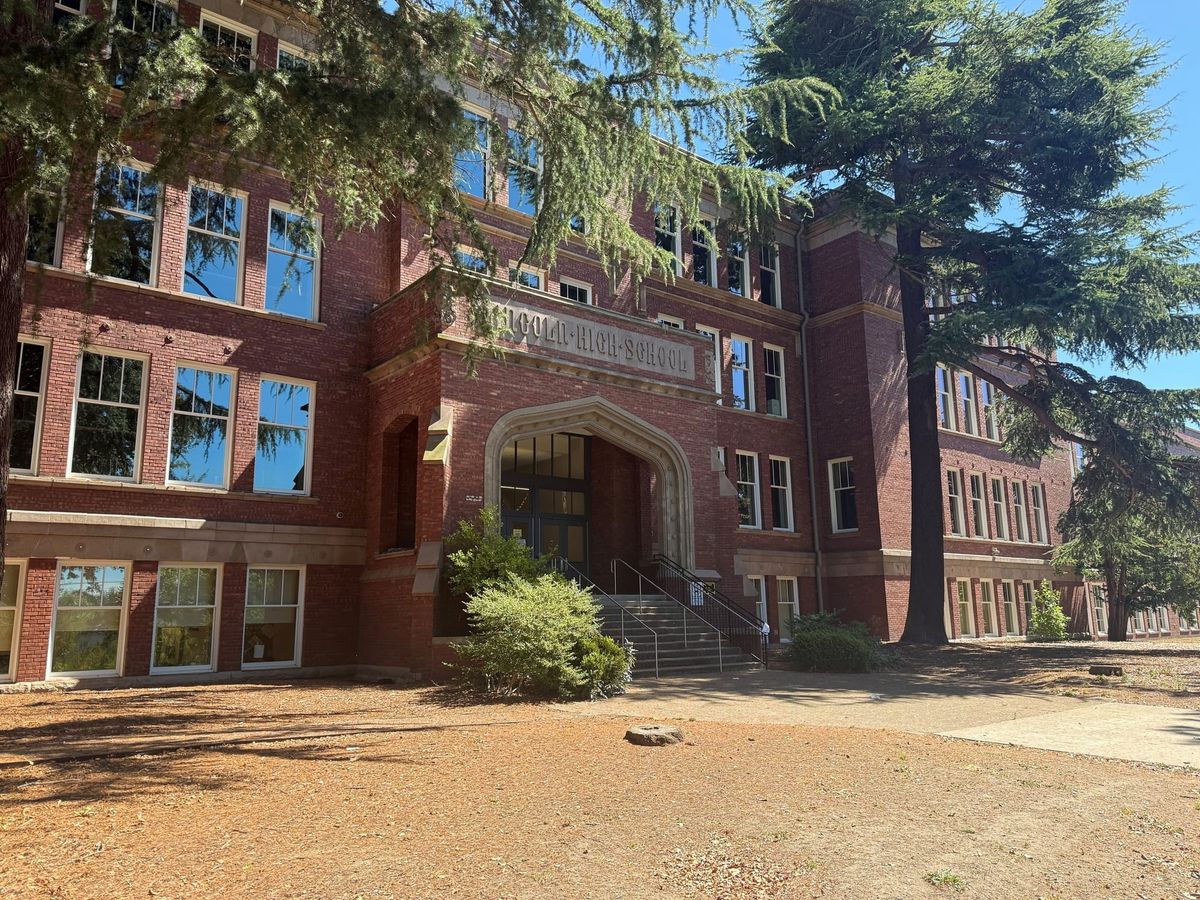
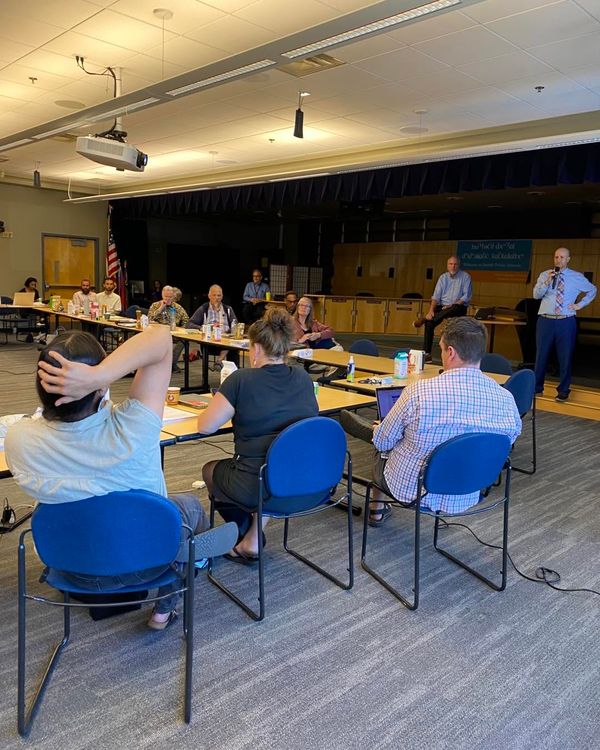
On a sunny Saturday morning, over 200 people crowded into the cafeteria at Hamilton Middle School to discuss the final two options for situating new athletic fields to be used by students at nearby Lincoln High School.
In a surprise twist, Seattle Public Schools staff presented three options instead of two, reviving an old plan that had previously been cut from consideration.
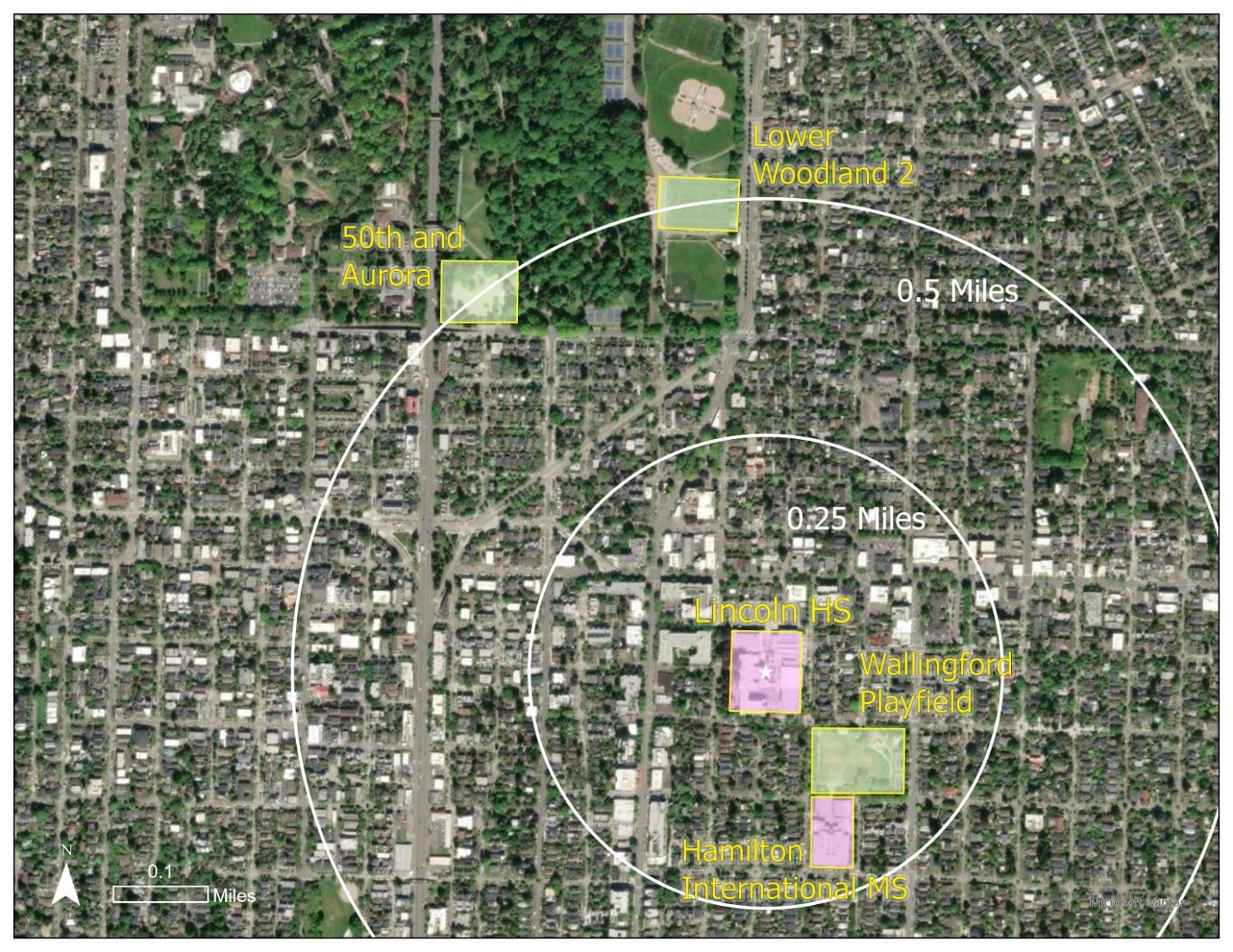
All three of the current proposals locate the fields within Lower Woodland Park, which is roughly half a mile from Lincoln. All three options would result in separate soccer and football fields, with cost estimates ranging from $8.6 to $11.5 million and projected completion times between autumn of 2028 and autumn of 2029.
Original proposals from 2024 would have built the fields at Wallingford Playfield—which abuts both Lincoln and Hamilton schools—but these plans were dropped after pushback from some neighbors (a brief history can be found here).
Saturday’s discussion was the latest step in a field development process characterized by delays, opaque communication, and community tension. This effort began in 2022, when Seattle voters approved $5 million in funding for Lincoln athletic fields as part of the BTA V capital levy.
Lincoln’s former field space was repurposed as part of its 2017 rebuild; it reopened in 2019 as the only comprehensive SPS high school with no athletic fields. Students have been bussing to fields elsewhere in the district for practices and games, which requires funds for the buses and a significant additional time commitment for athletes.
Saturday’s community meeting may mark a shift in both the speed and opacity of the process.
Superintendent Ben Shuldiner took the mic early in the meeting, sporting a business suit and a Lincoln baseball cap given to him by the football team. His opening statement, “I am the superintendent of this district, and I want a field to be built,” was met with raucous applause. Shuldiner’s brief remarks emphasized that his priority is to choose an option and execute it. He remained at the meeting for over an hour, conversing with anyone who approached him.
The format of the meeting was also a welcome break from past precedent. On Saturday, after an overview of the three proposals, SPS staffers spread into six groups and spent thirty minutes engaging with attendees. Each staffer then summarized their group’s input to the full audience. At the previous community meeting in November, there was no opportunity at all for the community to ask questions.
Members of the public have until May 9 to submit additional feedback about the three proposals. SPS speakers noted that the next step after today’s meeting is for SPS to select a single option, likely this summer. SPS will then present their choice to the Seattle Parks & Recreation (SPR) department, who is ultimately responsible for the land in question. None of the speakers provided details on how long a negotiation or approval process with Parks & Recreation might take.
Read on to learn more about the options presented at Saturday’s meeting.
In this issue:
What are the three options for field configuration?
The three proposals currently on the table are named—dazzlingly—Options A, B, and C. The details of each are outlined in a slide deck linked from the project’s website.
Option A
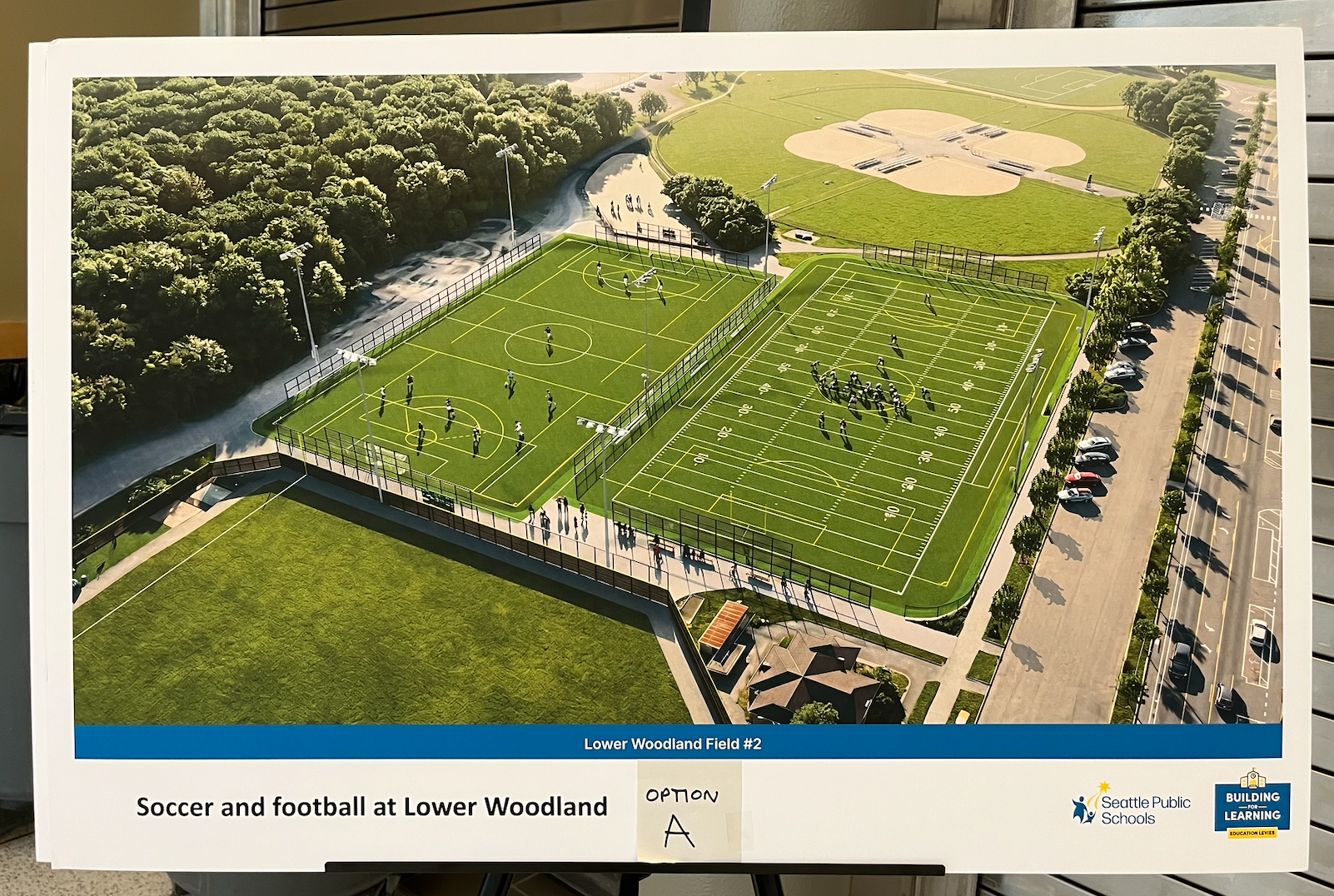
Option A is the only option that locates the soccer and football fields adjacent to one another. The proposal builds two side-by-side fields in the place of the existing soccer field at Lower Woodland, known as Lower Woodland #2.
Option A has a projected cost of $8.6 million and is expected to be ready for use by fall of 2028. It requires the removal of eight “Olmsted” trees that were planted along the park’s periphery as part of the original plan for the park designed by the Olmsted Brothers.
An earlier version of Option A would have impacted the bike jumps located west of the athletic fields. Local BMX and dirt bikers created the jumps from dirt stored by SPR starting in 1989, and have maintained and advocated for their preservation ever since. After a rally by the local bike community, SPS and SPR shifted the fields east, toward the trees. The current Option A would not impact the bike jumps or the nearby skate park.
Option A was presented as “preferred” in a previous SPS engagement session back in November, but SPS materials from that time do not explain why.
Option B
Option B leaves the existing soccer field (Lower Woodland #2) as it is today, allowing for its continued use by Lincoln athletes and the Seattle community. This proposal includes construction of a new hybrid football/soccer field on the site of the gravel parking lot at the Southwest corner of the park, where 50th Avenue and Aurora Avenue intersect.
Option B has a projected cost of $9.5 million and is expected to be ready for use in the summer of 2029. This option requires a more rigorous permitting and environmental review process compared to Option A because it repurposes part of the park for a use different from its current one. The area around the gravel parking lot is heavily forested; 40 trees would need to be removed to support Option B. The gravel parking lot is currently used as overflow parking for the sports fields and Woodland Park Zoo. It is unclear at this point what the city would require for parking at the site.
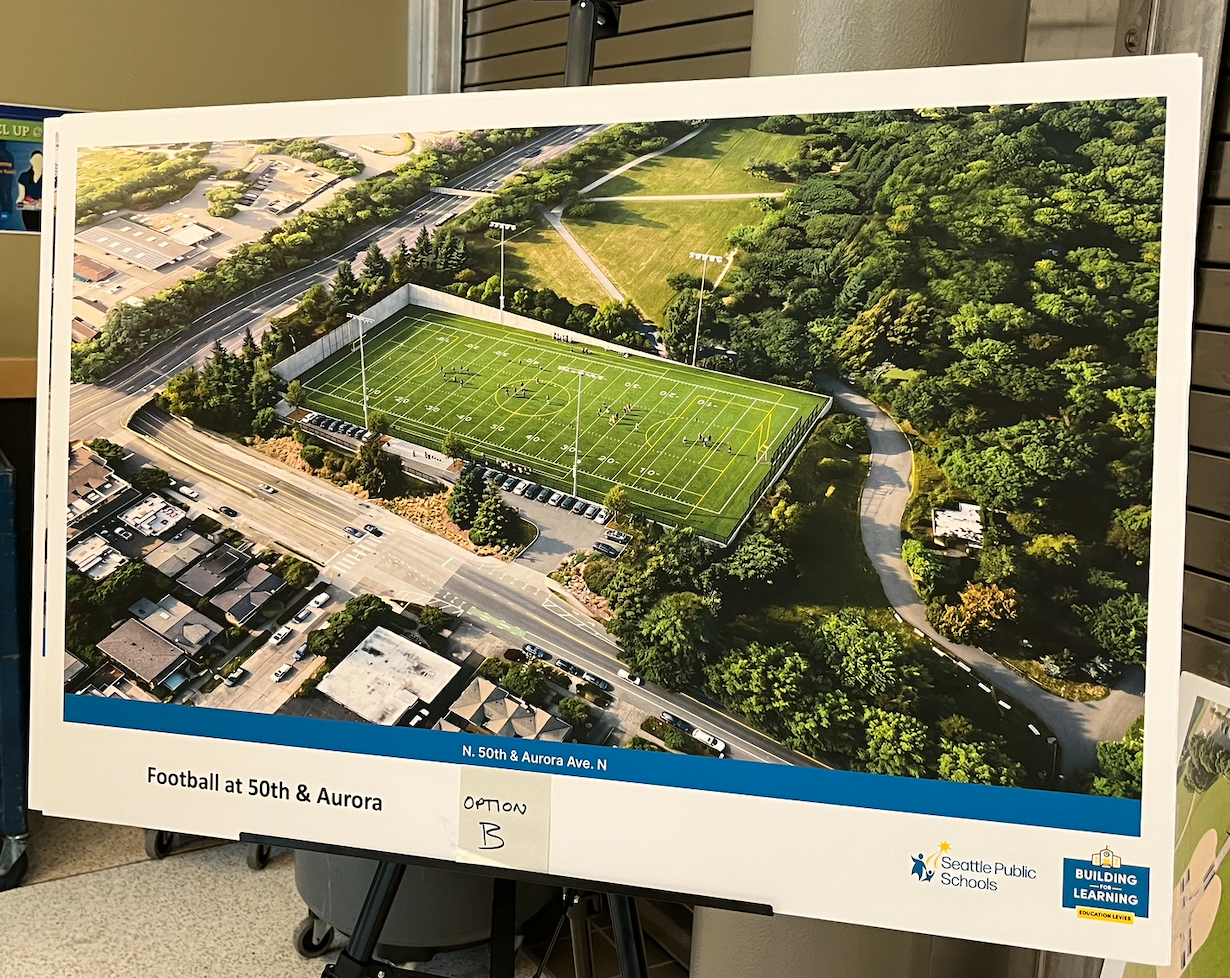
Oddly, the presentation of Option B was a surprise at Saturday’s meeting. Materials posted by SPS prior to the meeting referred only to Options A and C, and the project website was updated only after the meeting concluded. The large, foam-core posters used to facilitate group discussions were labeled with handwritten sticky notes, hinting that SPS staff were unsure until the last minute about the naming of each proposal.
Some participants in the room speculated that former Mayor Bruce Harrell, along with residents neighboring the park, disliked Option B and that SPS had therefore dropped it from consideration after the November 6 outreach meeting.
Tina Riss Christiansen—a consultant to SPS on the Lincoln fields project—confirmed when asked on Saturday that Option B had been added back into the list of choices in part because of opportunities arising from changes in mayoral leadership. An email to SPS’s Director of Capital Projects & Planning Richard Best asking for information about why Option B was dropped and/or revived on short notice before Saturday’s meeting was not returned by press time.
Option C
Option C would expand the existing Lower Woodland #2 soccer field into a hybrid football/soccer field, while also converting the gravel parking lot at the Southwest corner of the park into a compact-sized soccer field. As a result, the impact to the area at North 50th Avenue and Aurora Avenue North would have a smaller footprint than in Option B.
Option C is projected to cost $11.5 million and is expected to be ready for use in fall of 2029. It requires permitting equivalent to that of Option B, which is more than is required by Option A. Construction costs increase because two areas of the park would be impacted instead of one.
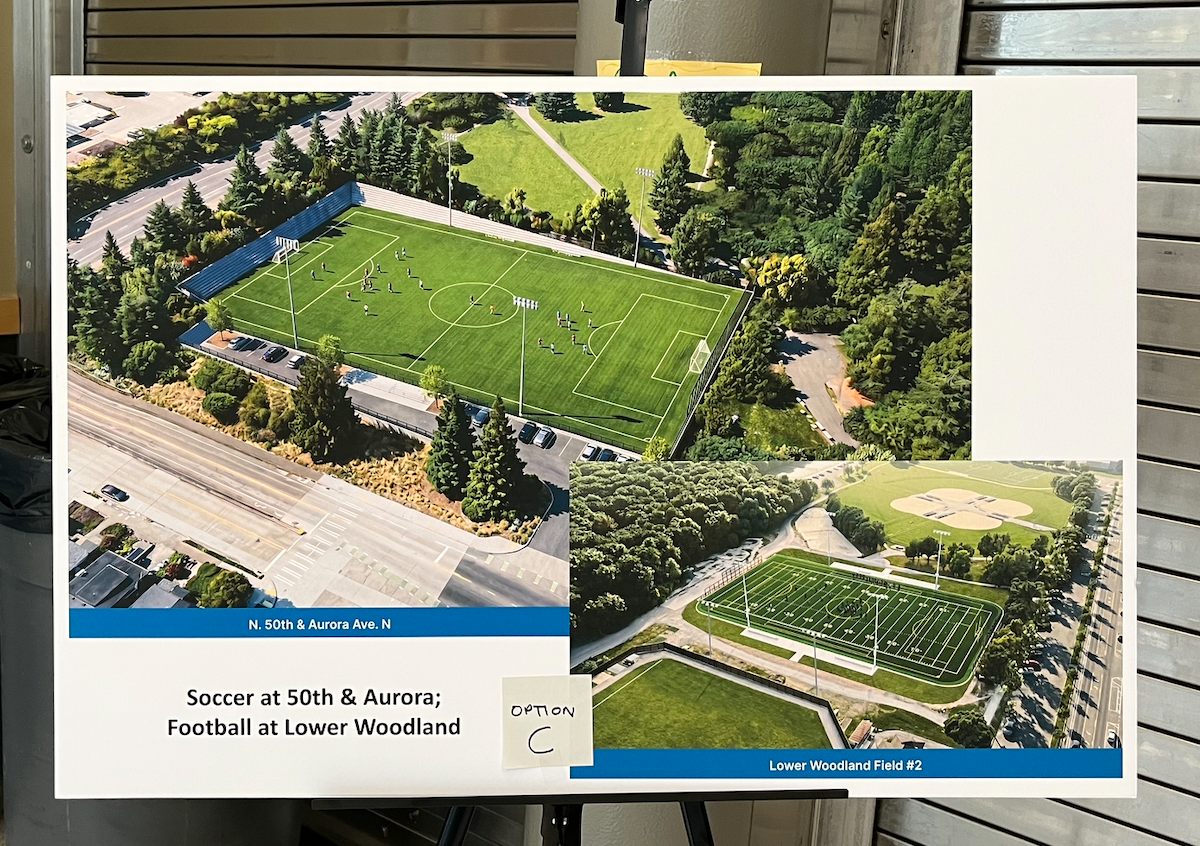
Option C is new. After the last meeting in November 2025, a group of advocates organized into Friends of Lower Woodland Park to propose what they call a compromise position blending the best of SPS’s A and B positions. They called their new proposal Option C.
Somewhat confusingly, the Option C presented by SPS on Saturday retained the very broadest strokes of the Friends of Lower Woodland Park proposal, but it altered the details significantly enough to anger members of the group who were in attendance and who felt that their best ideas had been ignored.
What did the public have to say?
The crowd contained two visibly organized cohorts—Lincoln families and the Friends of Lower Woodland Park—as well as plenty of individuals representing a wide range of viewpoints.
Lincoln Families Want Facilities Now
Members of the Lincoln community are frustrated at the years-long delays plaguing the project. For this reason, many preferred Option A for its fast timeline and for the reliability of its execution path. They worried that the additional permitting and environmental review required by Options B and C could lead to the eventual derailment of those proposals, leading to further delays. This cohort was easy to spot because they were decked out in Lincoln garb, including the entire football team, who were present in their jerseys.
Their fears are well founded. The original plans to place Lincoln’s field at Wallingford Playfield were ultimately scrapped by SPS after opposition from some neighbors, leading to a restart that added years to the project’s timeline. Neither SPS nor Seattle Parks and Recreation appear to be reconsidering the use of Wallingford Playfield.
Neal Freeland—a Lincoln parent—said, “Seattle cares more about dogs than kids!” as he referenced neighborhood pushback that emphasized the needs of dog walkers and ultimately killed the possibility of a Lincoln field adjacent to the school building.
As of April 26, the Lincoln cohort had 1,214 signatures on a petition advocating for Option A. Because SPS had previously dropped Option B from consideration, this petition was developed and signed when the only choice was between Options A and C.
During group discussions, one exasperated Lincoln parent said, “We’re spending $60,000 on buses!” Another parent explained how her daughter buses up to Ingraham High School, five miles north, for track practice. Lincoln’s practice starts at 7pm, after Ingraham’s teams have finished using their track, and it is 9pm by the time the Lincoln athletes return home.
Friends of Lower Woodland Park Advocate for a Different Path
The Friends of Lower Woodland Park were identifiable by the flyers they were distributing which advocated for their version—the original version—of “Option C.”
Members of this group were vocally frustrated at the meeting. They claimed that SPS’s version of Option C is a straw man version that waters down their proposal and leaves the public to choose among three unsuitable options.
The two “Option C” proposals differ in their footprint, parking accommodations, cost, field orientation, and treatment of trees, among other things. A speaker for SPS acknowledged late in the meeting that SPS should have named their newest proposal differently.
The Friends of Lower Woodland Park developed their Option C in response to their concerns about Option A, which they fiercely oppose. Their concerns include Option A’s small sideline margins and its impact on the “Olmsted” trees. The group’s Option C also includes room for a football grandstand, which is absent from any of the SPS proposals.
The details of the Friends of Lower Woodland Park proposal can be found here. The details of the SPS version are in an SPS slide deck linked from the project page.
As of April 26, the group had collected 556 signatures for a petition in favor of their Option C—which, again, is not one of the official options that SPS is considering at this time. Like the Lincoln petition, this petition was also developed at a time when Option B was not on the table.
SPS unintentionally inflamed tensions with the Friends of Lower Woodland Park before the meeting even began by quietly collecting flyers that the group had just distributed onto the cafeteria tables, next to SPS’s own printed materials. The flyers advocated for the unofficial version of Option C.
Richard Best did explain to the room at the end of the meeting that the Friends of Lower Woodland Park flyers had been removed to avoid confusion about the meaning and details of “Option C,” and he directed attendees to stacks of the previously confiscated printouts. It was the right response, but it came an hour later than it could have.
Attendees Flag Additional Concerns
Surprisingly, cost was not a leading concern in the group discussions. Perhaps the proposed costs are similar enough to avoid raising eyebrows, or perhaps attendees recognize that this project is paid from SPS’s capital budget, which is well funded and separate from the operating budget that carries the well-publicized SPS annual deficit.
During group discussions, attendees emphasized concerns including:
- Construction interference and accommodations: For proposals that involve building over an existing field (Options A and C), attendees wanted to know where students and community members would go while the current field space is being renovated. SPS did not have a ready answer but they promised to post one on the project website soon.
- Tree preservation: All proposals require some tree removal, ranging from eight to forty trees. Several attendees were particularly concerned about the eight “Olmsted” trees lining the side of the park along Green Lake Way, arguing that the trees are significant as part of the park’s historic aesthetic. These trees would be removed under Option A. Options B and C remove a greater number of trees from a more wooded area that the Olmsted brothers advocated be maintained as a woodland area.
- Field co-location: While SPS says that the co-location of the fields (in Option A specifically) is convenient for Lincoln students and staff, they also acknowledged community concerns that the space between and around the co-located fields is quite limited. The margins of the adjacent fields are limited on all four sides, leaving community members with concerns about insufficient space for spectators and teams. None of the football fields in the final proposals are intended for varsity football games, though all of the options provide sufficient facilities for junior varsity football games.
- Repurposing (“activating”) the gravel lot: Some attendees were excited about the potential “activation” of the Southwest corner of the park as proposed in Options B and C by increasing visitors to what is currently an underutilized part of the park. Others were worried about the impact of increased lighting and traffic on nearby residents. Crime along Aurora was also mentioned as a concern for any field in the park’s Southwest corner location.
- Support for additional sports: Several people expressed frustration that the new field constructed in Option C does not support lacrosse or ultimate frisbee. It was unclear from their discussion whether the limitation is an issue of physical space (field dimension, line painting, fencing for ball control, etc.) or something else.
- Parking: Some attendees felt that parking was being overly prioritized in the plans, especially for new fields in the Southwest corner. They argued that adding new parking in the Southwest unnecessarily inflates the cost of Options B and C. Other community members were concerned about insufficient parking, particularly for Option A which would increase total game capacity at a parking lot that is already chaotic during evenings and weekends. In the case of Options B and C, some community members were concerned about the loss of the overflow parking for Woodland Park Zoo events and activities occurring at the existing fields.
What's Next?
The public has until May 9 to provide feedback via SPS’s feedback form. The form comprises a single question: What additional information should we consider before making a decision about these three options?
If you have an as-yet-unspoken opinion or concern, now is the time to share it with SPS!
SPS representatives said that the district would make a decision on their final proposal this summer. They will then work together with Seattle Parks & Recreation on the next steps. Both SPS and Seattle Parks & Recreation must agree on a proposal for it to proceed to construction.
Update: After Saturday's community meeting, Friends of Lower Woodland Park published this response to SPS's Option C.