Issue 7 -- December 3, 2025 Seattle School Board Meeting Recap
New directors get bad news about student achievement.

by Beth Day and Julie Letchner
In this issue:
- New School Board Directors Oath of Office
- Progress Monitoring Goal 1: Early Literacy
- Progress Monitoring Goal 2: Math
Watch: YouTube video
Read: Transcript
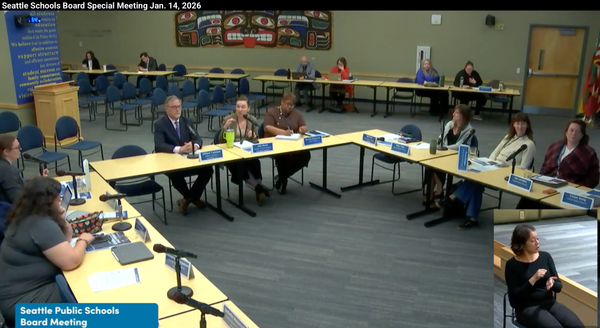
Roll Call: Departing board members Sarah Clark, Brandon Hersey, and Michelle Sarju were not present (initially), but all the other continuing board members were there.
New School Board Directors Oath of Office
(Beth Day)
After a welcome intro from Board President Gina Topp and Interim Superintendent Fred Podesta, each of the new school board directors were sworn in. The new directors then gave comments.
District 7 (Southeast Seattle): Jen LaVallee
Director LaVallee spoke about the love families have for SPS’s teachers, diversity, and community. However, she acknowledged that is not true for every student and pledged to create change, and that “our community does not expect perfection, but it expects progress.” Click here to watch her remarks.
District 4 (Queen Anne/Fremont): Joe Mizrahi
Director Mizrahi reflected on his experience as a union organizer. He said there is a saying in organizing, “It’s not complicated, it’s just hard,” and explained how that also applies to the problems facing SPS. He also spoke to his optimism about how much the community loves its schools, which is a strong foundation to build from. Click here to watch his remarks.
District 2 (Magnolia/Ballard): Kathleen Smith
Director Smith said that she was “dedicated to Seattle's students, families, and educators, guided by values of transparency and clear communication, collaboration that brings diverse voices to the table, and centering human connection while making thoughtful, data-informed decisions.” Click here to watch her remarks.
District 5 (Capitol Hill/Central District): Vivian Song
Director Song’s comments tied together her experience as the child of immigrants and the current moment in the Trump Administration. She also touched on the need for change in the way the district and leadership listen to the community and govern. Click here to watch her remarks.
Progress Monitoring — Goal 1: Early Literacy
(Beth Day)
With the change in guard from Superintendent Jones to Superintendent Podesta, there was a different feel to progress monitoring, which pleased the Board. However, there was also a tentativeness, as Superintendent Podesta recognized the changes ahead: new board members, new Superintendent. The graphics were certainly snazzy though! Let’s get into it. Click here for the full presentation slide deck.
Presenting with Superintendent Podesta were Associate Superintendent Rocky Torres-Morales and Accountability Officer Ted Howard. To start things off, Howard presented the plan to create a culture of continuous improvement and how that would impact progress monitoring going forward. District leaders and down through the levels of district hierarchy are expected to constantly be reviewing data and making immediate changes to improve student outcomes.
For example, at the classroom level, teachers would use curriculum-embedded assessments to evaluate student understanding of taught concepts. Each question represents different standards, and if students aren’t successful answering those questions, teachers need to adjust their teaching to better teach that concept.
Principals and up through the chain would also have access to these real-time results and support teachers in making adjustments as well as changing processes throughout the system that block student progress. Similarly, at the district level, leaders will be using those assessments as well as the topline standardized tests used for progress monitoring.
Here’s a fancy graphic that helps explain the approach to continuous improvement:
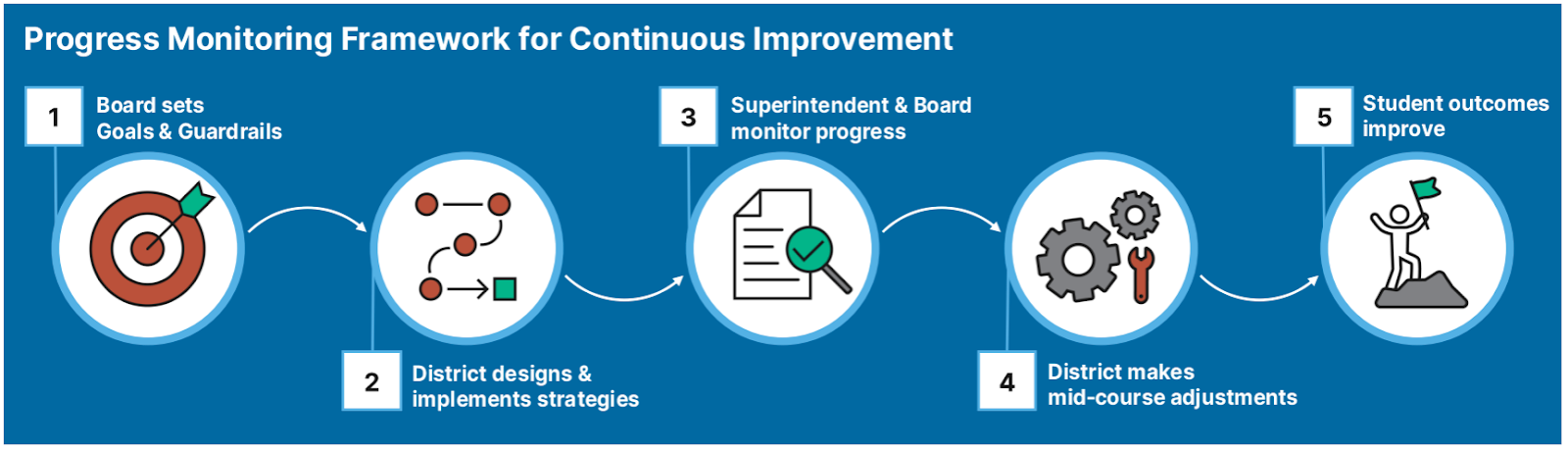
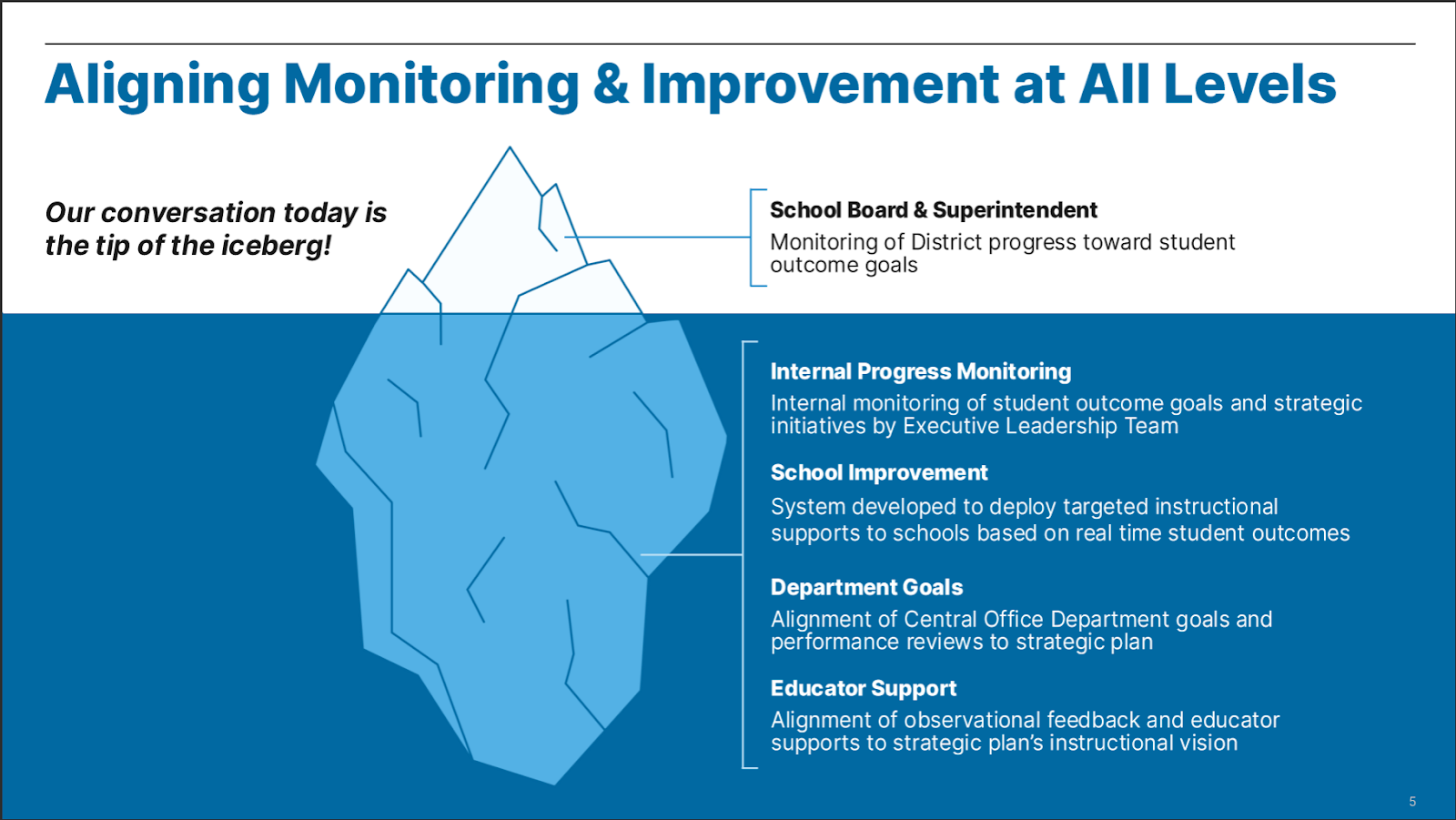
To break down how this process works further, district staff showed this “iceberg” slide, emphasizing that the work seen in public meetings during progress monitoring filters down through the entire hierarchy.
So let’s get specifically into Goal 1, which states the following:
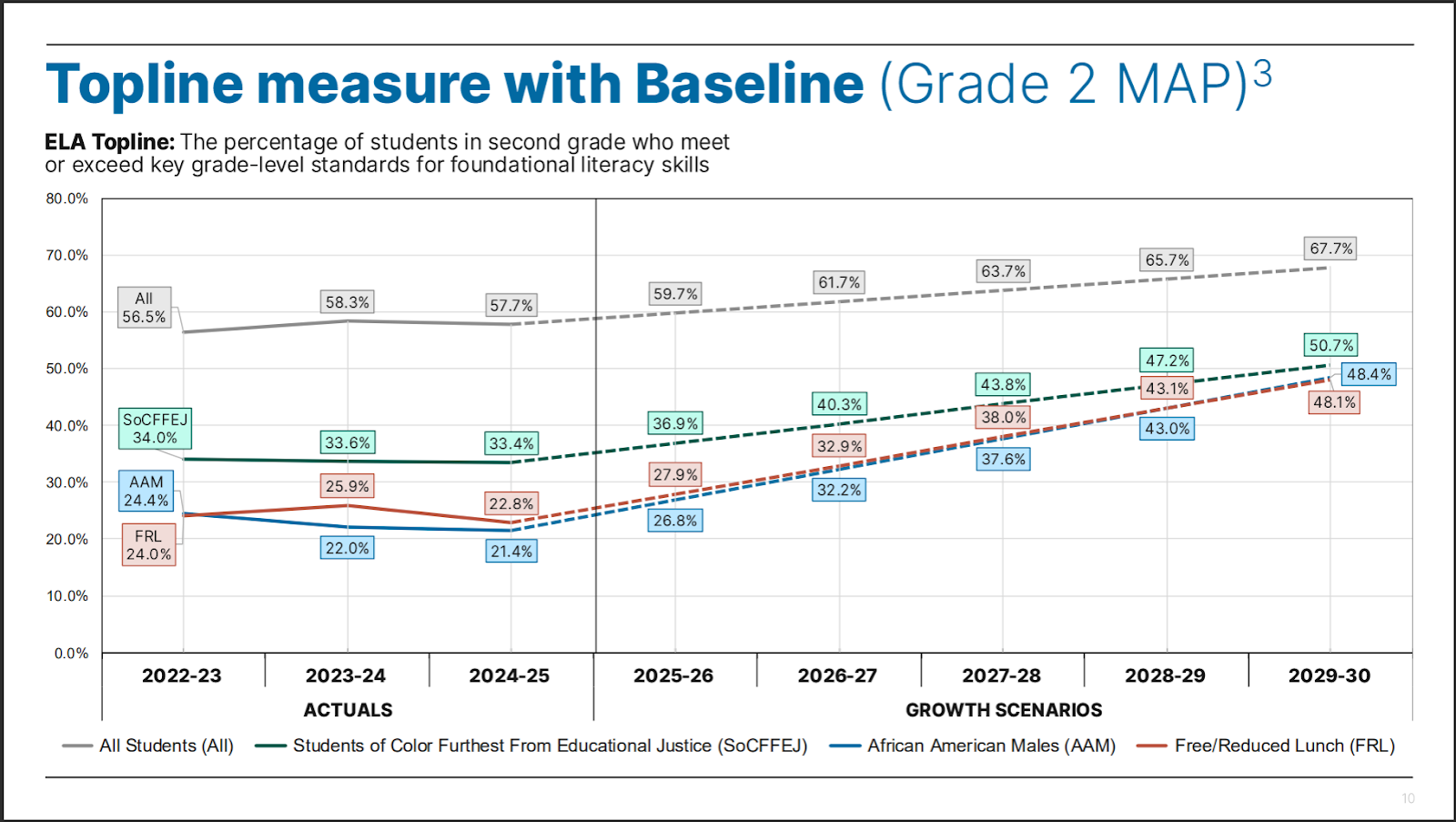
The percentage of 2nd grade students who meet or exceed grade-level standards for early literacy skills based on the MAP assessment will increase from 57.7% in Spring 2025 to 67.7% by Spring 2030.
In addition to monitoring the progress of all students, district leaders set differentiated accelerated goals to address achievement gaps for Students of Color Furthest from Educational Justice, African American males, and students receiving Free/Reduced Lunch. Students of Color Furthest from Educational Justice (SoCFFEJ) is an SPS-defined designation that includes students who are: Black/African, Native American, Pacific Islander, Hispanic/Latino, Southeast Asian, Middle Eastern/North African, or multiracial students from any of these groups.
During board director questions and comments, it was clear that directors would also like to monitor groups such as Multilingual Learners and Students with Individualized Education Plans (IEPs). Staff told the board they could disaggregate further, but it will be interesting to see if that happens in a public meeting.
The topline standardized tests the district plans to use to measure student progress in early literacy (detailed in the slide below) are Measures of Academic Progress (MAP) and Dynamic Indicators of Basic Early Learning Skills (DIBELS), a one-on-one assessment conducted by classroom teachers.

Here’s where students are at now and the projected goals through the end of the monitoring period. In summary, 57.7% of all Grade 2 students met or exceeded standards on the MAP, with only 33.4% of Students of Color Furthest from Educational Justice (SoCFFEJ), 22.8% of African American Males (AAM), and 21.4% of Free/Reduced Lunch Students (FRL) met or exceeded standards:
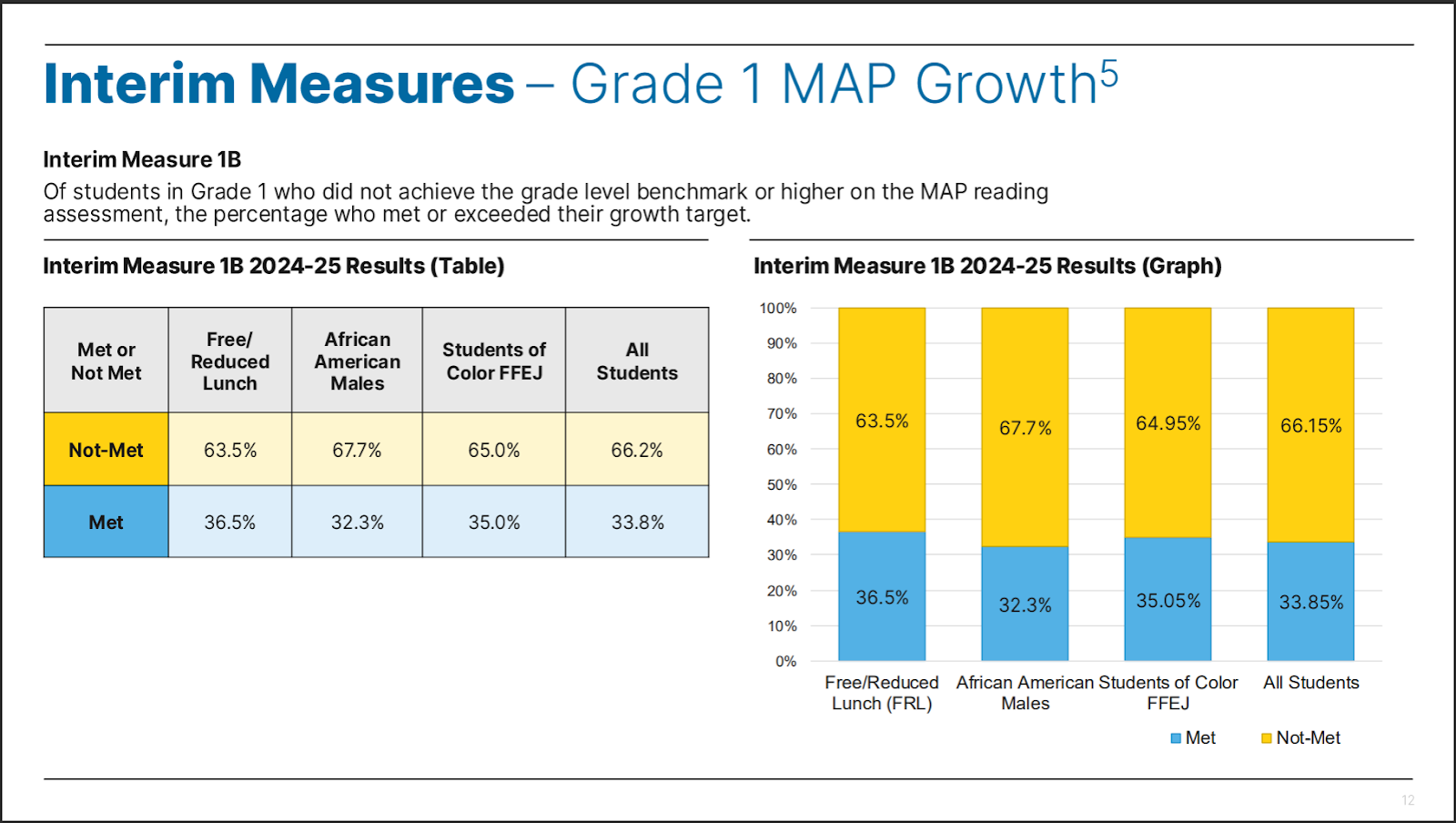
One of the cool things about the MAP test, because it is given multiple times a year, is that it also estimates individual student growth. This was somewhat confusing (thank you to Director Mizrahi for asking staff to explain this slide in more depth). If my understanding is correct, the MAP projects a growth target based on the beginning of the year test results for each student. Thus, we can see whether a student who is not meeting standard has at least met or exceeded that year-of-growth goal and is making progress. Ideally a student below standard would exceed their growth goal to “catch up,” but most importantly we can see which students are falling further behind.
The results for Grade 1 MAP growth for students who didn’t meet standard are presented in the slide below: About 2/3rds of students who did not meet grade level standard are also not making at least a year of growth in reading skills.
So, things are not looking awesome for student achievement in early literacy. District staff’s primary approach appeared to be to double down on Multi-Tiered System of Support (MTSS). In the slide below, they presented the strategies they tried during the last cycle of the Strategic Plan/Progress Monitoring and what they learned:
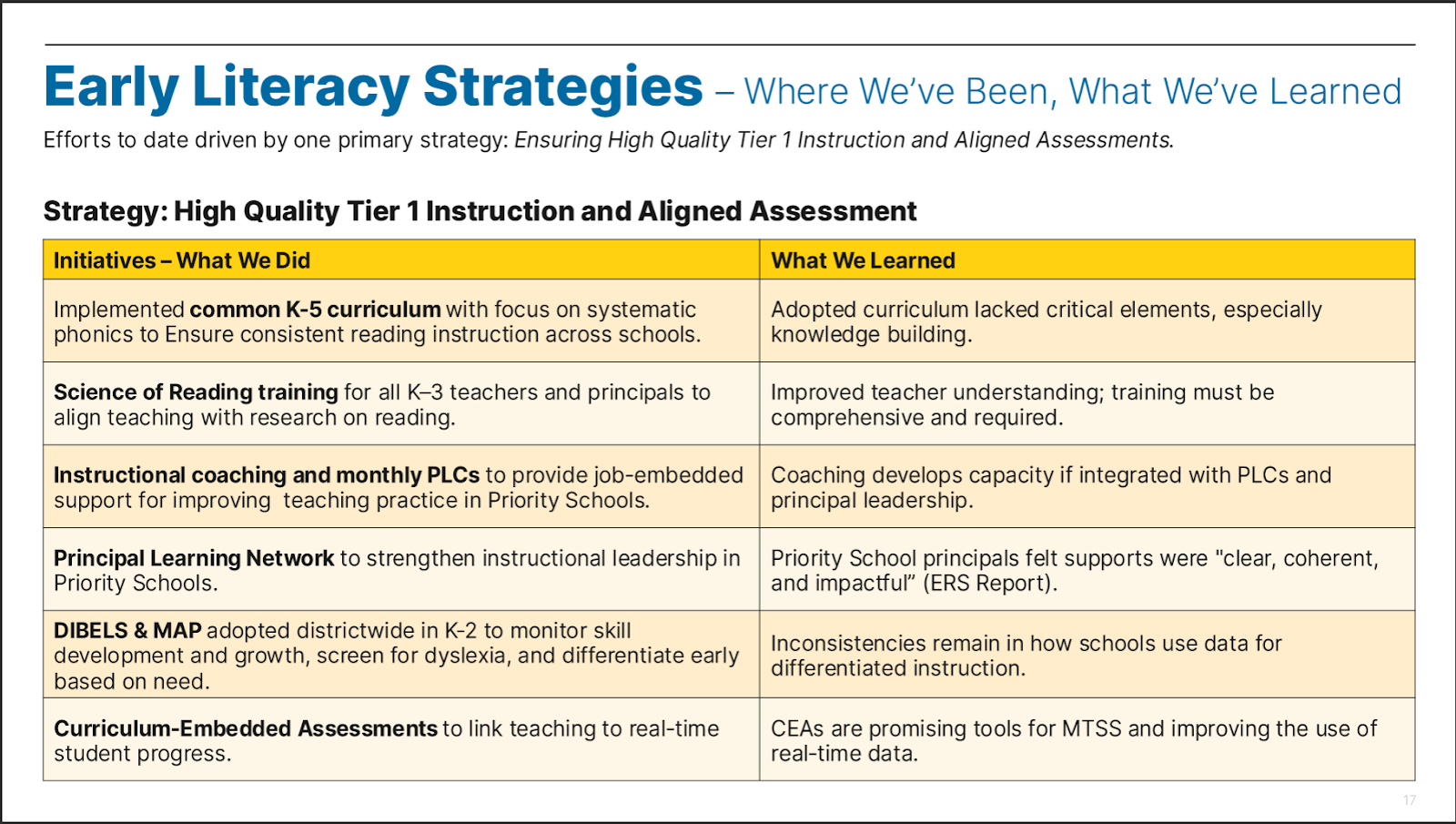
Two of the big takeaways from this portion of the presentation and board director comments is that the common K-5 reading curriculum that was adopted towards the beginning of the previous cycle did not align entirely with Science of Reading principles, especially knowledge building (though many advocates in the past have pointed out that the phonics elements were also lacking in the common curriculum each student receives, or “Tier 1” in MTSS speak).
The second takeaway was that the professional development provided for Science of Reading was just one two-hour session for most teachers (shout-out to Director LaVallee for pressing staff on this). There was discussion of successful districts such as those in Mississippi where training was more in-depth and continued throughout the year.
Finally, here are, at a high level, the strategies the district plans to employ to improve student outcomes in early literacy. The district staff spoke long on implementing It will be interesting to see how they refine these into more specific strategies. I’d like to note that they are in the process of adopting a new K-5 reading curriculum now, details of which can be found on the SPS webpage.

As a parent whose children have struggled with learning to read under the current curriculum, I’m excited that we are adopting a new curriculum so soon. However, I would like to know specifically what the central office is doing to remove blocks around accessing Tier 2-3 supports. Tier 2-3 supports are anything beyond the standard curriculum that all kids receive (Tier 1), including special education interventions. For both my children, this has been a difficult process.
I also have had multiple teacher friends leave SPS because of the lack of support from HR and central office, and wonder where that factors into recruiting, developing, and retaining a diverse and effective workforce.
One interesting point of discussion with the board directors around these strategies was how to encourage fidelity of adoption while balancing that with teacher autonomy to respond to the needs of their individual students. There was also some skepticism around the workload on teachers under the implementation of Multi-Tiered System of Support (MTSS) and how much the district was including teacher feedback. This led into discussion of allocation of resources, and how these strategies would feed into budget decisions.
Progress Monitoring - Goal 2: Math
(Julie Letchner)
In January, the board adopted the following math-related strategic goal:
The percentage of sixth graders prepared to succeed in math coursework in seventh grade, as measured by the sixth-grade Smarter Balanced assessment (SBA), will increase from 56.8% in June 2025 to 66.8% in June 2030.
At Wednesday’s board meeting, Fred Podesta and district leaders presented a baseline monitoring report and nascent strategic plan to the newly seated board. All of the benchmark data can be found in the district’s presentation slides.
Baseline Benchmark
The core metric being tracked by the board for their math goal is the sixth-grade SBA proficiency, measured each spring. As of June 2025, 56.8% of sixth graders reached proficiency. This number has risen in recent years, from 50.9% in 2022-23 and 54.6% in 2023-24.
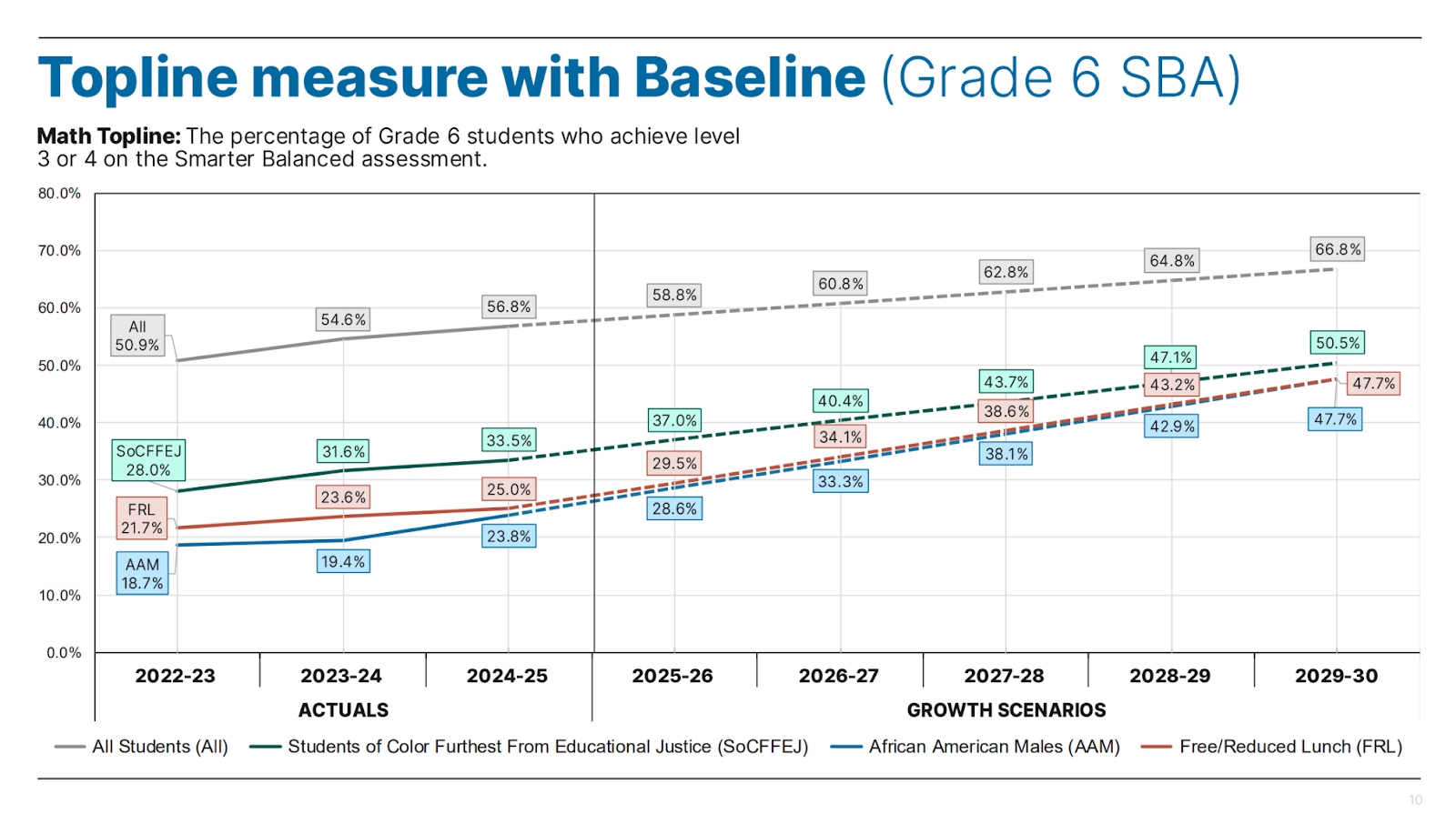
District staff is also tracking interim goals in an effort to better understand what interventions are needed to improve the sixth-grade math goal. These include:
- Fourth-grade math proficiency: 62.1% of last June’s fourth graders were at grade level (as measured by the SBA, taken in spring). Within subpopulations, this drops to 31.2% for students receiving free/reduced lunch (FRL); 28.9% for African American males; and 39.2% for students of color furthest from educational justice* (SoCFFEJ).
- Fifth-grade math proficiency: 56.2% of last June’s fifth graders were at grade level (again measured by the SBA). Again, subpopulations show stark opportunity gaps, with proficiency levels of 25.3% for FRL students; 28.1% for African American males; and 34.0% for SoCFFEJ.
- Sixth-grade autumn math proficiency: 51.4% of this year’s sixth graders were at grade level, as measured on this autumn’s MAP test. Notably, this is the same cohort of students reflected in the previous interim goal, who were collectively at 56.2% proficiency last spring. Collective proficiency dropped among each of the subgroups as well: 22.0% for students receiving FRL; 22.7% for African American males; and 28.9% for SoCFFEJ.
During board Q&A, directors noted that proficiency within a given cohort drops year-over-year as students progress upward through grade levels. This is true for the overall student population, as well as for the smaller populations whose data is broken out separately. Staff did not provide hypotheses about what is driving this trend but said they were looking into it.
Many board directors expressed gratitude for the level of data provided in this benchmark report, compared with previous progress monitoring sessions. Much of the board also shared excitement that this baseline might actually create room to make meaningful improvements moving forward.
Strategic plan for math
The strategic, forward-looking portion of the discussion was split into two parts: what SPS has tried and learned in the past, and what SPS will aim for moving forward. Both sections were light on specifics, compared with the benchmarking portion.
Learning from the past
Dr. Torres-Morales outlined six experiments from SPS’s past, and what the district has learned. Four of the six boiled down to the importance of professional development opportunities for teachers. One related to increasing curriculum-embedded assessments. The final one emphasized the importance of a standard curriculum across grades, especially across the jump from elementary to middle school.
Oddly absent from the math presentation was research or findings from other districts trying to improve math scores. Director Smith highlighted this during Q&A, emphasizing that this omission in the math discussion was especially glaring because of how well peer examples were used in the earlier literacy discussion.
Planning for the future
The strategic plan portion concluded with a list of the same four strategies introduced earlier in the meeting in the context of improving literacy scores.
The math-tailored “emerging initiatives” supporting these strategies were vague, including items such as, “Expand use of Curriculum-Embedded Assessments to align instruction to timely student data,” and “Align systems district-wide for consistent job-embedded professional development.” The strategic plan is still being developed, of course. As presented, it is not clear what the execution of the emerging initiatives might entail.
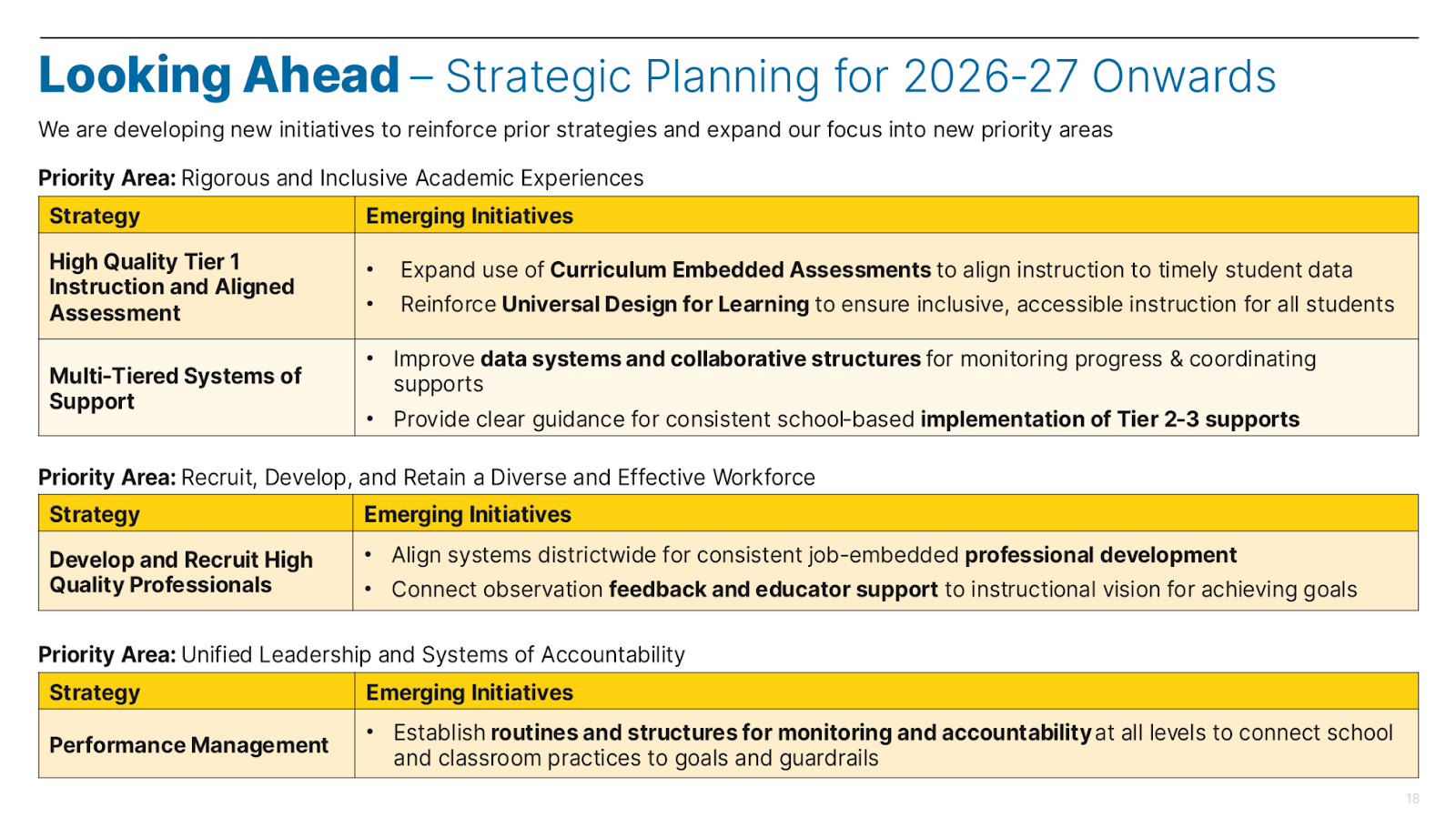
Directors Mizrahi and Song both expressed their desire for more details relating to the emerging initiatives for both the math and literacy goals. Song in particular emphasized that since many solutions focus on professional development, she sees a need for systems that support teachers with professional development: When is it offered? How is it delivered? How can teachers provide feedback about what is and isn’t working, and how is that feedback integrated back into the system?
Torres-Morales acknowledged that alignment of district-wide professional development is a target area for improvement. Podesta echoed that the district is working to consolidate decisions about professional development more centrally, so that decisions about trainings aren’t made in an ad hoc way.