Issue 15 -- January 21, 2026 Seattle Public Schools Regular Board Meeting Recap
Board members discuss restoring committees, updated the rules about cops on campuses, and extended the student representative program.
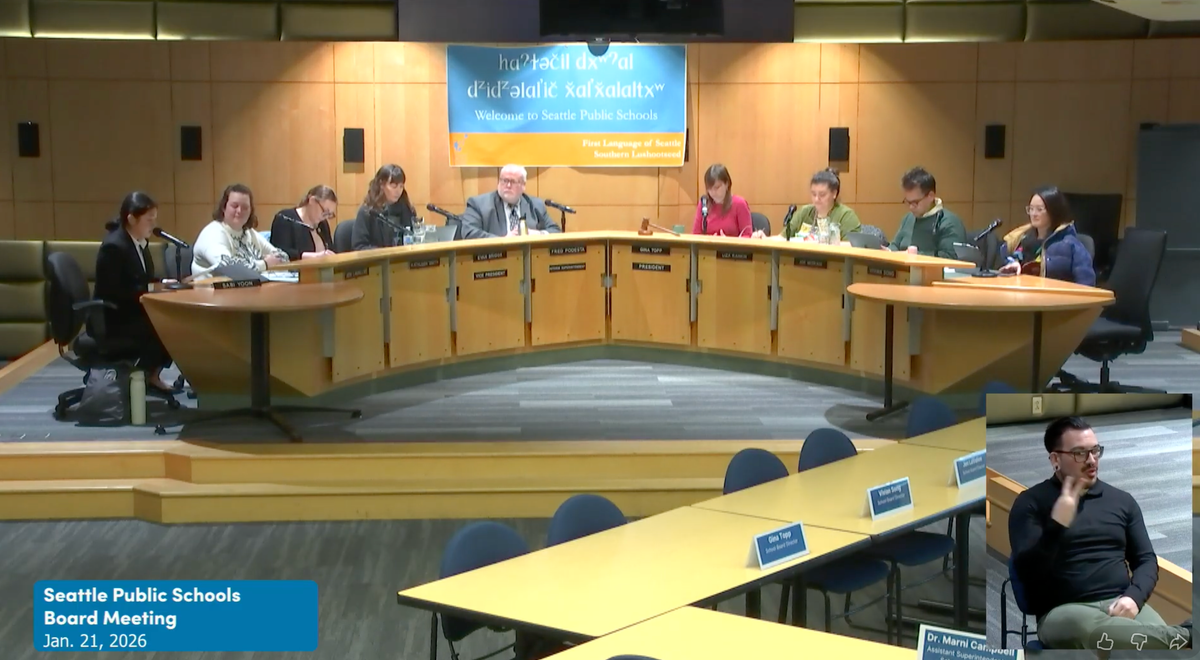
Watch: YouTube video
Read: Transcript
In this issue:
- Superintendent comments
- Board Liaison roles
- Public Comment
- Consent Agenda
- Cops on Campus
- Student Representatives
- Restoring Board Committees
Roll Call: All school board directors were present in-person.
Superintendent Comments
Superintendent Fred Podesta reflected briefly on his time as Interim Superintendent. The new Superintendent, Ben Shuldiner, starts February 2nd.
Podesta also commented on the Shelter-in-Place that happened in multiple SE Seattle schools after reports that ICE were near SPS school buildings on Tuesday, January 20th. It remains unclear whether ICE was indeed scoping out areas around schools. Podesta acknowledged the difficulty around unconfirmed reports of ICE, and that the district needed to better support individual building leadership in decision-making.
Podesta expressed his pleasure with the renewal of the Student Community Workforce Agreement, which is a partnership with SPS’s construction and trades labor partners that gives SPS students hands-on work experience in construction and the trades.
Finally, Podesta announced that SPS would once again be celebrating Black Lives Matter at Schools Week, February 2-6, 2026. Student Director Sabi Yoon then read the proclamation, which can be found in its entirety here.
Board Liaison Comments
President Gina Topp announced this year’s assignments for board liaison positions:
Head Start: Director Vivian Song
Tribal Nations: Vice President Evan Briggs
Washington Interscholastic Activities Association (WIAA): Director Joe Mizrahi
BEX and BTA Capital Levy: Director Song and Director Jen LaVallee
Legislative: Director Song
City of Seattle FEPP/DEEL and King County: Director Mizrahi
Council of Great City Schools: Director Liza Rankin; and
Scholarship Committee: Director Kathleen Smith.
There has been some shakeup in the assignments, most notably replacing Director Rankin with Director Song for the Legislative Liaison. I’m unsure how active the board has been with WIAA in the past, but with the upcoming initiative proposing to ban trans girls from K-12 sports, I imagine a closer relationship is warranted.
The first bill Director Song mentioned in her legislative report is Senate Bill 5906. This bill would prohibit early learning providers and school district employees from collecting information about the immigration statuses of students or their family members. It would also prohibit early learning providers, school district employees, health care facilities, higher education institutions, and county auditors' offices from allowing immigration enforcement officers to enter the nonpublic areas of those locations without a warrant or court order. SPS has signed in “Pro” for this legislation. You can click here to email your state legislators with your opinion on the bill.
The second bill mentioned was Senate Bill 5858. This bill would provide pupil transportation safety net awards to school districts that can show excess costs due to serving special education students, homeless students, and foster care students. This is a large part of SPS’s overspend on student transportation, so would be beneficial to the district.
Song also appears to be paying attention to the contracts going through the Consent Agenda for approval. She thanked staff for including the cumulative sum of the change orders for Alki Elementary for transparency. She also mentioned the removal of the Novak Consulting contract from the agenda, stating “I think this is an example of the kind of contract cleanup and process work that this board needs to do.”
Song noted that the Board Action Report (BAR) for the 2026-27 and 2027-28 calendars did not include the Kindergarten start dates, which has conflicted with religious holidays in the past. She also expressed disappointment with the calendar approval process, saying, “The calendar approval has increasingly taken on the character of labor negotiations instead of being centered on students and families.” Director Rankin, in her comments, agreed with Director Song.
Public Comment
Much of the public comment was related to the Shelter-in-Place in Southeast Seattle schools because of reported ICE activity near schools. Teachers and parents called for better support from the district, including more training/instructional materials on student and family rights. One notable speaker talked about how kids didn’t really understand what was going on and were scared for themselves and their families. Like a game of Telephone, these kids then talked to their parents with limited information, likely causing more fear for families. Speakers with connections to immigrant communities spoke on how it has fallen to the communities to make sure kids and families are safe between school and home.
Another notable comment was by Adam Gish, teacher at Garfield High School. He made a Public Records Request (PRR) to learn more about the Novak Consulting contract, which provides professional development for Multi-Tiered System of Supports (MTSS), Universal Design for Learning (UDL), and Restorative Practices. He called the sessions he had attended, “a textbook example of bad pedagogy.” He also noted the disorganized process in which the contract has been handled, as revealed in the back and forth between staff in the PRR.
Consent Agenda
Director Briggs asked for the Human Resources Personnel Report to be removed from the consent agenda and abstained from the vote because she didn’t “have sufficient confidence that required procedures were followed for all actions on this report.” Director LaVallee also abstained for the same reason, while the rest of the board voted for approval. Neither director explained the reason for their concerns.
The approval for restoration and repair of Emerson Elementary after flood damage was pulled from the Consent Agenda by President Topp because the amounts in the BAR needed to be corrected. The corrected motion was passed unanimously. The rest of the Consent Agenda also passed unanimously.
Action: Amendment to Board Policy No. 4311, School Safety and Security Services Program
This was a leftover piece of the conversation around whether to allow School Resource Officers (SROs) in schools again, particularly at Garfield High School. Director Mizrahi introduced this amendment at the December board meeting.
The intent of this amendment, according to Director Mizrahi, is to clear up confusion about policies allowing police officers access to school buildings. The moratorium has always been, and continues to be, on specifically having SROs in the buildings.
The board and school district hope that this clarification will grease the wheels of impending conversations between the school district and the Seattle Police Department (SPD) regarding school safety and security. SPD seems to be willfully misunderstanding the current intent of the policy. As Director Rankin commented, “Sometimes misunderstandings are in good faith and sometimes they're not on all parties.”
The policy amendment was passed unanimously by the board.
Introduction: Amendment to Board Policy No. 1250, School Board Student Members
The School Board Student Member policy was first implemented in 2021 and the first members were seated for the 2022-23 school year. Since the program’s beginning, current and past student board members have suggested ways to improve the experience, and the changes in this policy reflect those ideas. Student Board Member Yoon, a senior serving her second term, presented the major changes:
- Changing the name to “Student Representatives,” as the students are appointed and not elected, and do not have a board vote.
- Changing the length of the terms for better continuity. Now there will be two seniors, ideally serving the second year of their two-year term, and two juniors, beginning a two-year term.
- Student representatives will get a chance to weigh in before the board votes: Pro/Con/No Position.
- Current and former students working with staff and the board created a handbook for future Student Representatives to the board.
- Minor changes include requiring district staff to provide the Student Representatives with the board agenda and materials before the meeting and attendance at all board meetings (including Special Meetings).
Julia Warth, Director of Board Relations and Strategic Initiatives, added that they also have formalized the use of a student-led selection committee in the policy. Director Rankin also brought up that the policy is vague about the relationship between elected school board directors and the student representatives. Should there be a liaison position? Should it be more of a mentorship? She would like the board to discuss it more in the future.
Introduction: Amendment to Board Policy Nos. 1240, Committees and 6550, Internal Audit and Board Procedure 6550BP, Internal Audit
This proposed amendment would bring back standing committees in a limited capacity. As part of implementing Student Outcomes Focused Governance (SOFG), the board suspended all the standing committees except the Audit Committee in October 2022 and made the change permanent in June 2023. The three new standing committees would be the Finance and Audit Committee, the Policy Committee, and the Operations Committee.
The stated scope of the Finance and Audit committee is to monitor the district’s finances and the budget approval process as well as perform the functions of the former Audit Committee on non-capital/building related audits and corrective actions.
The Policy Committee would be focused on drafting and revising policy as recommended by directors and district staff.
The Operations Committee, as described by President Topp and Warth, would focus on capital levy/facilities and operations, which includes departments such as transportation, nutrition services, enrollment, boundaries, and safety and security. Any audits for these departments would also be within the purview of the Operations Committee.
President Topp asked that they only discuss the policy language during this meeting, saving a more in-depth discussion about the committee charters for the upcoming Board Retreat on February 7th. She noted that a committee charter (which discusses the purpose of the committee in more detail) would be decided between the Board President and the Committee Chair in the proposed policy. There was some disagreement on this point by other directors.
Director Rankin in her comments seemed to prefer that the charters be decided by the full board. She also suggested that the policy require that the board review the committee charters every two years to ensure the scope still accurately describes the work. Director Smith noted that much of what was in the scope of the proposed charters was also in the policy, so that there wouldn’t be much wiggle room to change the scope in the charters.
Director Rankin also had concerns about the scope of the committees in the charters, particularly the Operations Committee. She felt that the scope included too much of Operations that should be the work of the Superintendent to direct staff, and not the board’s work. She wanted to ensure that board members were not directing district staff without the superintendent present.
Director Song questioned whether it made sense to remove the BEX/BTA Liaison position. This liaison position attends the BEX/BTA Capital Programs Oversight Committee, which consists of professionals and other citizens from the Seattle community. While the answers from President Topp and Interim Superintendent Podesta were unclear, it seems they felt the role was duplicative with the committee.
Director Song also asked to have a conversation about the board’s budget, in particular the budget for directing internal audits and board travel. Interim Superintendent Podesta indicated that the Office of Internal Audits’ budget would be the proper place to finance board-directed audits.
Follow this link to read Julie Letchner’s recap of the work session on the Highly Capable Program and changes to the Student Assignment Plan.