Issue 16 -- Shuldiner Takes Command
"Your voice should lead to action," says the new Superintendent, who begins his job with high expectations – and immediate concerns about student safety.
It is a measure of how poorly Seattle Public Schools has been served by its leadership in recent years that basic interactions with the public by a superintendent are welcomed, even praised.
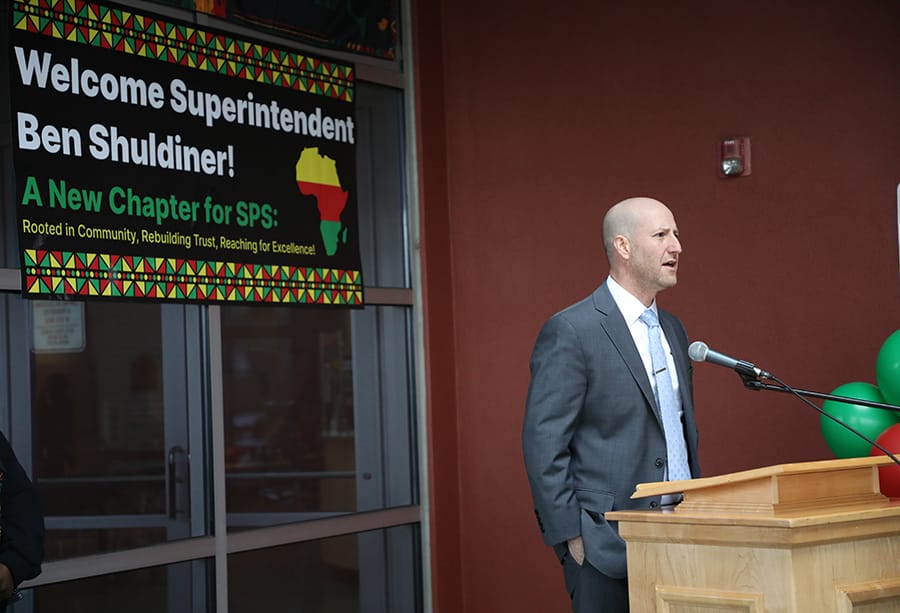
Ben Shuldiner started his job as SPS superintendent on Sunday and immediately sent out his first message to families. He was clear, direct, and interacted with the public like we were intelligent people who can be trusted to understand the issues and come to reasonable conclusions about them:
I will always put the students first. My role is first and foremost to serve the 50,000 children that wake up every day and attend our schools. It is they whom I work for.
I will be present. As superintendent, I will show up. I will be with you whenever and wherever you need. I am of service and that means being alongside each and every one of you.
I will disappoint you. There will be times when I make decisions that some of you won't like. Sometimes we must act when not everyone is in favor, but you will always have a rationale from me. Nothing I do will be without explanation.
It’s a stark contrast with the condescending, top-down way SPS leaders have communicated to the public for years, treating parents like enemies who could not possibly understand or give meaningful input on district issues.
Shuldiner doubled down on his promise “to be present” a day later, emailing families to invite them to in-person community meetings in each of the seven school board director districts. “Your voice should lead to action,” Shuldiner said, words that were never uttered by Brent Jones, Denise Juneau or any Superintendent in recent memory.
All of this is normal practice for most school superintendents, including in large districts here in the Puget Sound. But it’s become unusual in SPS.
Many current SPS parents weren’t in the district in the 2010s when Superintendents regularly met with the public, sent weekly email updates to families, and treated the public like their opinions mattered. That began to change under Denise Juneau, who did not regularly interact with or cultivate the public (and paid for it when she had no public support to turn to when the school board refused to renew her contract in 2021).
Jones ended the weekly “Friday memos” that Superintendents used to regularly send, and rarely interacted with the public. His administration dismissed public input, though to be fair, so too did most school board members at the time. Under Student Outcomes Focused Governance, public input was discounted. Community members had to become loud, squeaky wheels in order to have concerns addressed.
Shuldiner is promising a different, better approach, and that is to be welcomed. But this isn’t just about keeping the public happy. Shuldiner faces urgent problems to solve as Superintendent, and will not be able to do so without restoring public trust in district leadership. It’s not that the trust has weakened or faded. That trust is simply gone, and must be rebuilt from scratch.
Tackling the Budget and Academics
Shuldiner takes office needing to rebuild trust in order to tackle several urgent priorities. The three that stand out in his first week are the district’s budget, student academics, and student safety.
SPS’s fiscal needs are going to absorb the bulk of Shuldiner’s time, especially in his first months as the 2026-27 budget is crafted. (Schools are already assembling their budgets based on projections given to them by the Central Office.)
Shuldiner will have to work with the public and the board to address the district’s budget deficit, caused by the ongoing refusal of state legislators to amply fund public schools as is required by the state constitution.
In response to questions about his financial plans at his Monday press conference, Shuldiner said “I don’t think initially you’re going to see any (changes/cuts) large scale.”
Community members have already shared their in-depth analysis of the SPS budget with Shuldiner as he prepared to take office, including the excellent work of Albert Wong.
It’s still unclear whether Shuldiner would yield to the persistent efforts of some board directors and senior admins who still want to close schools, but his comments this week suggest he recognizes closures would not be a smart way to start off his time as Superintendent.
The public has also clamored for huge changes to how SPS is run, particularly in the Central Office. Senior administrators have earned a reputation for arrogance and condescension when interacting with families, students, and educators. Shuldiner has already heard from many people that he needs to “clean house” and fire or move out of the Central Office most of the senior leadership.
Shuldiner made no explicit promises in his public remarks, but his stated values suggest a fundamentally different approach to district leadership. He told KUOW “it’s more important for us to support the people in the classroom than for us to be supporting the people in the central office.”
The new superintendent will also have to tackle the district’s academic needs. After years of abysmal test scores, and threats to close K-8 and option schools, families are demanding a return to academic excellence and diversified offerings. Hopes are that SPS will shift away from the “one size fits all” approach of low standards and hostility to student success that characterized the last several years in SPS.
Parents hope that Shuldiner will follow in the successful footsteps of neighboring districts such as Bellevue and grow enrollment by offering different kinds of course offerings, more dual language programs, and welcoming rather than belittling highly capable programs.
In interviews just after he was hired, Shuldiner suggested he might pursue that course. “We made our schools better,” he told Tracy Record of the West Seattle Blog in describing his strategy to grow enrollment in Lansing. He expanded K-8 offerings, and had a philosophy of “You increase enrollment because people want to come to our schools.”
Shuldiner Addresses Student Safety
While the budget, enrollment, and student learning will be his largest long-term tasks, student safety is an immediate challenge. Two students were shot and killed at a bus stop near Rainier Beach High School on Friday, and Shuldiner has been very prominent and vocal in his response, showing up in the community and pledging to address public concerns.
In his Sunday message, Shuldiner acknowledged the shootings and the need to act to protect student safety:
“But if today is the day to mourn, tomorrow must be the day for us all to come together and act....
The question, of course, is how. How can we help to address this issue? This question, I will ask to you. I am open for ideas. I am open to conversation. I am open to anything we can do to stop one more child from dying. Please feel free to email me at boshuldiner@seattleschools.org. I know that together, we will be able to move forward.
So again, today we mourn. We mourn for our fallen family members. And tomorrow, we act to help stop this from happening again.”
Shuldiner also conducted several media interviews and held a Monday press conference. Understandably, student safety was a prominent topic. Here’s some of what Shuldiner said:
- “Shuldiner detailed plans for improved physical security, including single-point entry systems, enhanced fencing and camera installations at schools. But he emphasized that safety extends beyond infrastructure, calling for community partnerships to protect students at bus stops and other vulnerable locations,” according to King 5.
- Seattle should “consider” installing metal detectors in high schools, Shuldiner told KUOW, as his previous district in Lansing, Michigan has done.
- Shuldiner is “not sold” on bringing armed officers back onto SPS campuses, he also told KUOW, saying “there’s not necessarily as much of a need” for it. He does support having unarmed officers on campus, with extensive training and without having the power to make an arrest on campus. However, this still leaves open the question of exactly what he envisions these officers doing.
One of the challenges SPS faces is that recent shootings have happened close to, but not inside, school buildings. Amarr Murphy-Paine was shot and killed outside the Garfield High School building, and the two students killed on Friday were shot at a bus stop.
As community members have said and Shuldiner himself has noted, safety is going to require more than just changes on campus. It’s going to take the community coming together to work with SPS, SPD, the City, and local organizations to address student safety off campus as well.
A Hopeful Start
In his Sunday message, Shuldiner acknowledged the loss of trust and need to rebuild it:
“And with that, I hope I can ask you all to try to see any decision we as a district make with positive intent. I appreciate that I am brand new to Seattle and have not been here long enough to earn your trust. So, it is a big ask of me, and I understand that. Hopefully, as we get to know each other, I will begin to be worthy of that trust. And the best way I know to build trust is to address difficult situations honestly, openly, and clearly.”
That’s a good sign that Shuldiner gets it. But the results will be what matter to the families, students, educators, and wider community.
Shuldiner will need to treat the public as full partners in the work ahead, creating solutions together and collaborating as much as possible. We here at The Bulletin are hopeful that he’ll be a strong ally with families, educators, and students in building a better future for all our kids.