Issue 17 -- School Board Budget Work Sessions
Ben Shuldiner previews a new approach for SPS budgeting: direct, honest competence.
Watch: January 28 meeting and February 4 meeting
Read: Transcript of January 28 meeting and Transcript of February 4 meeting
Agenda: January 28, February 4
Summary: Seattle Public Schools recently held two budget work sessions, marking a philosophical shift from years of deficit-focused cutting to strategic, goal-aligned investing—though the presentations were often too vague to be truly informative.
The district faces an $87 million projected deficit for 2026-27, offset somewhat by a $97 million fund balance that leadership wants to protect and eventually grow. New Superintendent Ben Shuldiner, just four days on the job, delivered a blunt reality check: no new spending, focus on attrition over layoffs, and a fundamental reorientation of the budget to fund schools first and central office second.
A major wildcard is the city's FEPP levy, which funds nearly 100 critical school positions that SPS cannot replace if the city doesn't renew the funding—something five senior staffers struggled to address before Shuldiner bluntly acknowledged it as a "sword of Damocles." Potential cuts include athletics, transportation, and central office restructuring, while class size increases and school closures remain off the table.
Directors pushed for bigger systemic solutions, better transparency on the fund balance, and deeper analysis of whether the district's heavy investment in professional development is actually working.
In this issue:
- Budget Presentation
- The FEPP Levy
- The $87 Million Deficit
- Potential Cuts Under Consideration
- A New Superintendent Weighs In
- Board Reactions
- What's Next
Budget Presentation
Seattle Public Schools presented a dramatically different approach to budget planning at back-to-back work sessions on January 28th and February 4th, as senior staff attempted to shift focus from deficit cutting to strategic investments.
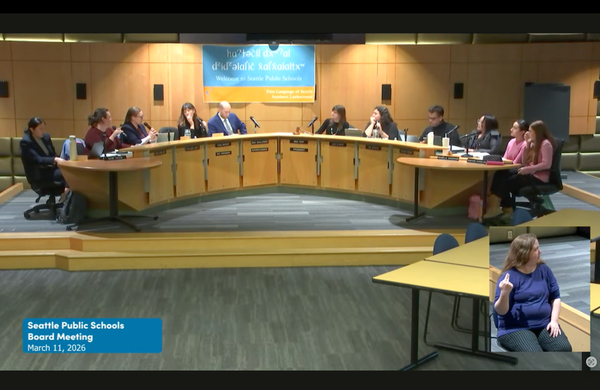
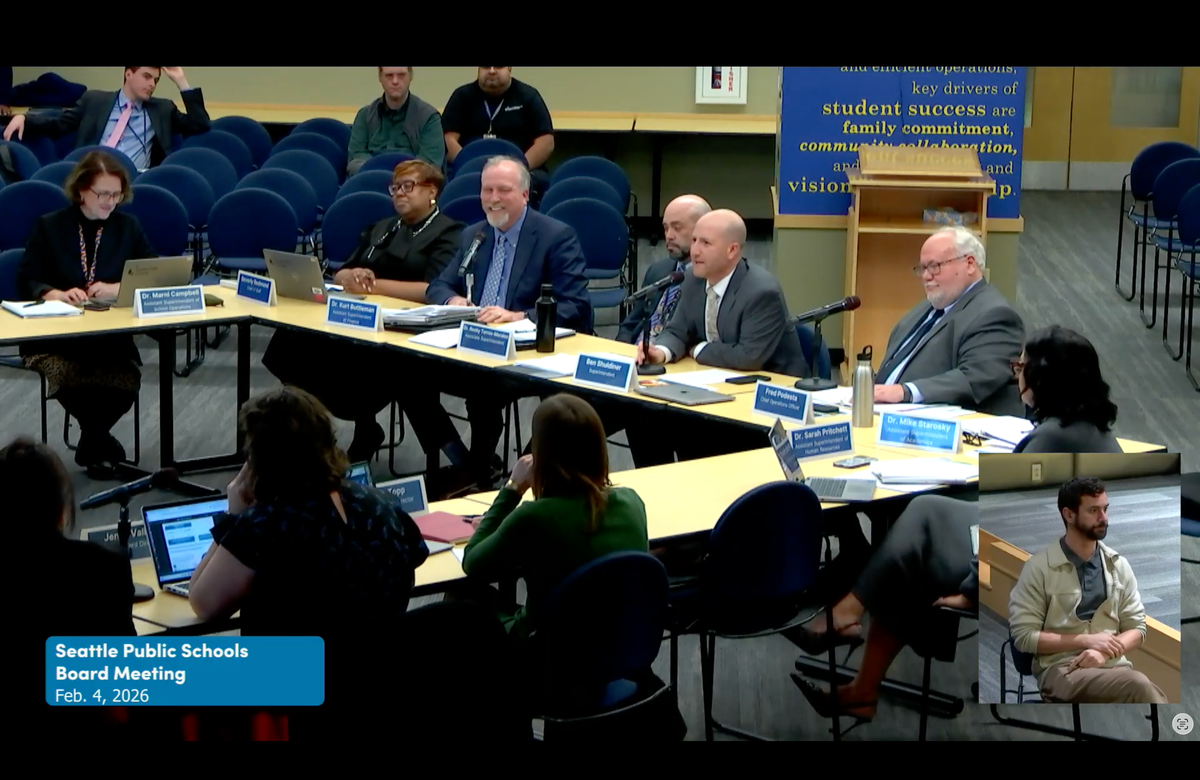
The January 28th session, led by Fred Podesta during his last week as interim superintendent, emphasized aligning spending with district goals. Just four days into his tenure, the February 4th session featured newly hired Superintendent Ben Shuldiner, who delivered both blunt truths and high aspirations about the district's financial future.
Interim Superintendent Fred Podesta acknowledged the shift in focus upfront, as he explained that their past practice has been, “we spend 100% of the time talking about 6% of the budget," because senior staff would focus only on the cuts — and not the investments — to be made.
After the school board had made clear last summer this approach wasn't working, Podesta and senior staff decided to center their presentation on the draft strategic plan. At the January 28th meeting, they tied proposed investments to three goals: improving second-grade reading, boosting sixth-grade math performance, and increasing high school graduation and college readiness.
As Podesta explained, the presentation was intentionally high level, because he wanted incoming Superintendent Shuldiner to weigh in before presenting a formal budget proposal to the board.
The “strategic investments” outlined are familiar to any district watchers: updated literacy and math curricula, expansion of prekindergarten and summer school, and support for high school graduation pathways. The "foundational investments" they listed were overly broad. For example, for the second-grade reading goal they noted that they were investing in K-2 teachers at every elementary school, which, frankly, seems both obvious and insufficient..
Director Kathleen Smith noted the presentation still felt "a little vague," particularly around how the investments detailed would differ from current spending (after all, there are already K-2 teachers at every elementary school).
The FEPP Levy
Director Vivian Song identified a critical flaw: many of the “strategic investments” staff identified are actually funded by the city's The Families, Education, Preschool, and Promise (FEPP) levy—money that SPS does not control. This includes an early childhood education expansion and school-based investments at 35 priority schools, which pays for critical positions such as reading and math interventionists and family support workers. The City’s Department of Education and Early Learning (DEEL) has invested an average of $16.4 million annually, with $115 million FEPP Levy funds allocated over the last 7 years.
The reality is that SPS doesn't control how FEPP money is spent, the city does.
In response to Song’s comments, five staffers—Podesta, Assistant Superintendent of Finance Kurt Buttleman, Associate Superintendent Rocky Torres-Morales, Accountability Officer Ted Howard, and Assistant Superintendent of Academics Mike Starosky—struggled to answer what would happen if these positions go unfunded.
A week later, at the February 5 meeting, Superintendent Ben Shuldiner not only acknowledged that the potential loss of this funding would be huge, but leveraged a mythological reference to drive the point home. “Everybody knows that there's something called DEEL and the FEPP levy” and compared the loss of that funding to a “sword of Damocles over our heads.”
Unlike the senior staffers the previous week, Shuldiner acknowledged that if the city doesn't renew the funding for those positions, the district can't backfill those dollars—they’d simply lose that revenue. A city council vote on the FEPP funding plan is expected in spring, so all city investments are still TBD.
The $87 Million Deficit
As for hard numbers, Buttleman explained that SPS faces a projected $87 million deficit for 2026-27.
The projected deficit, as presented, has a lot of padding built in. For example, there’s been a Central Office hiring freeze since 2023, but they still include the costs of those unfilled positions in the budget. It’s unclear how much those positions are budgeted for, but Shuldiner mentioned this as one obvious “cut” and said the number was “pretty significant.”
There’s also a $97 million fund balance that can help plug the deficit, though, as Buttleman explained, they don’t want to erode that fund balance to zero. In fact, Shuldiner said that he hopes that over the next five years, SPS can build a sustainable fund balance of around 10%.
And so cuts are still on the table. “Let's just get out of the hole first, and then we can start to dream,” Shuldiner said.
Potential Cuts Under Consideration
Here are some budget cuts senior staff proposed, many of which are the same cuts that get suggested year after year, such as returning to three-tier bell times and charging high school students to play sports. The school board has already said no to these cuts for several years running.
It would be nice to see staff research and propose new financial efficiencies instead of trotting out the same ideas every year.
All of that said, here’s their list of possible cuts.
Teaching and Support: Save up to $10 million by restructuring to prioritize direct student services, possible elimination of half-time academic interventionists at high schools, different administrative structures at non-comprehensive high schools.
Central Office: Senior leadership reductions targeting $1.5 million, continued hiring freeze for non-represented positions, organizational restructuring.
Compensation: Continuation of two furlough days for non-represented staff ($587,000), ongoing vacation cash-out suspension ($660,000), reduction of some year-round positions to 223-days (TBD) or a general reduction of FTE within departments (TBD).
Athletics: The most controversial option—reductions saving $2.6 million, possibly eliminating middle school sports (serving 6,300+ students), introducing pay-to-play fees, or reducing high school sports offerings. Data shows students in athletics have higher GPAs and better attendance.
Transportation: Return to three-tier bell times, consolidating to one bus vendor, assigning more special education students to general education buses, totaling up to $13 million in savings.
The following cuts are off the table: class size increases, reducing schools' discretionary funding, school closures, transportation cuts to option schools, across-the-board salary reductions.
A New Superintendent Weighs In
Superintendent Shuldiner acknowledged that the district is in a difficult financial situation.
"Every single person who has come to me in the last four days asking for more money—that is not happening," he said. "It's going to be the opposite."
Shuldiner shared some of the financial inefficiencies he had observed during school visits that week: a classroom with one child that was staffed by two adults, a school building with an entire unused wing, and another school that is paying for rented space despite the district having tons of unused space.
"That can't possibly be okay," Shuldiner said. "Is that the right way to use the money we have to support the 50,000 children that we are to serve? Clearly the answer is no."
Shuldiner proposed a fundamental change: Starting with what schools need, then allocating whatever remains to the Central Office.
He acknowledged the approach "is gonna suck, and it's gonna be really hard, but if we are gonna put kids first, that's kind of what we need to do."
Shuldiner said there are some inefficiencies in terms of departmental structure and staffing and that he hopes there will be attrition rather than layoffs. He says that with approximately 5% annual turnover among 9,000-plus employees, not backfilling hundreds of positions at roughly $100,000 each could generate significant savings.
Shuldiner expects this process will take about two years.
Podesta also clarified the hiring freeze since 2023 hasn't been arbitrary—each vacant position is evaluated for strategic priority. Many positions that have remained unfilled for three years are still in the budget. Permanently eliminating them creates savings without affecting current employees.
Board Reactions
Director Liza Rankin praised the philosophical shift: "We've focused on 6% of the budget and doing the least harm to the status quo… But the baseline foundation doesn't seem to be working." She said that the deficit-focused approach created "a sense of scarcity" where everyone feared what would be taken away.
Director Mizrahi appreciated the strategic presentation but noted that the proposed cuts—which will directly affect families, students, and low-wage workers— just “chip away around the edges of a really big problem.”
"How do we get to those big systemic solutions?" he asked the senior staff.
Director Song questioned whether the plan addresses the Weighted Staffing Standards formula, which determines how many staff are assigned to schools: "Without examining our WSS, in a sense it is maintaining the status quo."
She also requested deeper analysis of professional development spending: "Professional development is actually a pretty large dollar amount." Her comment carried extra weight given that many of the district's strategic proposals—from the new literacy curriculum to math interventions to high school readiness—ultimately boiled down to additional professional development for teachers and staff.
What's Next
Budget discussions continue throughout winter and spring. Shudliner said there would be an organizational meeting at the end of February that will examine the org chart and FTE (full-time equivalent positions) decisions. The public hearing for the budget will be July 1st, with final adoption in August.
After years of budget crises and incremental cuts, Seattle Public Schools finally has a superintendent willing to ask hard questions about resource allocation and challenge the status quo. Shuldiner's commitment to building the budget from the ground up—schools first, central office second—signals a genuine shift in how the district approaches its finances. If he can deliver on that two-year timeline while protecting classrooms, Seattle's students may finally get the stable, well-resourced district they deserve.