Issue 18 -- February 11, 2026 School Board Meeting Recap
The board re-establishes standing committees, weighs changes to the student assignment transition plan and to financial thresholds triggering board review, and hears public testimony on highly capable programs, ethnic studies at SPS, and student safety.
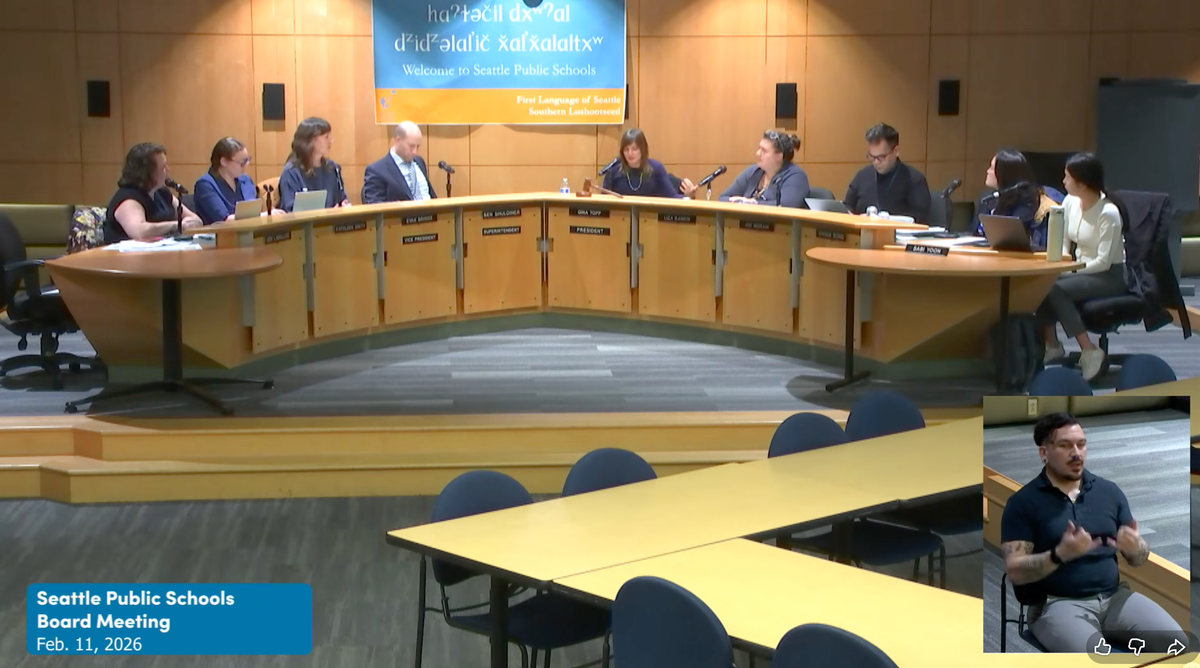
Watch: YouTube video
Read: Transcript (includes video and text)
Agenda & meeting materials: (SPS website)
In this issue:
- Highlights (A 3-Minute Meeting Summary)
- Opening Business (Board Comments & Liaison Reports)
- Public Testimony
- Consent Agenda & Discussion of Gersh Academy Contract
- Action Items
- Amendments to School Board Student Member Policy
- The Board Re-Establishes Committees
- Introduction Items
- Student Assignment Transition Plan
- Proposed Changes to Financial Thresholds That Trigger Board Review
Highlights (A 3-Minute Meeting Summary)
Public testimony themes: Testifiers appealed for a new HC cohort site at Rainier View Elementary; requested changes and/or reversions to the new HC eligibility requirements; called for ethnic studies to be integrated through the SPS curriculum; and pleaded for a student safety plan in the wake of several incidents of recent gun violence near SPS campuses.
Board votes: The board passed two votes, both unanimously.
The first vote updated the policy governing student board directors (now called student representatives), and increased the number of student representatives to four, from three.
The second vote established three new standing committees (Finance and Audit, Policy, and Operations). An amendment to the proposed committees, limiting their scope and longevity, was discussed and then withdrawn. Its contents will soon be taken up by the newly-established Policy committee.
Introduction (discussion) items: The board discussed two items, which will be voted upon at a future meeting.
The first item, the Student Transition Plan, proposes several changes including revised highly capable (HC) eligibility rules; the creation of two new HC elementary cohort sites; and more flexibility in the number of students who can enroll in a choice school. There was some uncertainty during the meeting about whether the plan for creating the two new HC sites is contingent on superintendent approval, or whether it requires a board vote.
The second item discussed was a proposal to change the dollar thresholds that trigger a board review. For incoming dollars (grants, gifts, etc.) the threshold would increase to $500,000 from the current $250,000. For outgoing dollars (contracts, etc.) the threshold would decrease to $500,000 from the current $1 million. The proposal is intended to help board directors better understand where district money is spent.
Opening Business (Board Comments & Liaison Reports)
In Superintendent Ben Shuldiner’s opening comments at his first regular board meeting, he acknowledged the heartbreaking loss of two SPS students two weeks ago, before moving on to a more upbeat tone.
He noted that Seattle is an amazing city, and shared that he thinks that rumors of SPS not being amazing have been greatly exaggerated. He shared a few stories from the 20 schools he has visited in his 11 days on the job, emphasized the reality of a budget deficit to address, and gave shout-outs to union representatives and staff in attendance for their work.
Liaison Reports
The board moved through liaison reports quickly, with brief updates on the FEPP levy K-12 money; the Council of Great City Schools relationship; and a legislative update.
FEPP Levy (Director Joe Mizrahi)
The Families, Education, Preschool, and Promise (FEPP) levy is a city tax renewed by Seattle voters in 2025. Among other things, it provides $235 million over 7 years for K-12 health and safety. There are about 100 positions at SPS that are currently funded using these city dollars, and which SPS would not be able to afford to backfill if the city decided to reallocate the levy money for a different K-12 use.
Director Mizrahi said he is working with the City Council and the Mayor’s Office to determine how to best use these funds. He said there is talk of keeping the allocations stable for the coming year, as a transition year, as they figure out how to possibly evolve use for years 2-6 of the levy’s term. Parents at the impacted schools, along with All Together for Seattle Schools, have been urging the City to keep those allocations stable for at least another year.
Council of Great City Schools (Director Liza Rankin)
Director Rankin announced that she will be attending the policy and legislative conference of the Council of Great City Schools in March, and that she’s been in touch with other members exchanging policy and strategy ideas.
Legislative Update (Director Vivian Song)
Director Song highlighted five bills she is tracking that are of greatest potential impact to SPS:
- HB 2160 / SB 5883: These are unfunded mandates that add benefits for substitutes. Song noted that substitute compensation is already a large source of deficit spending for SPS; these bills would increase the deficit.
- HB 2257: This amendment excludes K-12 schools from the new sales tax imposed last year on services including IT, and special education staffing. Song said the new tax is costing SPS about $7M this year, meaning that savings from the exemption would be significant.
- SB 5918: Materials, supplies, and operating costs (MSOC). This bill increases basic state funding for school operations, but it is stalled in committee. It is unlikely to pass this session unless it moves out of committee soon.
- SB 5858: Relating to school transportation funding, this bill is stalled in committee as well. Transportation is one of the areas where the SPS spending most outpaces its income. In a Jan 28 budget review with the board, staff noted that in 2024-25 SPS spent about $20 million more on transportation than was granted by the state for that purpose.
- SB 6260: Nicknamed the “efficiencies bill,” Song noted that this proposal takes some of the K-12 funding increases approved last year and allocates them to the Office of the Superintendent of Public Instruction (OSPI). If passed, the income gains seen at the district level would be diminished.
Public Testimony
Several themes emerged from the full slate of public testimony on Wednesday, including:
- HC cohort at Rainier View
Several testifiers spoke in support of the Jan 26 staff proposal to create a new Highly Capable (HC) cohort site at Rainier View Elementary. Discussion later in the evening made it clear that staff is moving forward with this plan.
- HC eligibility & site changes
A handful of additional testifiers advocated for HC program changes. Some asked for reviews or rewinds of the HC program’s new eligibility rules; others advocated for HC services at all neighborhood schools. Two more spoke to the difficulties facing “twice exceptional” students, who must often choose between a school site that can serve their HC needs versus one that can meet their special education needs.
- Ethnic and/or Black studies at SPS
A group of speakers advocated for ethnic and/or Black studies in all grade levels at SPS, supporting each other’s testimonies as a group, including signage. The cohort included several student speakers from the NAACP Youth Council. They cited personal experiences feeling misunderstood and alienated, and called on SPS to back its equity-minded words with action.
Michelle Sarju, who was an SPS board member until her term ended last fall, voiced her support for this cohort’s proposal and critiques in the second half of her testimony. Her primary testimony related to welcoming Superintendent Shuldiner, whose hiring process she helped oversee.
- Student safety & gun violence
Several speakers referenced incidents of traumatic gun violence in their communities, asking what SPS is planning to do to increase safety. One speaker recounted two separate incidents in which her daughter had to react, in her elementary school, to the sounds of nearby gunshots; several more spoke to the situation on the ground before & since last week’s tragic shootings outside Rainier Beach high school, asking for help from SPS and for the community to be involved in safety plans moving forward.
Consent Agenda & Discussion of Gersh Academy Contract
Director Vivian Song requested that one item, a Gersh Academy contract amendment, be pulled from the consent agenda for separate discussion.
The remaining consent agenda items were passed unanimously. Items included the usual minutes from recent meetings, personnel report, and warrants for payment. The passed agenda also included a contract for sidewalk and landscaping work at Roosevelt High School.
The Gersh Academy amendment that was reviewed separately was added to the consent agenda in the first place because it increases the total Gersh contract amount by roughly $150,000, to around $1.1 million. Contracts exceeding a total of $1 million require a board vote.
The contract increase accommodates one new SPS student who has been identified as qualifying for Gersh Academy services, supporting students with autism. SPS uses non-public agency (NPA) placements to provide services for students with exceptionally high needs that the district cannot support in house.
When asked about the finances of the Gersh arrangement, Executive Director of Special Education and Inclusion Devon Gurley explained that SPS receives Safety Net funding from the state. Safety Net funding covers expenses exceeding 2x the cost of educating an average general education student.
For SPS, this means that Safety Net funding kicks in at $38,000 in expenses, leaving SPS to cover the $19,000 gap between what the state provides for every student and where Safety Net coverage begins.
Action Items
Action Item 1: Amendments to School Board Student Member Policy (Policy 1250)
The board unanimously approved updates to the policy governing student representatives (previously called student directors), as introduced in the Jan 21 board meeting. Before the vote, student director Yoon thanked the NAACP youth council for their work in creating and evolving the student roles.
Key changes include:
- Expansion of student representative seats from three to four.
- An appointment process that selects two high school juniors annually, to serve in two-year terms. Once this process is established, the board at any given time will comprise two juniors serving the first year of their term, and two seniors serving their second year.
- Renaming of the role to “student representative” to better reflect the non-voting, advisory nature of the role.
- Establishment of advisory votes of ‘pro’, ‘con’, or ‘no position’ to be solicited from student representatives in advance of each board vote. Before this change, the student representatives could participate in board discussions but were not consulted during votes.
Action Item 2: The Board Re-Establishes Committees (Policy 1240)
A unanimous board vote passed the proposed amendment to board policy 1240, thereby establishing three standing committees: Finance and Audit, Policy, and Operations.
The existence of committees has been a source of tension among board members in recent years. Historically, the SPS board had operated using an array of committees, including Audit & Finance, Executive, Curriculum & Instruction, and Operations. Committees allow a subset of board members to dig deeply into specific lanes of district oversight, bringing context and expertise back to full-board votes.
In an October 2022 meeting, as part of the shift to the School Outcomes Focused Governance (SOFG) framework, the board suspended all standing committees except Audit. They made this change permanent the following year. Critics of SOFG argue that the framework, including a lack of committees, has hamstrung the school board by eliminating their ability to influence or even understand important district decisions.
The tensions between board members who see committees as a useful way to provide oversight, and those who view them as a distraction, are likely to continue.
In a last-minute move, Director Rankin had introduced a proposed amendment-to-the-amendment the day before the vote, including changes that would have weakened both the scope and longevity of the committees.
This amendment-to-the-amendment generated intense public opposition, with board members reporting being flooded with dozens of emails against it. After discussion with fellow board directors, Rankin withdrew the amendment.
Many of the changes in Director Rankin’s proposed amendment are likely to be brought before the newly-created Policy Committee. Indeed, this is what the policy committee is for, as President Topp pointed out.
The key changes in Rankin’s withdrawn amendment included:
- Shifting the standing committees into committees established “when needed,” and requiring renewal every 2 years.
- Eliminating the language that grants the board president the power to appoint board members to committees.
- Removing the ability for board committee members to interact with district staff (e.g. to ask for information) unless specifically given that authority by the board.
- Renaming the Operations committee to the Capital and Facilities committee and refocusing its purpose to long-term facilities planning, versus the more general “operations.”
- Removing the board president’s authority to establish ad hoc committees, instead requiring a vote of the full board.
President Topp asked her fellow board members to express their committee preferences to her within two days, so that the committees can get staffed and running ASAP.
Introduction Items
These are topics that the board will vote on at a later date, and are introduced in a discussion-only capacity in the current meeting.
Student Assignment Transition Plan
The board continued the discussion that began at the Jan 21 meeting, relating to updated HC eligibility, the establishment of two new HC cohort sites in South and West Seattle, and updated processes for option school enrollment.
Confusingly, a board vote on the student assignment transition plan is scheduled for March, but Chief Operating Officer Fred Podesta and Assistant Superintendent of School Operations Marni Campbell both acknowledged that much of the content has already been implemented.
This begs the question: What does a board vote mean, in this case? [Author’s note: I have the same question about other items that often appear before the board, including the Personnel Report that appears regularly on the consent agenda, for example.]
There appeared to be particular confusion among staff about whether moving forward on establishing the two new HC cohort sites is contingent on superintendent approval, or on a vote from the board. Though the question wasn’t resolved during the meeting, it was clearly resolved shortly thereafter, as parents in South and West Seattle received email from SPS the next day announcing the creation of the new HC cohort sites, along with a link to a form to apply for their HC-identified student to attend.
Director questions repeated many of the same themes as in the last discussion, indicating that previous answers were insufficient. They probed at the enrollment process for MLL students, including whether families were getting sufficient help to understand the dual language options available to them; they expressed frustration that the proposal doesn’t outline clear pathways for HC students, which is creating confusion among the community; and they wondered again about the longevity of the plans for the new HC sites and about the reasoning behind the selection of these two sites specifically.
Superintended Shuldiner joined the discussion near the end, acknowledging that the current proposal is imperfect but indicating that he’d prefer to see how it works and adjust as necessary. He closed diplomatically, saying, “I think we have to admit that this was done quickly—perhaps even hastily—but with the best intentions of doing what the board and community wanted.”
Proposed Changes to Financial Thresholds That Trigger Board Review
The board discussed an amendment brought by Director Song, which if passed would change the dollar thresholds that trigger a board review for money going both in and out of the district.
The amendment to board policy 6114 (Gifts, Grants, Donations, and Fundraising Proceeds) would require a board review of all incoming gifts, grants, etc. exceeding $500,000. Previously, the threshold triggering board review was $250,000.
The amendment to board policy 6220 (Procurement) would lower the dollar amount requiring board review for outgoing funds down to $500,000 from the previous threshold of $1 million. Assistant Superintendent of Finance Kurt Buttleman noted that this change would have triggered review for approximately 50 additional contracts in the past year. He noted that many of these are related to construction projects.
During discussion, directors debated the merits of various limits. Director Mizrahi noted, amused, “I like that we’re making it easier to give us money and harder for us to spend money. That seems like the right balance for a district that has financial issues.”
Several directors also had questions relating to the process of contract review in general, which are likely to be taken up in the newly created Finance Committee.