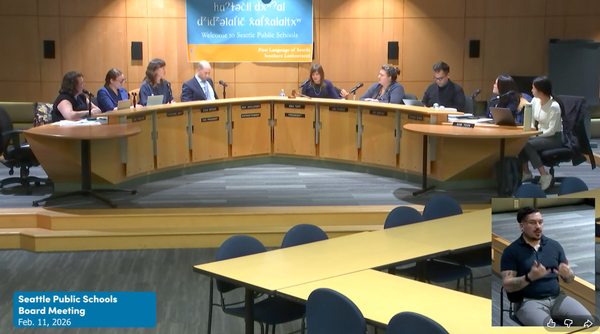
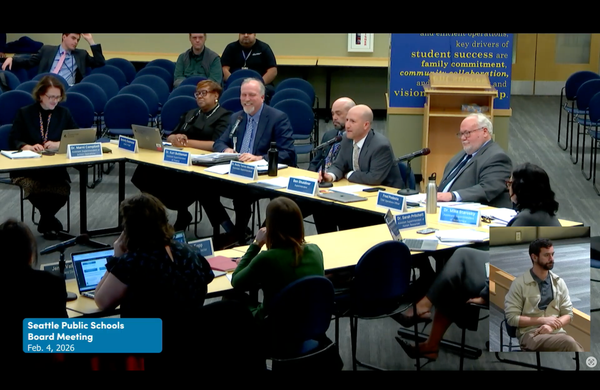
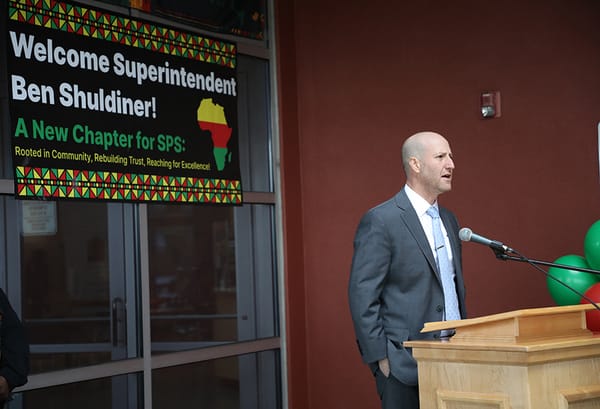
Issue 20 -- March 11, 2026 School Board Meeting Recap
The board discussed their frustrations with the Student Assignment Transition Plan rollout; lowered the threshold for board approval of outgoing payments but not incoming grants; and hears public testimony pleading for increased staff allocations at several alternative learning sites.
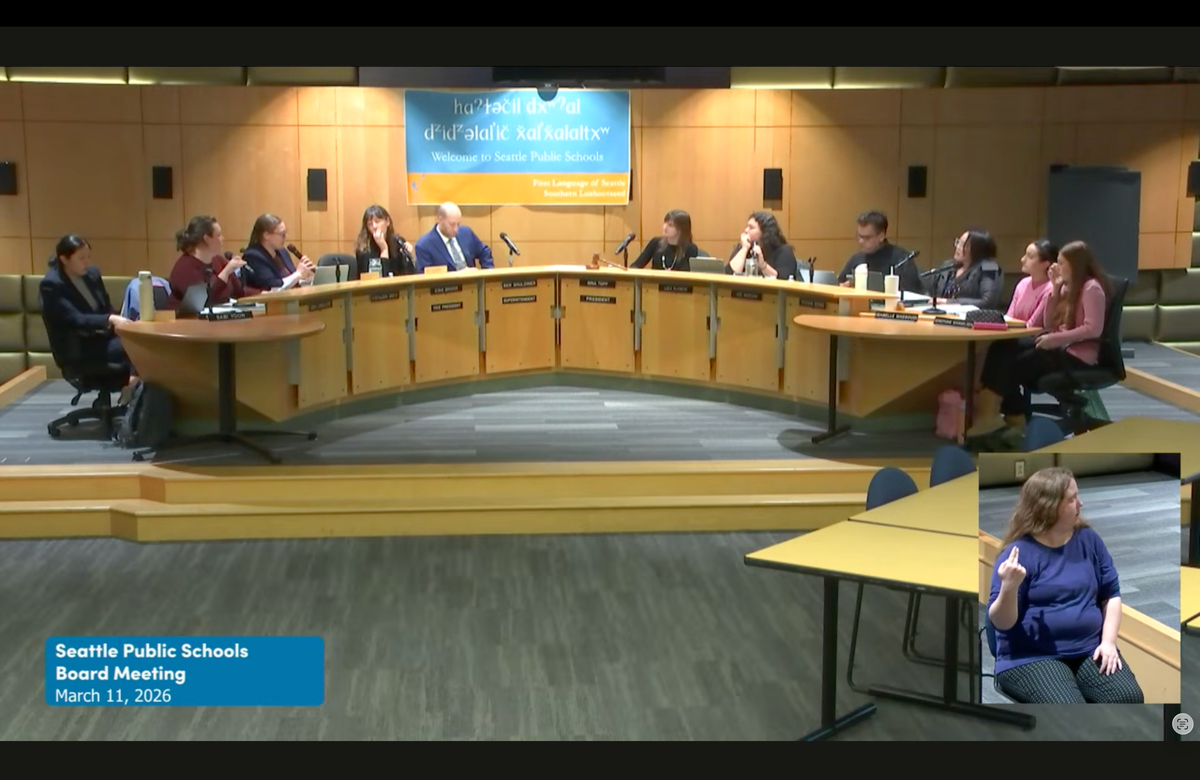
Watch: (YouTube)
Read: Transcript (includes video & text)
Agenda & meeting materials: (SPS website)
In this issue:
- Highlights (A 3-Minute Meeting Summary)
- Opening Business (Board Comments & Committee/Liaison Reports)
- Public Testimony
- Contentious Board Votes
- Unanimous Board Votes
- Introduction Items (Postponed to March 18)
Highlights (A 3-Minute Meeting Summary)
Wednesday’s meeting included three standout items: an unusually focused set of public testimonies and two contentious board votes that took nearly an hour each.
Seventeen of the twenty-five available testimony slots were taken by people asking for increased staffing allocations. The 2026-27 allocations went out last week, and alternative programs like Interagency and Cascade Parent Partnership are set to lose a surprising number of staff. Parents from both schools turned out in force to lobby for help, sharing heart-wrenching personal stories about the importance of their school and its staff to their families.
The first contentious board vote related to the Student Assignment Transition Plan (SATP). The district has already implemented changes in the proposed SATP, such as increased flexibility in choice school admissions for next year. The SATP also directs some significant but underspecified changes to the Highly Capable (HC) program—namely, the establishing of two new HC sites.
Directors were confused about what it means to cast a single ‘yes’ or ‘no’ vote on such a complex item. Everyone at the dais was confused about what to do, and they explored many dead-end options. Finally, the board passed the full item in a 5-2 vote, along with an amendment sending it to committee to ensure that a situation like this does not repeat.
The second sticky board vote was divided for more philosophical reasons. The board debated a two-part proposal that would update the dollar thresholds requiring a board vote for monies coming both in and out of the district.
The part of the proposal that decreased the threshold for board approval of payments, from $1 million to $500,000, was not particularly controversial, and it passed 5-2.
The second part of the proposal, raising the threshold for board approval of incoming grants/gifts from $250,000 to $500,000, was controversial and generated nearly an hour of discussion. This part was amended out of the original proposal in a 4-3 vote, and thus was not adopted into policy.
Advocates for raising the grants threshold argued that it is backward for money coming into the district to receive more scrutiny than money going out. Detractors argued that the lower threshold is required to ensure appropriate financial oversight.
Opening Business (Board Comments & Committee/Liaison Reports)
The meeting opened with both Board President Gina Topp and Superintendent Ben Shuldiner congratulating two SPS sports teams: the Rainier Beach High School boys basketball team, who recently won their second state championship in a row; and the Roosevelt High School girls basketball team, who made it to the state semifinals, placing third, in an outstanding season.
Superintendent Shuldiner then set the tone for the rest of the meeting by thanking the people present in the audience—many of whom were about to testify about staffing cuts—and acknowledging that difficult budget decisions, especially staffing ones, were recently sent out to schools.
Student representative reports and liaison/committee reports were extremely brief.
Public Testimony
With one exception, all of the public testimony fell under one of two themes: differing opinions on a policy related to grants acceptance and people upset at decreased staffing allocations for the 2026-27 school year. The one testifier who escaped categorization cheered for libraries and brought small, personalized gifts for the board.
Differing Opinions on Grant Policy
The board’s agenda for the night included a vote on an amendment that would increase the dollar threshold of a grant triggering a board vote, from the current $250,000 up to $500,000.
Four testifiers lobbied against the passage of this amendment. They mentioned equity concerns, claiming that schools with wealthy PTAs can buy their way out of staffing shortages, while less wealthy schools cannot.
A fifth speaker argued in favor of the grants threshold change, noting that her school’s PTSA uses its funds to pay for a full-time counselor, who is helping the students who are furthest from vital services. She noted that this PTA-funded position strengthens equity within her school.
Opposition to Staffing Decreases for 2026-27
In late February, SPS released the 2026-27 staffing allocations for schools across the district, leaving some schools with significantly fewer staff than they’ve had in the past. The estimated savings of the overall allocation reductions is $9.5 million, as discussed at last week’s special board meeting (slide deck here).
One testifier spoke out against the reductions overall, while the remaining speakers were asking for increased allocations at two specific schools. This speaker cited the harms of breaking trusted student-teacher relationships and pointed out that these harms fall disproportionately onto already vulnerable populations.
Cascade Parent Partnership Allocations
A whopping fourteen testifiers turned out to plead for increased staffing at Cascade Parent Partnership (CPP). They lobbied as a group, with a large community of youth and adults standing behind each speaker, holding signs.
CPP is an Alternative Learning Experience school, supporting a variety of students who have experienced significant difficulties in more traditional learning environments. Many of the speakers told stories of children with serious mental health struggles or physical disabilities that make learning in a traditional neighborhood school impossible. They called CPP a “lifeline,” “lifeboat,” “last resort,” “our only home in SPS,” “our safe space,” and more.
According to several testimonies, Superintendent Shulidiner had already granted a mitigation of 2.0 FTE a few days prior to the board meeting—that is, he granted an additional two full-time teachers to the school, on top of the allocations assigned by the staffing formulas. Several speakers thanked him for that, but all insisted that it was still not enough.
Interagency Academy Allocations
Three testifiers requested increases to 2026-27 staff allocations at Interagency Academy, which they said is set to lose an eye-popping seventeen staff members next year. Like the CPP cohort, members of this group also testified against a backdrop of students and adults from their community holding signs.
Interagency is an Alternative Learning Experience which is actually a network of small high schools across Seattle. The program engages students who need supports that differ from what other high schools offer, including specialized support for students detained in the criminal justice system, students in recovery from substance use disorders, and those recovering credits over several years.
One testifier mentioned tearfully that the community had just learned that their principal, Sharonda Willingham, had waived mitigation. Mitigation is the process by which principals can advocate for staffing adjustments beyond what is assigned by the formulas. The community questioned why mitigation was waived.
Taken in aggregate, the night’s testimony highlighted the fact that the standardized funding models do not work well for small and/or specialty schools like Interagency and CPP.
Contentious Board Votes
The board then debated two items that took significantly more time than planned: approval of the Student Assignment Transition Plan and approval of changes to board policies on grants and contracts.
Approval of the Student Assignment Transition Plan
The Student Assignment Transition Plan (SATP) is a set of proposals relating to the assignment of students to schools, including choice schools and the Highly Capable (HC) program sites. The board had already discussed these proposals for several hours in the recent past, in January and again in February.
The evening’s big snag stemmed from the fact that the SATP includes several changes that the district has already put into place and would thus be extremely disruptive to reverse. For example, the SATP-proposed increased capacity at choice schools for the 2026-27 school year is already in effect. School choice assignments have already gone out to families and updated staffing and budgeting for the increased student volume at these sites is already underway.
Director Jen LaVallee kicked off discussion by expressing confusion and distress about what it means to vote on a plan for which some pieces are already well underway, while other pieces are frustratingly incomplete. She expressed particular disappointment over the lack of clarity in plans for new HC sites in West and South Seattle.
Other directors echoed her frustrations, at which point the discussion devolved for nearly an hour into a bit of a circus: Various amendments were proposed and went nowhere; a proposal to split the plan into separate pieces for separate votes was considered and abandoned; and the group debated what the interpretation of a ‘yes’ or ‘no’ vote would even mean in this context. District legal staff, along with Superintendent Shuldiner, were consulted many times throughout.
In the end, the board approved an amended SATP in a 5-2 vote, with Directors Briggs and LaVallee dissenting. The amendment is effectively meaningless: It sends the original item to the board’s Operations Committee for a process review to prevent the unfortunate timing of this particular vote from happening again.
Just before the vote to adopt the amendment, Director Evan Briggs commented, “This motion is just about us not feeling crappy about voting for something that we don’t think is good.” The amendment itself passed in a 6-1 vote with Director LaVallee dissenting.
Near the end of the discussion, Superintendent Shuldiner earned chuckles from the board, stating, “[the amended item] gives me enough direction to move forward, and certainly your concern is noted…it would be very clear that if you do vote yes, then—other than enacting it—the next job would be to make sure that this never happens again like this.”
Clearly, there was broad agreement that the pattern of voting on items already underway is untenable. Superintendent Shuldiner is notably not responsible for this pattern, as implementation of the SATP occurred before he began his tenure as superintendent.
Approval of Amendments to Board Policies 6114 (Gifts, Grants, Donations, and Fundraising Proceeds) and 6220 (Procurement)
The amendment up for vote, brought by Director Song, included two major elements:
- To increase the grants/gifts threshold triggering a board vote, from $250,000 to $500,000
- To decrease the spending/procurement threshold triggering a board vote, from $1,000,000 to $500,000.
The first change—raising the grants threshold—is what exposed philosophical differences among directors.
In the end, the board resolved the situation with two successive votes. First, they passed Director Rankin’s amendment-to-the-amendment in a 4-3 vote, striking out the grants changes and leaving only the spending/procurement changes in place. The dissenting votes came from President Topp, Director Mizrahi, and Director Song.
The board then passed the amended version of Song’s proposal—leaving current grants/gifts thresholds in place—in a 5-2 vote, with Topp and Song dissenting.
Most of the amendment discussion came from Directors Song and Mizrahi, advocating for increasing the grants limit, debating with Directors Briggs, Rankin, and LaVallee, who opposed the change.
Inconsistent scrutiny
Directors Song and Mizrahi reasoned that it makes no sense for a district in a financial crisis to put more scrutiny on incoming money than it does on outgoing expenditures.
They both pointed out that the board regularly accepts grants in sums much larger than these thresholds, with no discussion at all, including, for example, the $2M grant accepted by the board via the consent agenda earlier that very evening. They wondered why smaller grants, often funded by PTAs, should be subject to a higher level of board scrutiny than a large grant from an anonymous private donor.
Director Briggs responded that the difference is that the $2M was for a specific program, so directors know where the money is going. Her implication was that smaller or PTA-sourced grants don’t have this characteristic, which is untrue.
As Directors Topp and Song both pointed out, the board—and indeed, the public—-already has full visibility into all grant money entering the district, regardless of amount, via the grants inventory found on this page.
Board vs. district authority
Briggs and Rankin both argued that direct board oversight of grants is important for accountability. Rankin said, “If we…raise the threshold for acceptance of all gifts and grants, we open the door even wider to private interests and outside influence to enter our schools unchecked, unknown, and unseen by us and the public in a formal way.”
Director Briggs commented, “I absolutely will not sign off on letting $500,000 just go unaccounted for. It doesn’t mean I don’t welcome the money, I absolutely do and I will happily approve it.” Of course, there is an unresolvable tension between the concept of approval as a tool for accountability and the concept of approval as automatic, for visibility only. A vote exists to be exercised, implying there would be some grants that Briggs would indeed reject.
Neither director seemed aware—or perhaps they felt unable to trust—that such accountability is already in place. Each grant proposal, including those under $250,000, is discussed and approved by the relevant school principal, building leadership team, regional educational director, and the grants team at Central Office itself. The publicly accessible grants inventory shows the flow and purpose of this money as well.
Briggs’s and Rankin’s desire for board approval of small grants is somewhat of an interesting reversal of their previous stances on board oversight. In recent years, both have championed the Student Outcomes Focused Governance (SOFG) board framework, which encourages the board to set high-level goals and guardrails, and then leave the superintendent and the district to sort out the details of execution.
Both directors expressed a desire during the meeting to lower the grants threshold down significantly, to the $5,000-$10,000 range. Such a move would be quite at odds with the idea that the board should delegate operational concerns to the district.
A threshold operating as a cap
In recent years, the board’s $250,000 grant threshold had functionally transformed into a hard limit on PTA donations. This legacy colored the opinions of those looking to raise or lower the threshold.
Directors LaVallee and Mizrahi both emphasized that PTAs have been explicitly told that they cannot donate more than $250,000. They noted that the district webpage on PTA grants described the $250,000 threshold as a hard “cap.” Several grants hover just under $250,000 indicating that applicants understood $250,000 to be a cap and not just a threshold for review.
By the end of the meeting, many of the directors had expressed a desire to clear up the difference between a board vote and a hard cap. The district webpage has since been updated to clarify.
Unanimous Board Votes
The board unanimously passed a series of action items with minimal discussion:
- Consent Agenda. The only noteworthy item on the consent agenda was the acceptance of a $2 million grant from an anonymous private donor. Normally, this would be unremarkable; however, this scrutiny-free acceptance became symbolic during the board discussion of grant limits later in the meeting.
- Adoption of Policy 2416 (performance-based pathways for high school graduation). This policy establishes a performance-based graduation pathway for SPS high school students enrolled in an alternative learning environment. Essentially, it allows these students to demonstrate graduation readiness through project-based work, if the existing pathways such as state assessments, dual credit courses, college entrance exams, etc., are not a good fit for them. Superintendent Shuldiner assured the board that other districts already have similar pathways and that this issue should have been brought before the board years ago.
- Approval of Head Start policy & procedure changes. Head Start is a federally funded program offering free programs to three- and four-year-olds who qualify. The federal funding given to the SPS-hosted Head Start programs requires that the SPS school board approve certain policy changes. The approved changes included: updates to background check policies; to the criteria used to select children into the program; initiation of a community needs assessment; and defining focus areas for a program self-assessment.
- Approval of a superintendent evaluation tool. A subset of the board developed a one-time evaluation tool for use this June, to account for the fact that Superintendent Shuldiner will be only five months into his tenure at that time. The same directors are planning to develop a more robust evaluation framework after the board, in collaboration with Shuldiner, settles on their goals and guardrails.
- Approval of an amendment to protect sensitive locations. The board voted to sign on in support of a letter drafted by the Bellevue School District urging Congress to protect the designation of schools as sensitive spaces (in relation to immigration enforcement).
- Approval of the Rainier Beach High School basketball team to participate in the Throne National Basketball Championships. Teams cannot participate in the tournament without explicit approval from their school board. The Rainier Beach team is eligible after winning the state championship on March 7.
Introduction Items (Postponed to March 18)
The meeting ended without discussion of any of the introduction items on the agenda, due to time constraints. Discussion of the introduction items was postponed to a newly-scheduled special meeting later this week, on Wednesday, March 18.