Issue 28 -- April 22, 2026 School Board Meeting Recap
The first school board meeting in over a month saw a new K-5 ELA curriculum, new options for middle school advanced math, and an enrollment update.
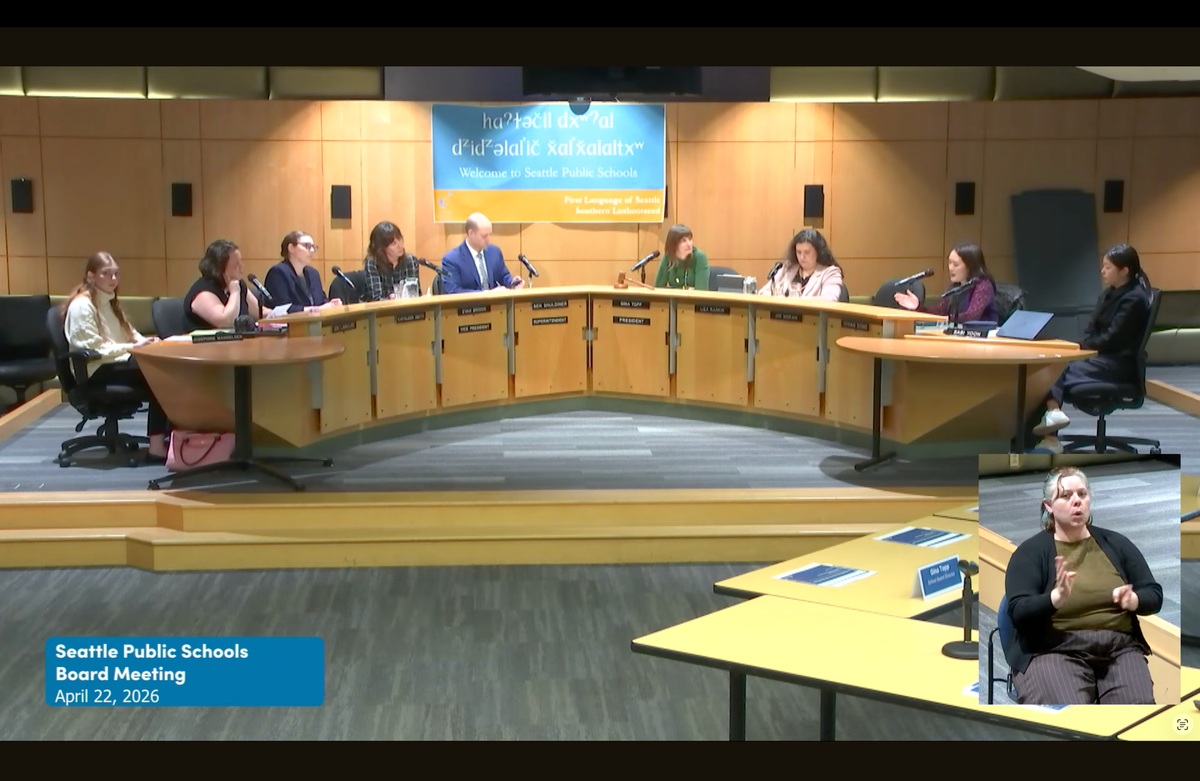
Watch: (YouTube)
Read: Transcript (includes video & text)
Agenda & meeting materials: (SPS website)
The first school board meeting in over a month included public testimony raising concerns about the harmful impact of school-issued devices in the classroom, Native education and raising awareness about the harmful impact of residential schools, and about a contentious placement of a principal at Adams Elementary School. The board’s primary action item at this meeting was to adopt the McGraw Hill Emerge! K-5 ELA curriculum. They also heard important updates about advanced math learning for 5th graders, and an update on SPS enrollment.
In this issue:
- Opening Business
- Public Testimony
- Consent Agenda
- The Board Adopts a New K-5 ELA Curriculum
- Delaying Rainy Day Fund Repayment
- Expanding Access to Advanced Math in Middle School
- An Update on SPS Enrollment
Opening Business
The Eckstein Jazz Band provided a warm welcome to the public, and President Gina Topp called the meeting to order at 4:31pm.
All elected directors were present, with Director Joe Mizrahi calling in remotely. All student representatives were present except for Isabelle Masoudi.
Student representatives showed a video soliciting applications for the new Project-Based School Board.
Board members gave brief reports about their liaison assignments and board committees. Director Vivian Song, Head Start liaison, mentioned that SPS Head Start classrooms “scored above both the federal quality thresholds and the competitive thresholds in all three categories.”
As Finance and Audit Committee chair, Director Song explained the committee’s next steps. The committee plans to closely examine specific areas of district spending, focusing on discrepancies between budgeted and actual costs, alignment with district goals, and areas like transportation, special education, and multilingual services. Staff will present briefing papers at the May 4th meeting, after which the committee will choose which spending areas to prioritize for deeper review.
Director Jen LaVallee reported from the Operations Committee. She said they “discussed some of the past struggles from past iterations of the committee,” and are working to ensure the committee’s work includes multi-year oversight plans, as well as tackling contract reviews and capital budget expenditures. They also discussed the Student Assignment Plan and policies surrounding that plan, including policies regarding boundary changes.
After that, Director Joe Mizrahi reported from the Policy Committee. Their work has focused so far on the process by which policies reach the full board agenda. “I know that it might seem a little bit meta for a policy committee to be talking about how policies come to the board,” Mizrahi said, “but that seems like foundational work that needs to be done before we can move on to other things.”
Director Liza Rankin then mentioned her desire for an HR audit. “We clearly have structural issues in HR, in timelines and investigations, in leaves, in hiring decisions, all kinds of things,” she said. She suggested it cover “recruitment, hiring, promotion, and separation processes, staffing authorization practices, employee relations, workplace investigations, complaint response procedures.”
Public Testimony
Prior to public testimony, Superintendent Ben Shuldiner spoke about the community meeting that had taken place two days before at Adams Elementary School regarding the appointment of Anitra Jones as principal. We covered that meeting, the Superintendent’s comments, and public testimony at this board meeting from Adams families in Issue 26. The Seattle Times also covered Shuldiner’s comments.
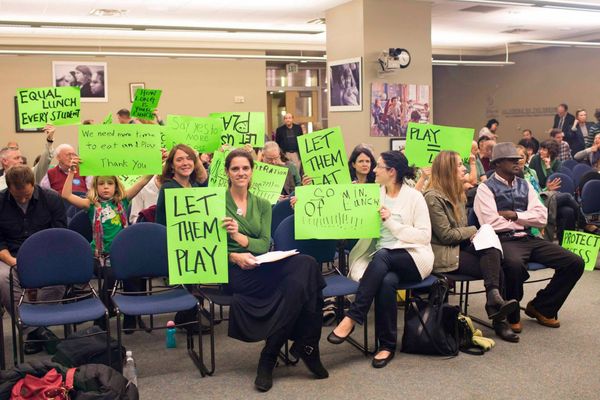
Many speakers at this board meeting were there to raise concerns about the use of technology in the classroom — specifically, the iPads and laptops issued by SPS to each student. We covered a new community organizing effort about “intentional tech” in Issue 24, and a sizable contingent of that group came to the board meeting to speak out about it.
The first speaker was Emily Cherkin, a former teacher, an SPS parent, and a key national and even international leader in the intentional tech movement.
“The answer to these questions,
‘How many children should be able to use their school laptop to:
Watch YouTube and play games?
Search up harmful content?
Talk to strangers?
Watch porn?
Use AI to write their essays?’
…should be “Zero.”
But it is not. Seattle students have done all of these things on their school devices.”
Another speaker, Kyle Ellman, asked for “a district-level EdTech policy review with a real timeline and with an informed audit of EdTech and devices. Not delegated down to schools.”
Hilary Paterson and Erica Shuts-Noble also spoke. They co-founded Seattle Families for Intentional Tech, and delivered a petition for intentional tech limits with nearly 1,000 signatures to the school board.
Although neither the Superintendent nor the school board directly addressed these topics at this board meeting, it’s likely to come up at the April 29 board meeting where the school board will hear about new districtwide policies limiting personal devices.
The other major topic of discussion in public testimony was Native Education. Speakers asked that SPS adopt a resolution to recognize and acknowledge Every Child Matters Day on September 30, regarding the experience of Native children in Residential Schools in North America.
Former school board director Lisa Rivera, a member of the Comanche and Tarahumara tribes, ceded her time to an Ingraham student, an enrolled member of the Makah tribe, who said:
“More people need to be aware of the impacts on boarding schools across generations and their effects on native people, and my hope is for SPS students to graduate knowing more about boarding schools than in previous years.”
Consent Agenda
After a short recess, President Topp reconvened the meeting. The board adopted the consent agenda without any items being removed. The consent agenda included approval of legal services contracts, contracts with several service providers for “students who require therapeutic day services and programming,” and several construction contracts related to ongoing projects at SPS buildings.
Action Items: The Board Adopts a New K-5 ELA Curriculum
The board then proceeded to discuss and approve the adoption of Emerge! from McGraw Hill for the new K-5 English Language Arts (ELA) curriculum. This was introduced at the March meeting and drew some concerns from the public and from board members about the length of the contract for a new and untested curriculum, as well as its reliance on screens in the classroom.
Dr. Mike Starosky, Assistant Superintendent of Academics, told the board that SPS was able to get the contract length shortened by two years, from nine to seven. That in turn lowered the cost of the contract from $9 million to $5.78 million.
Shuldiner said that they were able to answer most of the questions raised at the March board meeting, and that SPS leaders “feel confident moving forward” about adopting the Emerge! curriculum.
A major source of concern from some SPS parents about the Emerge! curriculum is its digital component. Director Kathleen Smith asked about community concerns regarding screen time in kindergarten. Dr. Starosky said that there were only “20 minutes allotted in that block of time” for screen use, but could not guarantee to Director Smith that kindergarteners would not have more than 20 minutes of screen time with this ELA curriculum.
Director Song said she’s “feeling pretty confident about my vote” for Emerge!, flagged a concern about the pacing of the curriculum when it comes to dual language schools.
Director LaVallee raised a concern about how differentiation would happen within a classroom where there are highly capable learners, though she also noted this was an “ongoing question” that is “not necessarily solved by any curriculum.” Shuldiner said “As we try to move to be the best urban school district in America, we want to make sure that students are able to go as far as they can as quickly as they want to.”
Director Rankin raised similar concerns about how special education students were receiving services in the classroom, but similarly noted that wasn’t an issue that could be solved in a single curriculum adoption. She said that “oftentimes, I think the board ends up feeling like they vote yes because they have to. I feel good about this vote.”
The board then unanimously adopted Emerge! from McGraw Hill as its K-5 ELA curriculum.
Wrapping up the action items portion of the meeting, the board authorized the use of electronic payments, adopted state-level advocacy positions related to gun violence reduction and cell phone policies, and approved several ongoing annual programs, mostly related to therapeutic day services for students.
Delaying Rainy Day Fund Repayment
Shuldiner and Dr. Kurt Buttleman, Assistant Superintendent for Finance, then discussed a proposal to delay repayment of a loan SPS made to itself out of its rainy day fund to balance its budget. The proposal would:
“Defer repayments to the account until 2027-28. This would allow the District to use $7.2 million to help balance the 2026-27 budget. As annual expenditures for the most recently completed fiscal year are $1.2 billion, a 3% reserve will require a balance of approximately $36 million.”
As Shuldiner explained, this would lower the projected deficit for 2027-28 from $87 million to $80 million. He described it as “a really helpful mechanism that allows us to have a balanced budget without making even more cuts.”
Director Rankin if this change would make the deficit for 2027-28 easier to close. Shuldiner’s responded that in his first 87 days, “we’ve done some pretty good things” to balance the budget. “I don’t want to talk about what I might be sharing soon,” he said, “but clearly, one of the things we’re going to want to do is to actually be solvent, actually have a fund balance. I think the timeline to get there is a couple of years. He concluded:
“This allows us to buy one more year of figuring out how to cut thoughtfully without it going to the bone, only to the fat, and hopefully not the muscle either.”
Director Song felt this proposal was “a little bit out of context without knowing what the ending fund balance will be.” She did note that this would be covered in more detail at the next Finance Committee meeting. Shuldiner responded that, as this was an introductory item, there would be more discussion before approval, including a budget presentation on May 6.
The board went on to hear two presentations from the Superintendent and his staff, one on advanced math and one on enrollment.
Expanding Access to Advanced Math in Middle School
Highly Capable Director Dr. Paula Montgomery delivered a presentation on SPS’s new Highly Capable Summer Math Program. Shuldiner introduced it with some words that indicate his overall direction for advanced learning in SPS, calling a restoration of high-quality instruction a “big win”:
“One of the first big wins [is] to show the trajectory we're trying to do to make sure that our students, our staff, our community really have access to this kind of high-quality, high rigorous work.
As I said from the dais earlier, this idea of possibly having an algebra for all or even a geometry for all, it starts with creating systems and structures that allow more children to have access to advanced work.
What I hope comes across is Dr. Montgomery's really thoughtful work over the last couple of months on how we create a system and structure that allows our students and all of our students, and you'll see this, access to the work that they are at the level of currently, rather than having to wait or be held back.”
The new program will advance participating students by two years (in math only) during the year after fifth grade. Doing so will place them on par with peers who attended HC cohort schools by the start of seventh grade.
The acceleration involves taking sixth grade math as an online, self-paced, 12-week course during the summer after 5th grade. Then, in sixth grade, students will take the accelerated math 7/8 class that is already offered at every SPS middle school. This will align them to the existing HC math track: algebra in seventh grade and geometry in eighth, with calculus taken in the junior year of high school.
Eligibility is determined either by having a Highly Capable designation or by having high math scores on the MAP standardized test. The presentation noted that 25% of the invited students currently do not have a Highly Capable designation.
Shuldiner said this program will help address the feeling of “being pulled in two directions” that parents of Highly Capable-designated children face, of having to send their child to a Highly Capable Cohort school to receive services or stay at their neighborhood school and risk not being given an education appropriate to their need.
Student representative Mangelsen noted that she entered middle school “right around when a lot of these programs were dismantled.” She asked what steps would be taken to ensure access to the curriculum over the summer. Dr. Montgomery noted that SPS is in touch with the eligible students and will assign them an SPS device if they need one to participate in the program.
Director LaVallee asked about completion rates for a summer online course, recognizing quite rightly that it might not be easy to convince a student to focus on an online math class during the summer months. Dr. Montgomery pledged to follow up with data about completion rates.
An Update on SPS Enrollment
Shuldiner then welcomed Dr. Marni Campbell to present on enrollment. The Superintendent noted that “we have heard from our families: they want a reason to believe to come back,” and that they are looking at “some thoughtful ways to try to increase enrollment.”
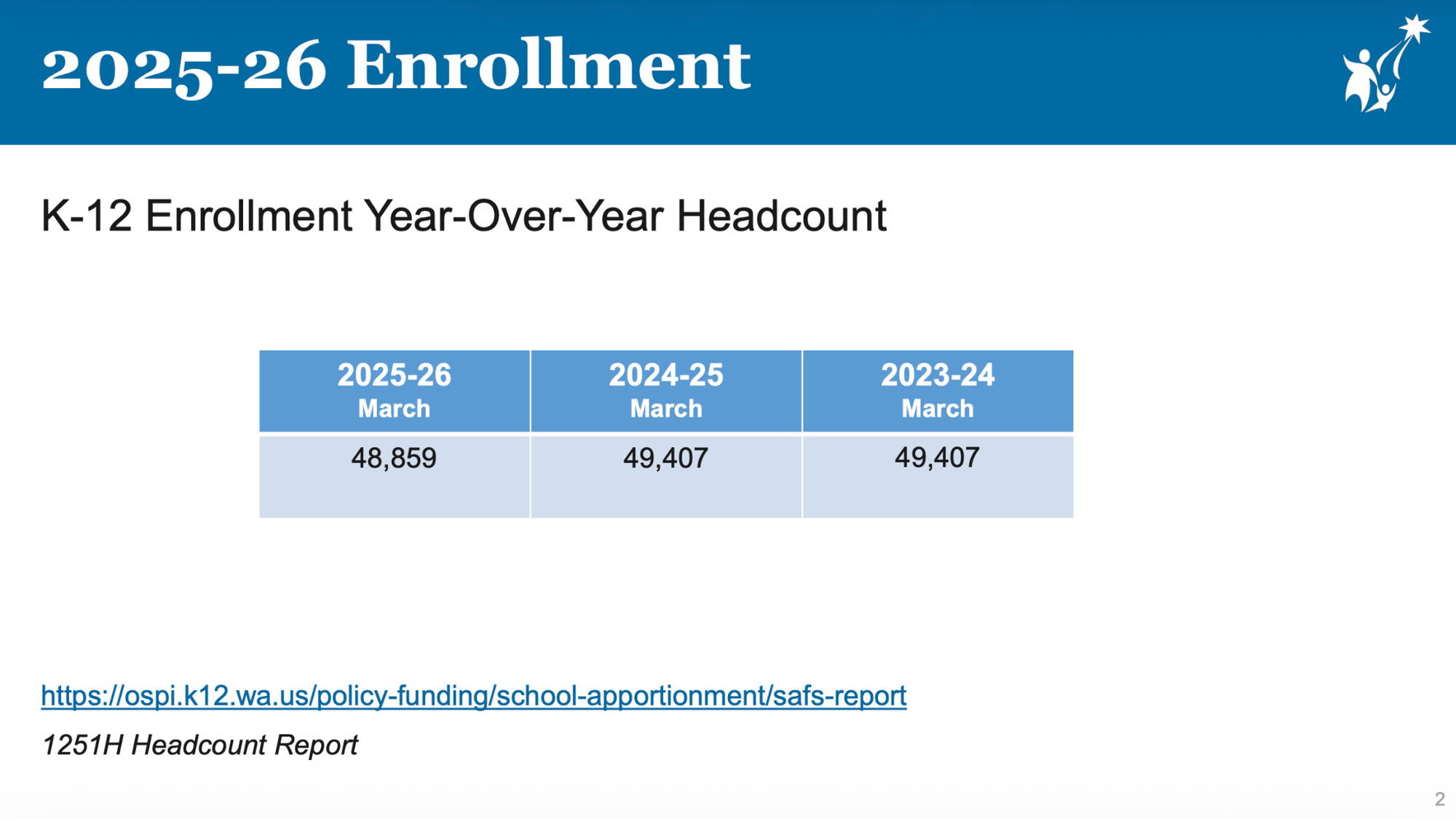
Overall enrollment at SPS is down by nearly 600 students. According to Campbell, the numbers for 2023-24 and 2024-25 were triple checked and, in fact, were exactly the same.
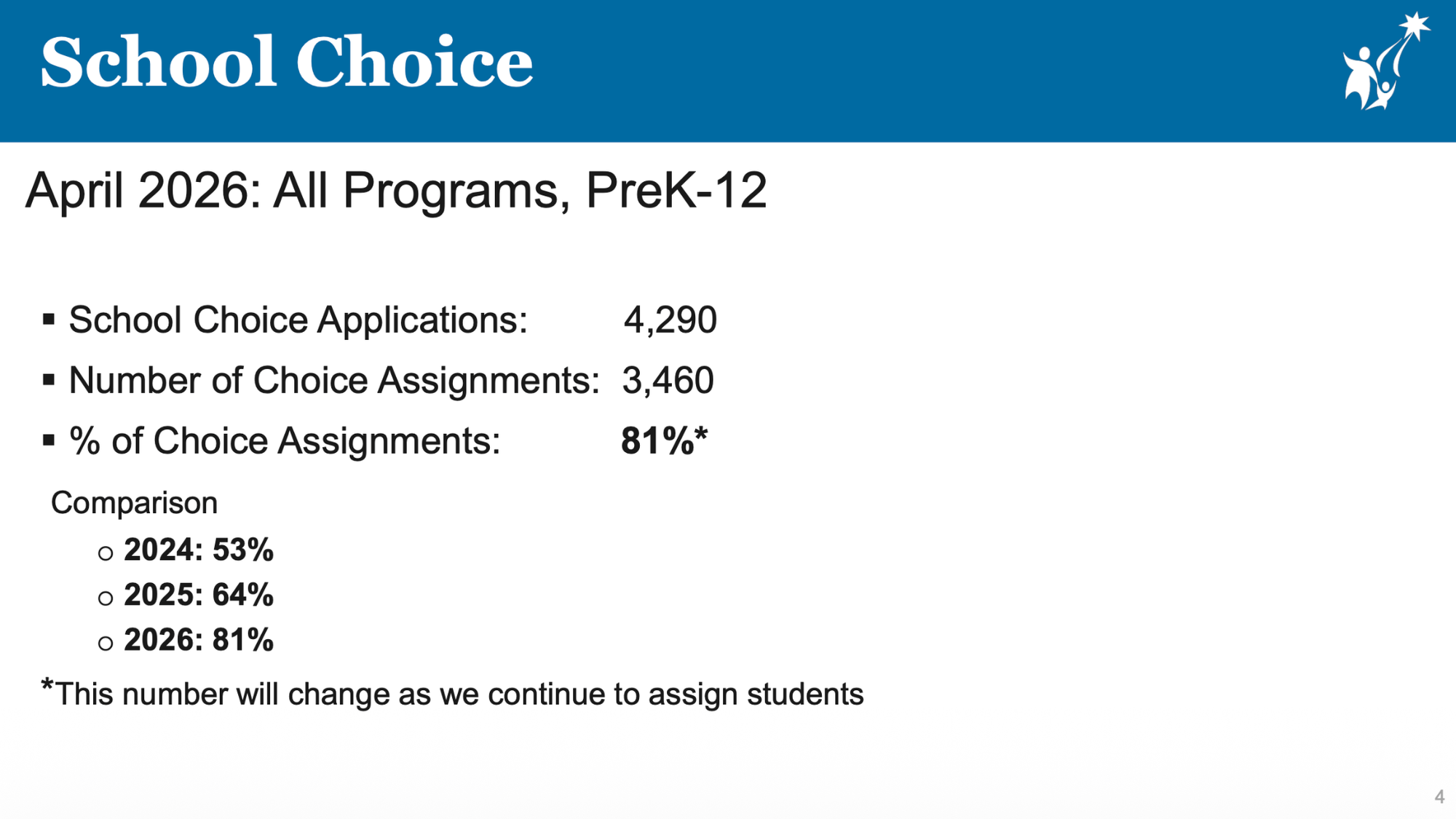
Campbell then discussed school choice. After a strong community pushback last year against SPS’s ongoing hesitation to grant students and families their choices, with key support from then-Director Sarah Clark and Director Mizrahi, SPS pivoted and approved more school choice applications this year.
Campbell obliquely referenced this community mobilization:
“Last year at this time, we were talking about what is the function of choice in our district. I think we understand really clearly now that choice is something that matters. That when you feel like you know what your student needs and deserves, when you as a student feel like you know what you need and deserve, you want to be able to say that and we want to be able to match you with that preferred option…
Listening to our students, listening to our families, providing those opportunities, we believe is something that can also help us make Seattle Public Schools feel like an option that is desirable for all of our families.”
It’s nice to see SPS finally embracing this fundamental reality. This is a change many Seattleites worked hard for, and these changes are their victory.
Shuldiner noted in a response to a question from President Topp that the main reason 19% of families have not had an approved choice application is because in those cases, there is simply not physical capacity at the building for those students. That is a different limitation than in the past, when SPS often capped the enrollment of a school at an arbitrary number below its physical capacity and then denied applications above that number.
Campbell also discussed the precipitous decline in the “kindergarten capture rate” — the percentage of eligible Seattle kindergarteners who enroll in SPS:
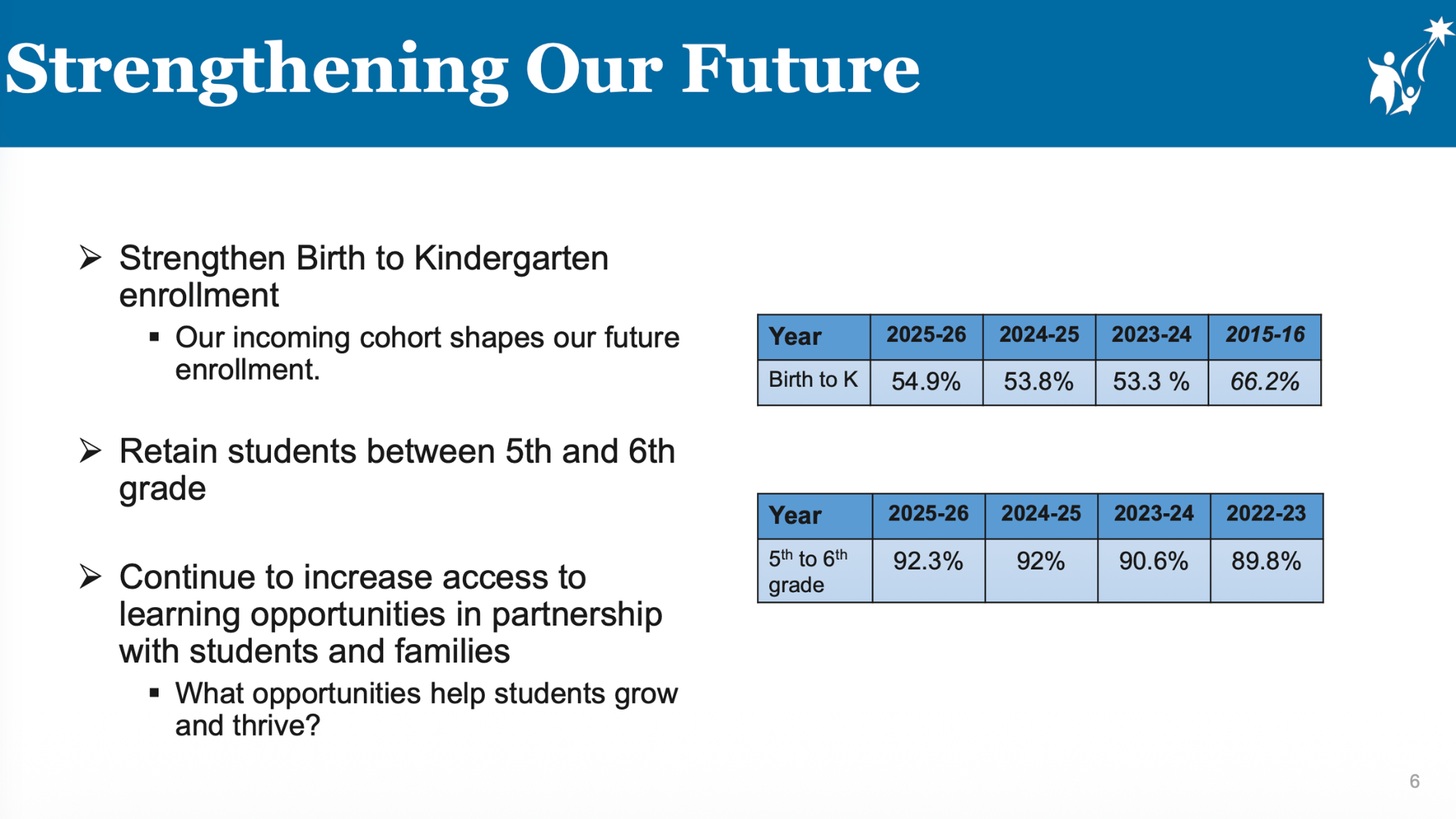
Campbell suggested that a key step SPS will take to try and improve this capture rate is to automatically enroll students in pre-k programs housed at SPS schools in SPS as kindergarteners. (Families could still opt out and send their child somewhere else.)
Director Song reminded SPS leaders that the district had been given $100,000 by the legislature in 2024 to conduct an enrollment study, and that it was a “missed opportunity” by SPS to not use that money to better understand the declining kindergarten capture rate. She also pointed out one possible reason for the lower kindergarten capture rate is the lack of before- and after-school care at some elementary schools. Campbell’s answers were vague and indirect.
Director Mizrahi suggested that the Superintendent adopt a specific goal for increasing the kindergarten capture rate and asked what a reasonable number would be, based on comparison to other urban school districts. Shuldiner responded that “I think we should probably be shooting for around 60 in the next couple of years. And if we could get to 65, we're talking a lot of kids.” He pledged to follow up with “real, hard numbers” in an email to the board.
Director LaVallee asked if the board could receive a breakdown of the numbers by region, which would certainly provide interesting and potentially quite valuable insights.
After some more board discussion on this item, President Topp adjourned the meeting at 8:39pm.