Issue 8 -- Yes, SPS Is Still Using SOFG
SPS uses a controversial governance model to guide board procedures and relations with the superintendent. Liza Rankin incorrectly claimed it doesn't.

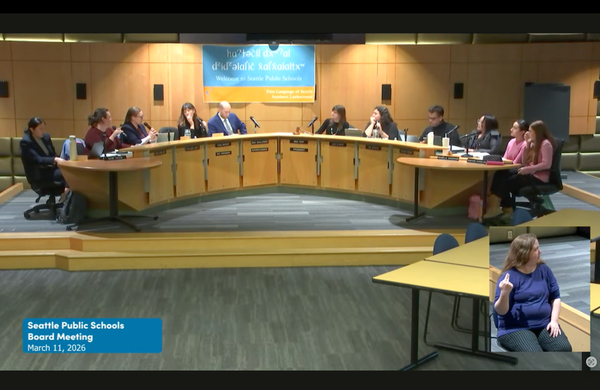
At Wednesday’s school board meeting, director Liza Rankin made a claim that surprised a lot of people: “We’re not doing Student Outcomes Focused Governance.”
Click the red button to go directly to Rankin's comments.
Her comments came in response to director Vivian Song rightly objecting to the nomination of Evan Briggs to serve a second one-year term as board vice president. Before the vote, Song wanted to know where Briggs stood on Student Outcomes Focused Governance (SOFG). After Briggs did not give a clear answer, Rankin jumped in with her claim.
Rankin went on to add “we need a framework to make sure we do the job of the board. We don’t have that. We’re not using one.” Exasperated, Rankin added, “I know people ran on repealing it. Congratulations, it’s repealed.” Briggs was then elected as vice president, with Song casting the sole dissenting vote.
Rankin is wrong. SPS continues to use SOFG to guide board procedures and its relationship with the superintendent. The school board took several votes in 2021 and 2022 to affirmatively adopt and implement SOFG. The board has not voted to repeal those decisions.
SPS’s contract with the Council of the Great City Schools to consult on SOFG lapsed over the summer. But this is not the same thing as ceasing SOFG. A declaration from Rankin isn’t enough to actually root out SOFG practices from SPS.
Let’s take a brief look at what SOFG is, and detail how the board embedded it deeply in their own operations.
What SOFG Is
Student Outcomes Focused Governance is a project of the Council of the Great City Schools. It is led by AJ Crabill, a former Kansas City school board director and deputy commissioner for the Texas Education Agency.
The core concept of SOFG is that the school board should focus only on monitoring “student outcomes” in the form of test scores, and leave other matters to the Superintendent. This turns the board into a rubber stamp, as the board is directed to no longer work in depth on budgets, student safety, or other important matters. Under SOFG, the board no longer conducts oversight of district operations.
You can learn more about SOFG in a 2023 article I wrote for the Stranger. Claudia Rowe at the Seattle Times also wrote an in-depth piece earlier this year criticizing SOFG. All Together for Seattle Schools, which has organized against SOFG, produced a flyer explaining how SOFG works in SPS.
Opposition to SOFG has erupted across the country. Parents and community members in San Francisco, Pittsburgh, Las Vegas, and St. Paul have organized against SOFG. Candidates for Seattle school board in 2025 pledged to end SOFG.
How SPS Adopted – And Still Uses – SOFG
Despite Rankin’s claim at Wednesday’s school board meeting, the Seattle school board has been using SOFG from 2021 to the present day. According to SPS’s own website:
Beginning in March 2021, the Seattle School Board engaged with the Council of Great City Schools to examine and transition district governance to a Student Outcomes Focused Governance (SOFG) model.
That same website goes on to state that the board adopted the “goals and guardrails,” a core element of SOFG, on August 25, 2021, with revisions on October 26, 2022. The goals and guardrails were revised again for 2025-30 on January 22, 2025.
In summer 2022, directors Rankin, Song, and then-director Chandra Hampson worked as an ad hoc governance committee “to develop a plan and timeline for the Board’s implementation of SOFG.” Their recommendations were adopted in October 2022 and remain in place today:
- Adopt an implementation timeline.
- Adopt a “committee diet” in which “all non-legally required committees” would be paused.
- Conduct a “policy diet” in which the board systematically removes policies.
- “Generally” hold two board meetings a month but consider reducing them to one.
- Adopt a new superintendent evaluation process, limited to SOFG goals.
- Adopt a new Board Code of Conduct.
- Create a new, narrower, shorter Board Action Report template.
- Create a structure for board community engagement.
Many of these changes were deeply unpopular, but remain in place. The elimination of most board committees drew particularly strong criticism. On the campaign trail in 2025, school board candidates pledged to restore these committees, especially a finance committee in order to provide better budget oversight.
In 2024, when serving as board president, Rankin eliminated the second monthly board meeting. This also drew opposition, but has not yet been reversed.
The new “community engagement” model for the board involves directors going out in official meetings led by and structured by SPS staff, rather than holding their own community meetings as board directors traditionally did prior to the 2020s. This too remains in place.
As reported by the Seattle Times, SOFG has cost SPS at least $300,000 in direct costs, including Crabill’s $1,000 per day fee. SPS also contracted with the Council of the Great City Schools for ongoing support to implement SOFG, including “coaches” who are assigned to the Superintendent and board directors to help them stay within the SOFG lines.
According to former school board director Sarah Clark, the board let that contract lapse in summer 2025, and Crabill is no longer providing regular coaching to the whole board in SOFG implementation. This does not mean SPS has abandoned SOFG, however.
SOFG is still deeply embedded in the way the school board operates. It will remain so until the board takes affirmative steps to undo the changes made earlier this decade to implement SOFG.
Most importantly, the core belief of SOFG, that the board should let the superintendent make operational decisions without board involvement, remains in place, effectively turning the board into a rubber stamp.
For example: Earlier this fall high school students across Seattle walked out of classes to protest Superintendent Fred Podesta’s sudden decision to shorten and split lunch periods, undermining students’ ability to eat, rest, meet with clubs, and engage in other student activities. More than 1,000 students protested at the district offices against this decision.
At the September 17, 2025 board meeting, Rankin led the charge against any board action, arguing that it was an operational issue and thus under SOFG principles the board should not get involved, despite the harm caused to students. Unfortunately her view won out, and the board did not reverse the lunch split.
Despite having successfully pushed SPS to adopt SOFG, Rankin has said on many occasions that she is dissatisfied with its implementation. She has every right to hold that view. But SPS has not stopped operating under SOFG. Rankin needs to come clean with the public about that.
The entire board needs to affirmatively vote to repeal SOFG. Then it needs to root out SOFG practices. Initial steps could include:
- Restoring the board committees
- Resuming a second regular monthly board meeting (there's too much to cover in a single regular monthly meeting)
- Ending the use of the consent agenda to push through important changes
- Ensuring administrators are responsive to board questions.
- Craft a new superintendent evaluation process, covering more than just the limited SOFG goals, now that Ben Shuldiner is about to start as SPS's superintendent in February.
Ultimately, the board needs to be able to address operational matters within a clear, effective structure.
Finally, the board needs to bring together parents, educators, students, and community members to develop a new governance model – one that's rooted in Seattle’s values of democracy, equity, effectiveness, and partnership.