Issue 9 -- December 10, 2025 School Board Meeting Recap
The board re-elects their officers, hears a budget update, and learns about changes to the choice process.
Watch: YouTube video
Read: Transcript
Agenda (SPS website)
In this issue:
- Public Testimony: Growing Concerns About ICE
- Consent Agenda – Including a Recusal from Kathleen Smith
- Officer Elections
- When Is Graduation Happening?
- Clarifying Police Officers’ Role on Campus
- Understanding SPS's Four Budgets
- Enrollment: Major Changes to School Choice
- Bottom Line
The first regular monthly meeting of the new school board took place on Wednesday, December 10. All seven elected directors were in attendance, all of them in person except Kathleen Smith, who participated remotely. Student directors were in attendance as well.
Part 1: Public Testimony and Officer Elections
(by Robert Cruickshank)
After some brief welcoming remarks from Superintendent Fred Podesta, and some short reports from elected and student directors, the public got their monthly chance to address their elected officials.
Public Testimony: Growing Concerns About ICE
Public testimony at this meeting was dominated by families raising urgent and serious concerns about ICE operations in Seattle. The Seattle Times’ Claire Bryan covered this in her own recap of the board meeting.
Parents rallied against ICE prior to the board meeting, and many of them spoke movingly about the terror and fear that Trump’s wannabe Gestapo scumbags are causing in Seattle. They wanted SPS to do more to address concerns about ICE kidnapping community members. While SPS has emailed the public about resources to support immigrants, speakers urged further action.
Testifiers want SPS to use its power and influence to try and halt deportation of community members. They cited the case of Darlin, a mother who fled Guatemala in 2021 to seek asylum in the United States, but who now faces possible arrest and deportation along with her two sons. Supporters have created a petition to support Darlin and oppose her possible arrest and deportation.
Speakers mentioned that there are an increasing number of students staying home from school out of fear of ICE, and Jen LaVallee mentioned in her own remarks that she is seeing the same thing in her community. (LaVallee lives in Rainier Beach.)
Others spoke about concerns of gun violence, and slammed a recent community presentation on the topic by SPS administrator Marni Campbell. One speaker, Warlina Wheeler, slammed that presentation as “an insult to our intelligence” and urged SPS to provide support to students and families, including mental health services.
Consent Agenda – Including a Recusal from Kathleen Smith
In recent years, important operational decisions and larger budget items have been moved to the consent agenda, in which numerous items are approved at once by a board vote without discussion. This is one of the recommendations under the controversial Student Outcomes Focused Governance (SOFG) model. This practice reduces board fiscal oversight. SPS staff can already spend up to $1 million without board approval (up from $250,000 prior to SOFG), with larger contracts often placed on the consent agenda for approval without discussion or close examination.
Directors removed two items from Wednesday’s consent agenda, meaning they could be discussed and voted on separately. Kathleen Smith asked to remove item 7, approval of a Microsoft Enterprise license agreement for $2.2 million. Smith’s day job is at Microsoft, and she rightly pulled the item from the consent agenda so she could recuse herself from that vote. The motion passed unanimously with Smith abstaining.
The other item removed from the consent agenda was item 9, a change order for the John Rogers Elementary school reconstruction project for $1.7 million. LaVallee removed it so she could ask the reasons for the change order and whether this was typical.
Amanda Fulford, SPS’s project manager for John Rogers, explained that it was typical and that the reasons were that the project experienced a larger than expected amount of water intrusion.
Vivian Song then said that in the future, the board should be told the cost of the overall project and the combined sum of change orders when asked to approve these kinds of items. The board then unanimously approved the change order, and the entire consent agenda.
Officer Elections
The board then proceeded to elect their officers for 2026. Podesta took the gavel for this portion of the meeting as a neutral arbiter. There are three board officer positions: President, Vice President, and Member At Large. They serve for one-year terms.
President Topp
Gina Topp was nominated for another term as president by Joe Mizrahi. Superintendent Fred Podesta noted that although seconds are not required, Evan Briggs seconded the nomination.
In explaining his nomination of Topp, Mizrahi praised her work, saying “it's been a busy year and I think President Topp has done an exceptional job navigating a lot of very complex issues.” He also pointed out how hard she works at the job.
That she certainly does. Last week the Seattle Times wrote an entire article about Topp’s work ethic. Topp spends “25 hours a day” balancing motherhood, being board president, and running two small businesses (the beloved Mission Cantina in West Seattle’s Admiral neighborhood, as well as her own legal practice). Folks, this is why board directors should be given a full-time salary!
Rankin then spoke, seconding what Mizrahi said but then adding her own comments suggesting she wasn’t totally happy to see Topp re-elected. She agreed that “I do think there is a lot of change happening and that Director Topp, Director Briggs, and Director Mizrahi have worked well together as a team.” But then she said “ideally, anyone would be prepared to take on that responsibility.”
Topp was then unanimously re-elected as president.
Vice President Briggs
Rankin then nominated her ally Evan Briggs for another term as Vice President, with Topp seconding it. This nomination generated some controversy, as Vivian Song asked whether Briggs was still committed to the unpopular Student Outcomes Focused Governance (SOFG) model.
This was a good time to ask such a question, as Briggs would be part of the board's leadership and could preside over meetings if Topp is absent. Her views on SOFG were germane to her nomination.
We devoted an entire issue to this topic, including Rankin’s surprising and incorrect claim that “we’re not doing SOFG.” We won’t rehash it here, only to say that Briggs was re-elected by a 6-1 vote, with Song dissenting.
We must note that Song, despite being the only woman of color currently serving on the board, having won election to the board twice, and having won the most votes of any director in the 2025 election, has yet to be elected to a board officer position. For a district that claims to make racial equity a priority, this is unacceptable.
Member at Large Mizrahi
Song then nominated Mizrahi to serve another term as Member at Large. Topp spoke to the nomination, saying he brings “a thoughtful, calm, steady presence to difficult and high-stakes conversations” and keeps students at the center.
Rankin added her appreciation that “he intrinsically understands that no one board director has authority, that everything should be done as a body.” Mizrahi was then re-elected unanimously.
When Is Graduation Happening?
The board then heard an introduction of the proposed 2026-27 and 2027-28 academic calendars from Dr. Sarah Pritchett-Goodman, Assistant Superintendent for Human Resources. She explained that the proposed calendars are created based on the Collective Bargaining Agreement (CBA) with the Seattle Education Association.
LaVallee asked whether staff had factored in religious holidays in the proposed calendars, particularly the Jewish High Holy Days in September. In the recent past SPS had not done so and wound up scheduling things like the first day of kindergarten on Rosh Hashanah.
Dr. Pritchett-Goodman said that she would check with staff and follow up next month when the board must approve the calendar.
Song then raised a related topic: when will graduation happen in June 2026? With construction at Memorial Stadium and especially with the FIFA World Cup in town during that time, families were concerned about being able to find and book space for family members who may wish to travel to Seattle to celebrate high school graduation.
Dr. Pritchett-Goodman did not have an answer at the board meeting. But late on Friday, SPS emailed parents to provide the answer. Here’s the 2026 high school graduation schedule.
Clarifying Police Officers’ Role on Campus
Mizrahi then introduced a policy clarification around the role of police officers on campus. He emphasized this is not a return of school resource officers. Instead, he wanted to make it clear in district policy that officers could enter campus for very limited and specific reasons, whether it’s to respond to a call, take a statement, chat with the principal, or even use the restroom.
He took pains to emphasize that this is a minor clarification:
So I think for folks who are wanting a deeper change to 4311 [the policy banning SROs], I think, unfortunately, I don't think this is it for you.
And for folks who are worried about a deeper change to 4311, good news, this isn't changing that much.
Rankin chimed in to suggest that the board did not need to act on this, that the Superintendent could just clarify it with SPD directly. (This is in keeping with her SOFG mindset that the board should not get involved in operational issues.) But Podesta explained that it’s SPD that wants clarity directly from the board.
Student director Sabi Yoon then spoke up:
Click the button to view Student Director Yoon's remarks.
Yoon pointed out “there are a lot of hurt feelings” in the Garfield community about this topic. “Trust was broken,” Yoon said, referring to the events that took place in October. The Garfield community worked on and brought to SPS a proposal to allow armed officers to patrol on campus. But at the last minute, SPS administrators made unilateral changes to the proposal, undermining that work.
As a result, Garfield PTSA leaders had to ask that the board not adopt these changes in the October meeting. They wrote an excellent op-ed in the Seattle Times explaining their disappointment at how SPS administrators handled this, saying that “board members were backed into a corner by a district either grossly incompetent or intentionally sabotaging” the community’s work.
As this item was introduction only, no vote will be taken until next month’s board meeting.
Part 2: Budget, Enrollment, and Big Changes Ahead
(by Jane Tunks Demel)
Wednesday's School Board meeting also had two work sessions: the district budget and enrollment changes. Here's what happened.
Understanding SPS's Four Budgets
Did you know SPS actually has four separate budgets? When people talk about "the SPS budget," they're usually talking about the General Fund—the $1.19 billion operating budget for 2024-25. The General Fund covers salaries and benefits (the bulk of spending), purchased services (utilities, insurance, the bus contract, Running Start, and legal services), supplies, and other costs. (The other funds are the Capital Projects Fund, the Debt Service Fund, and the Associated Student Body Fund.)
Assistant Superintendent of Finance Kurt Buttleman was flying through this presentation—almost too fast—but he was clearly responding to community questions that have been raised repeatedly about district finances. The presentation was a look back at the budget for the 2024-25 school year. You can view it here.
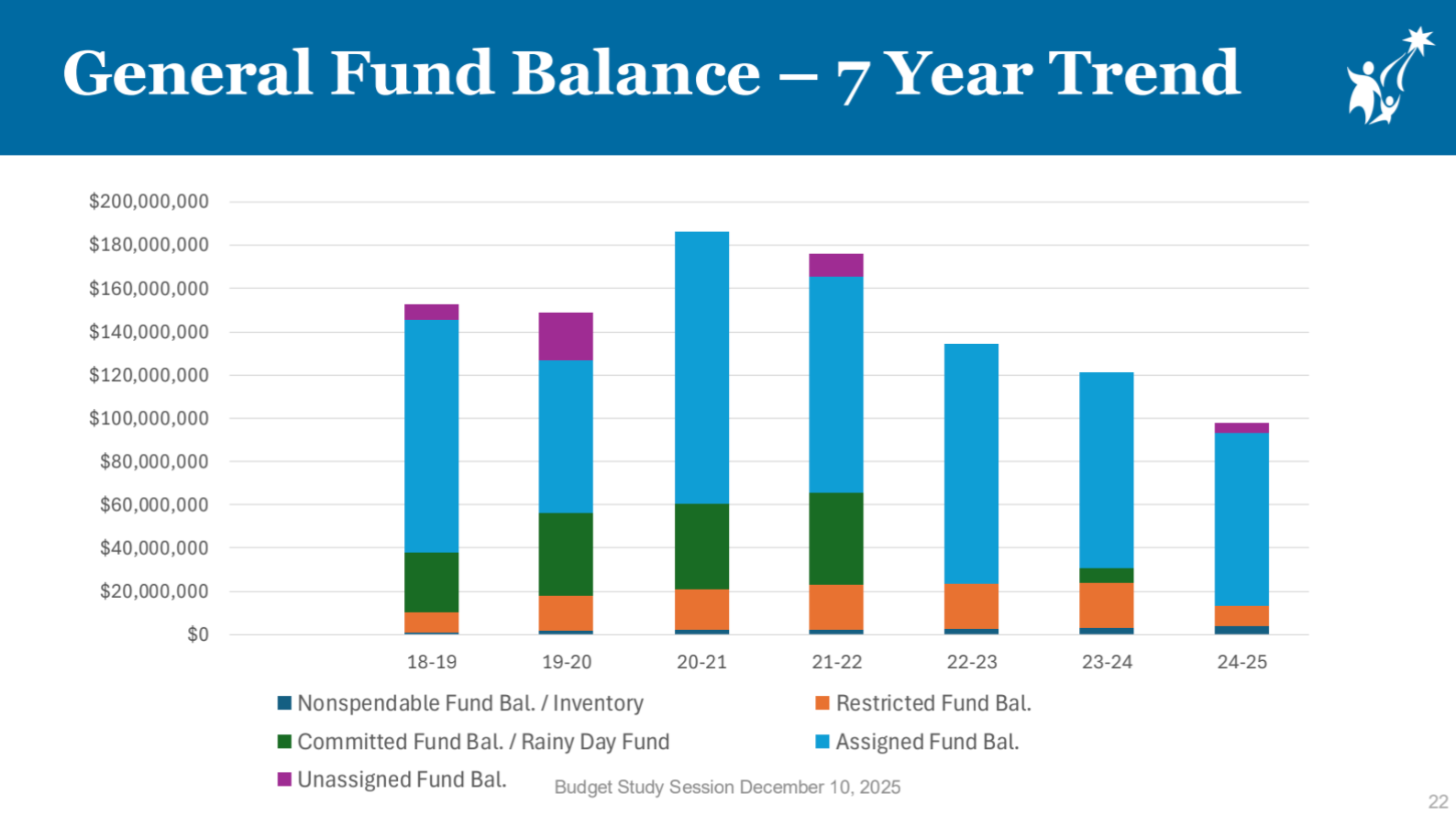
One confusing point: the fund balance, which Buttleman compared to a savings account. Buttleman explained that although it looks like SPS has a lot of money sitting in the fund balance, most of it is restricted for specific purposes and can't be used for just anything.
Director Vivian Song asked why the Unassigned Fund Balance dropped dramatically—from $42 million last year to just $4.2 million this year. Last year, the $42 million was used to help plug the deficit. Buttleman said it’s lower because SPS is anticipating significant legal costs, though the details weren't entirely clear.
The Deficit That Wasn't
Here's where things got interesting. Buttleman emphasized the deficit is just "projected", and that SPS actually balances the budget every year—by law, they have to.
For example, in the 2024-25 school year, SPS projected that it would need to use $78 million from its fund balance but ended up using "only" $23 million.

The budget turned out rosier than SPS projected because of a few things: enrollment was higher than expected, there was some additional funding from the state legislature, and due to a hiring freeze in Central Office, several vacant positions remained unfilled.
But most surprising of all, Director Song brought attention to the fact that SPS didn't even use the $27 million Interfund Loan they'd budgeted for. Critics believe that SPS planned to cite the need to repay this loan as one of the justifications for proposing to close up to 21 schools in 2024.
Board Questions Revealed Important Funding Gaps
Director LaVallee asked about the big increases in special education spending, which has increased around 20% each of the last three years—she wants to understand the reasons why.
LaVallee also asked for more details about the vacant positions. Acting Superintendent Fred Podesta mentioned there's a hiring freeze at the Central Office, so some positions are "intentionally" vacant.
Director Mizrahi asked a crucial question: what’s the gap between revenue and expenditures? Which programs are underfunded? Buttleman gave some sobering examples: SPS got $100 million less in special education funding than it spends. For food services, the gap was $6 million. For transportation, $19-$20 million.
Director Song asked that the departments with the biggest funding gaps come to the board and explain in detail where the funding gaps are.
Enrollment: Major Changes to School Choice
Assistant Superintendent Dr. Marni Campbell and Director of Enrollment Planning Faauu Manu presented changes to the school choice timeline—it's been moved up significantly. Click here to view their presentation.

Here's what's new and important:
Authentic School Choice Is Finally Here
Director Mizrahi asked the key question: Will SPS still be "protecting" neighborhood school enrollment when deciding how many students to let into option schools? The answer: NO. They are NOT doing that this year.
This is huge. Campbell acknowledged that some schools will get smaller as a result, but promised they won't let them "die on the vine." She didn’t elaborate on how SPS would support those schools.
Campbell also revealed that choice enrollment applications are split roughly 50-50 between choice schools and neighborhood schools—meaning families really do want options, including being able to choose other neighborhood schools.
Manu explained that when waitlists are "dissolved" on May 31, any unfilled seats will be available to students who are new to the district, including heritage speakers who might move into the area and want to attend the dual language schools.
Credit Where It's Due
These are massive changes to how SPS enrolls students into schools of their choice. And it happened thanks to the big push from the community—and then school board directors Topp, Mizrahi, and emeritus director Sarah Clark.
Rankin's Resistance
Director Liza Rankin was clearly unhappy with these changes. She suggested the enrollment presentation should have been "just a memo" and wanted instead to discuss "what portfolio of schools SPS offers" (which isn't the enrollment department's job).
Then Rankin said, "I never said I want to close option schools." As reported by the Seattle Times, the 2024 school closure proposal that was released when Rankin was School Board President would have "shut or repurposed more than a dozen of Seattle's option schools."
Rankin went on to say she's concerned that "they spend so much time talking about option schools" and expressed nervousness about schools competing for students, saying "I don't think that's good for kids."
Acting Superintendent Podesta pushed back effectively: He said that it’s district policy to allow school choice and that the previous constraints were "arbitrary and ambiguous." He said, "If we have it [choice], let's really have it." Before, there was "a black box on how much choice there is."
Seattleites strongly support there being a choice process within the public school system. A 2024 poll showed large majorities believed closing option schools would be inequitable.
Other Important Details
Director Song asked about highly capable (HC) students who left SPS for middle school: Can they get their HC designation back to attend HC pathway high schools like Garfield, Lincoln, and West Seattle? Manu said yes, if they show they continued those courses at out-of-district schools. Song emphasized they need really specific information for families about this process.
The 85% operational capacity target came up (we covered this in Issue 3)—Manu noted that if they fill every building to 100%, they'd never be able to add students at grades beyond kindergarten.
One lingering question: How will middle and high schools be affected by these changes? Will students be able to use the choice process to attend middle and high schools that aren't their neighborhood schools?
Meeting Adjourned
President Topp ended the meeting at 9 pm sharp.
Bottom Line
Wednesday's meeting showed both progress and continued tension. Voters gave the board a mandate last month to end SOFG, but it remains unclear how and when it will be rooted out of SPS.
The budget picture remains murky—projected deficits keep being far larger than actual shortfalls, and money keeps appearing in unexpected places.
Meanwhile, real choice within the public school system is finally coming back to SPS, though not without resistance from at least one director. The community's sustained pressure is making a difference, but vigilance remains essential.