Part 1 – The curriculum: Inquiry by Design
Let’s take a closer look at the IBD curriculum to see why it’s not a good fit for SPS.

by Julie Letchner
This is Part 1 of a four-part series on middle school English instruction at Seattle Public Schools.
Inquiry by Design (IBD) is an English Language Arts curriculum for grades 6-12. SPS has adopted only the 6-8 portion. IBD is an inquiry-based curriculum that emphasizes student group discussions as a means of learning.
Unfortunately, even though IBD proclaims itself a “print first” curriculum, SPS has adopted only its digital components.
Even worse, the entire curriculum is full of mistakes, unhelpful repetition, texts that range from bland to shockingly insensitive, and structural gaps that teachers have to spend significant time filling.
If the purpose of an ELA curriculum is to engage students in learning, IBD is not the answer. If the goal is to simplify teachers’ lives, IBD is again not the answer. If the goal is to introduce texts that align with SPS’s stated values, IBD is emphatically not the answer. If curriculum selection is simply about finding the most popular, best-rated curriculum out there—and it isn’t—IBD doesn’t hit that mark, either.
Let’s take a closer look at the IBD curriculum to see why it’s not a good fit for SPS.
Digital vs. print materials
The IBD curriculum includes both printed and digital offerings, but SPS has purchased only the digital materials. The district does make exceptions for students whose documented special needs accommodations include physical texts.
Although SPS teachers have access to the “digital portal” of IBD resources, the IBD curriculum is not designed to be used in this way.
IBD’s own marketing materials announce: “Print first. Tech intentional.” They continue: “Studies show that students comprehend more deeply when reading on paper, so our program prioritizes print-based materials.”
ELA teachers with experience using both IBD and different digital-first curricula described to me features that truly digital-first ELA curricula have, such as:
- Instructional slides for teachers to use in the classroom
- Texts including clickable links leading to additional information about words, concepts, authors, etc.
- Interactive views that allow students to develop an analysis of a text on one half of the screen while viewing the source material on the other.
- Individualized diagnostic tools that let students set goals and see progress in real time.
- Teacher supports for differentiated learning based on individual students’ progressions.
IBD offers none of these features. As one teacher lamented, “It’s just a portal full of PDFs.” Indeed, one story that my son brought home last year was stapled in backward page order, because the teachers have to print their materials manually from files meant to be read on a screen.
The nonexistent EdReports review
A first, basic step for understanding any curriculum is to read its EdReports review. EdReports is a widely trusted gold standard for K-12 curriculum reviews, evaluating for usability, text quality, and many other dimensions.
Even SPS Superintendent Ben Shuldiner agrees. As he said during board discussions of a different ELA curriculum in March, “My concerns are there isn't necessarily this third-party validator that, in my experience, I would just always use."
Naturally, my research led me to the EdReports review of Inquiry by Design.
It doesn’t exist. EdReports has never reviewed Inquiry By Design.
That’s unfortunate, but not catastrophic. What is bizarre, though, is that the proposal that SPS administrators put before the board during the adoption of IBD referred to the nonexistent EdReports review:
To ensure the criteria were well-informed, reflecting both the educational goals of our district as well as the interests of SPS families, community, school and district leaders and teachers, the committee drew from evaluation criteria pre-established by research-centered organizations. These included EdReports reviews of English Language Arts Instructional Materials… (emphasis mine).
SPS Director of College and Career Readiness Dr. Caleb Perkins also made a misleading reference to the nonexistent EdReports review during his testimony to the board. When asked if he’d consulted IBD reviews, he responded:
If you look through the BAR, there are many different reviews, including national reviews. There’s a group called EdReports that does a thorough analysis of various options to ensure standards alignment, to ensure cultural responsiveness.
I spoke with EdReports to confirm that, as of this writing (May 2026), they’ve never reviewed IBD. Their spokesperson added that they are currently reviewing IBD and will be releasing their review shortly.
Case study of an IBD unit: Sixth grade nonfiction
To get a better sense of IBD, I did a close reading of the student and teacher materials in the “Reading Nonfiction” unit that my sixth-grade son was engaging with.
This unit contains four ordered sections. The first section’s text is actually fiction, and the second section contains no text at all—teachers are responsible for finding their own. Of the two actual nonfiction texts, one focuses on the “miseries” of a poor, Black, South Bronx neighborhood as witnessed by the white author, and the other highlights the exploitation of teenage labor in fast food restaurants with a vignette about “attractive” brown-skinned teenager Danielle.
Both nonfiction pieces are written by white men with Ivy League degrees.
Overall, this unit is peppered with problematic representations of both gender and race. The content is the opposite of culturally responsive.
One factor that might help explain this discrepancy: the SPS screener for diversity and sensitivity ensures that texts represent a diverse set of people, but its criteria does not consider the tone or context of the representations.
Section 1: “The Landlady,” by Roald Dahl
Yes, that Roald Dahl, the famous children’s fiction writer. “The Landlady” is a work of fiction, written in 1959.
The seventh grade IBD curriculum also includes a nonfiction unit, and it also begins with fiction (Sir Arthur Conan Doyle’s short story, “The Adventure of the Speckled Band,” written in 1892). In some SPS classrooms, students engage with a film version of this story instead of with the text itself.
These are great stories! But they aren’t nonfiction, nor are they current, nor are they culturally responsive. Nor, for that matter, are the students doing close readings of these stories in this context. They’re used only to teach students what detectives do.
Section 2: Reading Ads Like a Detective
The second section of the sixth grade nonfiction unit focuses on reading advertisements. The seventh grade sequence includes a nearly identical unit, meaning that students evaluate advertisements for two years consecutively. In both cases, the curriculum provides zero examples, requiring teachers to source the ads.
The manual then reminds teachers to regularly help students to refer directly to the text using “What line?” questions, in what is clearly a poorly judged instance of copy/pasting instructions. Although IBD-provided texts come with line number labels, ads sourced by students and teachers obviously do not include line numbers (insofar as ads even have “lines” at all)!
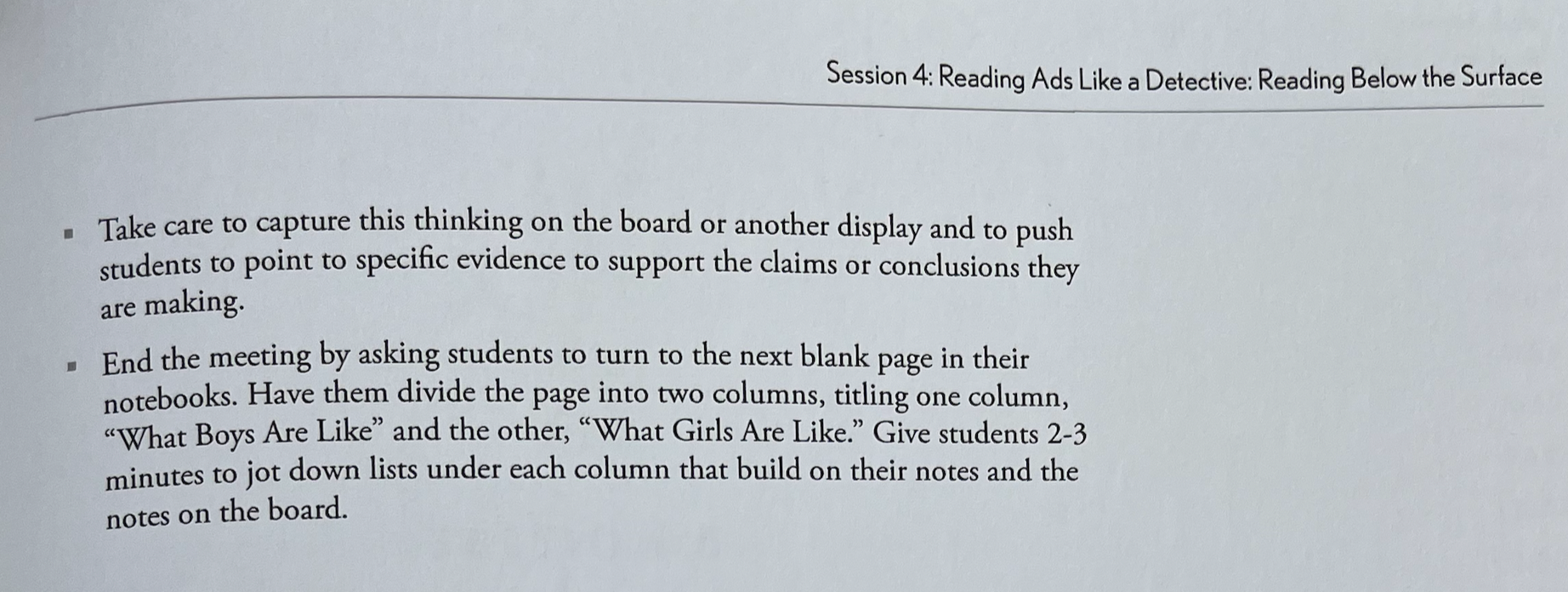
One lesson plan within the ads unit encourages teachers to talk with the class about the implicit assumptions that advertisers make about what boys and girls are like. It suggests that teachers close the session by asking students to make their own lists: “What Boys Are Like” and “What Girls Are Like.”
Gross. This exercise is toxic for boys, for girls, and for non-binary students alike. Why not get expansive and ask our students to enumerate stereotypes of other identity groups, too? What could go wrong?
Section 3: Excerpt from Amazing Grace by Jonathan Kozol
The IBD student reader’s biography of Jonathan Kozol—a white man with Harvard and Oxford degrees—reads, “Jonathan Kozol is an educator, writer, and activist who has spent most of his adult life working with and writing about—and on behalf of—people largely ignored by the mainstream culture…” (emphasis mine). It goes on to describe Kozol’s degrees before introducing the excerpt from a book published in 1995. 1995!
The excerpt follows Kozol as he is given a tour of a South Bronx neighborhood by a buoyant seven-year-old resident named Cliffie. Early in the excerpt, Kozol muses, “There are children in the poorest, most abandoned places who, despite the miseries and poisons that the world has pumped into their lives, seem, when you first meet them, to be cheerful anyway.”
Say what? Kozol doesn’t circle around within the excerpt to back up his claim that the people he meets aren’t in fact as cheerful as they seem. Presumably, our middle-grade readers are meant to trust that Kozol knows best.
The remainder of the text is a judgmental litany of the “miseries and poisons” that Kozol sees on his tour: a medical waste incinerator, a drug park (his words), the site of a recent shooting, a hypodermic needle on the ground, and an empty lot where people dump old metal and furniture.
Is this what SPS means when they highlight our values-aligned, culturally responsive texts?
I am certain that there are many middle-grade-accessible texts written by Black writers in the thirty-plus years since 1995 that describe authentic Black experiences without overtones of judgment and imagined misery. Where is Kwame Alexander? Jacqueline Woodson? Jason Reynolds? Trevor Noah? Why are voices like theirs missing, and why are we holding back the teachers who attempt to bring similar texts into their classrooms?
The problem of limited and stereotypical representation isn’t limited to the sixth grade texts, either. The eighth grade sequence contains two texts focused on Chicano kids. In both, the youths portrayed are members of poor, migrant farming families.
Section 4: McJobs by Eric Schlosser
Again, the IBD biography begins with a description of the white male author’s Ivy League degrees. Schlosser’s are from Princeton and Oxford, though, instead of Harvard and Oxford. Diversity!
McJobs, written in 2001, describes the effects of the fast food industry on labor. The essay emphasizes the importance of a teenage workforce to fast food chains:
…the fast-food industry seeks out part-time, unskilled workers who are willing to accept low pay. Teenagers have long been the perfect candidates for these jobs. They usually don’t have a family to support. And their youthful inexperience makes them easier to control than adults.
Best of luck to the SPS students who are working fast food jobs on the side and feel proud of their work, or to the students whose parents or siblings do. And best of luck to the students who do have a family to support. I’m sure that these sensitive, nuanced portrayals of their experiences will draw them right into the joy of literature.
Weirdly, the seventh grade IBD unit on nonfiction also focuses on fast food, using a 2006 text by Michael Pollan—yet another white male author trained in the Ivy League and at Oxford.
IBD is not a good match for SPS. Overall, its texts are outdated, prejudiced, culturally irrelevant, and disproportionately authored by white writers and men in particular. The digital nature of SPS’s adoption of IBD is also working against best practices for student learning.
So, how is IBD actually working out in SPS classrooms? Join me in Part 2 to find out!