Issue 29 -- SPS Rolls Out Districtwide Cellphone Policy
Phones will be away for the day in K-8 and during class in high school. Not everyone is happy about that last part.
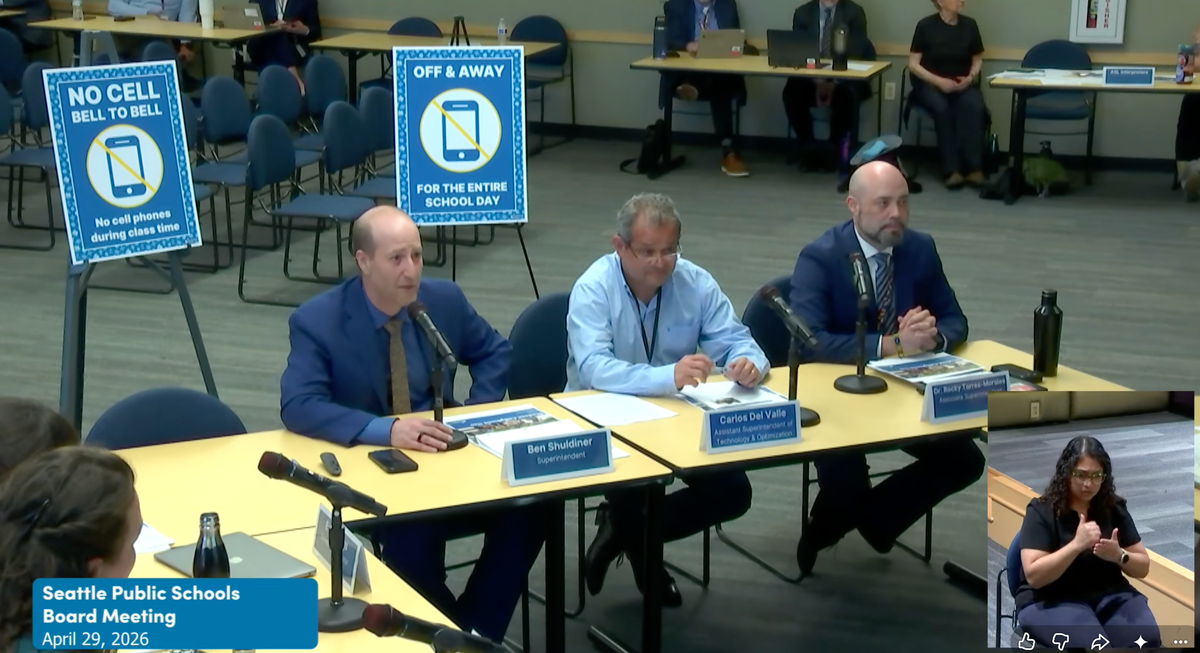
Superintendent Ben Shuldiner announced a districtwide policy on student phone use at the Wednesday, April 29 school board meeting. The policy, which goes into effect on Monday, has two key elements:
- An “away for the day” policy in grades K through 8. A cellphone has to be put away and not taken out at any time during the school day.
- A “bell to bell” policy in high school. Students must put away their phone during class time, but may use them during passing periods and lunches.
There are exceptions to this policy: “Students who require access to personal devices for medical needs or documented IEP or Section 504 accommodations will continue to be supported.” At the board meeting, Shuldiner gave the example of a student needing to check their insulin levels as an example of such an exception.
Schools will determine exactly how these policies will be implemented. Some schools can use a Yondr pouch, some can use a “calculator pouch” on the wall, or something else, as long as the policy is enforced consistently across the school and is in line with these new policies Shuldiner announced.
Other technologies, like smartwatches, aren’t covered — yet. Shuldiner said the cellphone policy is just the start of a “much broader" approach to technology policy. Many schools do already regulate smartwatches, requiring they be in “Schooltime” mode or not used at all.
Shuldiner acted in response to requests from parents and principals for a districtwide policy. The state legislature’s failure to pass a personal device in schools policy in the 2026 session also spurred him to announce the policy. Shuldiner told the board at last night's meeting:
“No offense to OSPI and to the state, but they know it's a problem too. And what was the response? Let's study it until 2030.
That's not what we're doing, and that's not the kind of school district that we're gonna have here, is that if we know we've got to do something, we're gonna act, we're gonna be thoughtful, we're gonna listen to folks, and we're gonna do what's right.”
Enforcement of the policy will still be left to the school. Student Representative Sabi Yoon raised some questions about that, noting “the enforcement piece is still a little lacking,” and that this could just lead to teachers yelling at students in the absence of something more specific. Shuldiner replied that this would be enforced the same way as any other rule about classroom behavior.
Contention Over the High School Policy
Board members welcomed the K-8 “away for the day” policy. But some expressed strong disagreement about the “bell to bell” policy as announced for high schools.
At the core of the issue is how to balance the needs of teenagers who are demonstrating increased independence, as is developmentally appropriate, while also addressing the harms of cellphone use.
In his introductory remarks, Shuldiner said he felt it made sense for the policy to be most restrictive for younger students, and become more flexible as students age, gain autonomy, and develop greater needs for their phones. Some high school students around the country have reported concerns with an all-day ban on phones at school potentially making it harder for them to communicate with employers or after-school programs.
Shuldiner also pointed out that high school students asked for a more flexible policy. “If we actually believe in student voice, we have to actually believe in student voice,” he said. “We can't believe in student voice only when it's convenient.”
Director Evan Briggs pushed back. “I have some pretty strong feelings about this,” she said, and took issue with the high school portion of the policy.
Briggs pointed out that in most states, the phrase “bell to bell” means the same thing as “away for the day” — a complete ban on using personal devices during school hours. “I don't think Seattle should have its own special meaning for words that are widely understood to mean something else,” she said.
Shuldiner’s presentation cited research that shows “students can take 20 minutes to refocus after each phone distraction.” That led Briggs to question the high school version of the policy, noting that a cellphone has been described as a kind of digital slot machine that constantly seizes attention:
“If a kid is walking into class looking on their phone and the bell rings, they put it in their pocket, again, slot machine in their pocket, and it's going to take them 20 minutes to refocus, I'm skeptical that we're going to see much of a positive outcome.
As a mom of two teenagers who fights this battle constantly, I'm going to really, really push for us to be way more aggressive about this because I genuinely believe that it is absolutely in the best interest of children.”
Emily Cherkin, a former teacher and SPS parent who has become a national and international leader in addressing the harms of screens on kids, raised similar concerns to the Seattle Times: “How, if passing periods are five minutes long, will that additional 15 minutes to refocus in class not negatively impact both teaching and learning?”
Shuldiner responded to these concerns by pointing out that SPS high schools have open campuses, and that enforcement of phone bans during lunch, or even during passing periods, would be more challenging than in class. But he did not rule out revising the policy after seeing how it plays out in practice in the coming weeks.
During his introductory remarks, Shuldiner noted “this is my call,” that he is implementing this policy under his authority as superintendent. The school board does still have the power to implement a policy that would override this should they choose to do so.
What About Devices Issued by SPS?
In recent weeks concerns have grown among SPS parents about the broader impact of student screentime in class, particularly the iPads and laptops issued by the district to each student. As we covered in Issue 24, some community members have organized as Seattle Families for Intentional Tech to address the concerns with EdTech in the classroom. Several members of this group spoke out at last week’s school board meeting, and presented a petition for limits on EdTech with nearly 1,000 signatures to the board.
At last night’s school board meeting, Shuldiner did not directly address these concerns. He did say that “we do know that there are concerns about all sorts of other technologies, and that's something that we're going to be working on moving forward.”