Issue 53 – School Board Votes to Accelerate Closure Timeline
Directors reduce public input in the closure process, while the Superintendent tries to keep reporters out of community meetings.
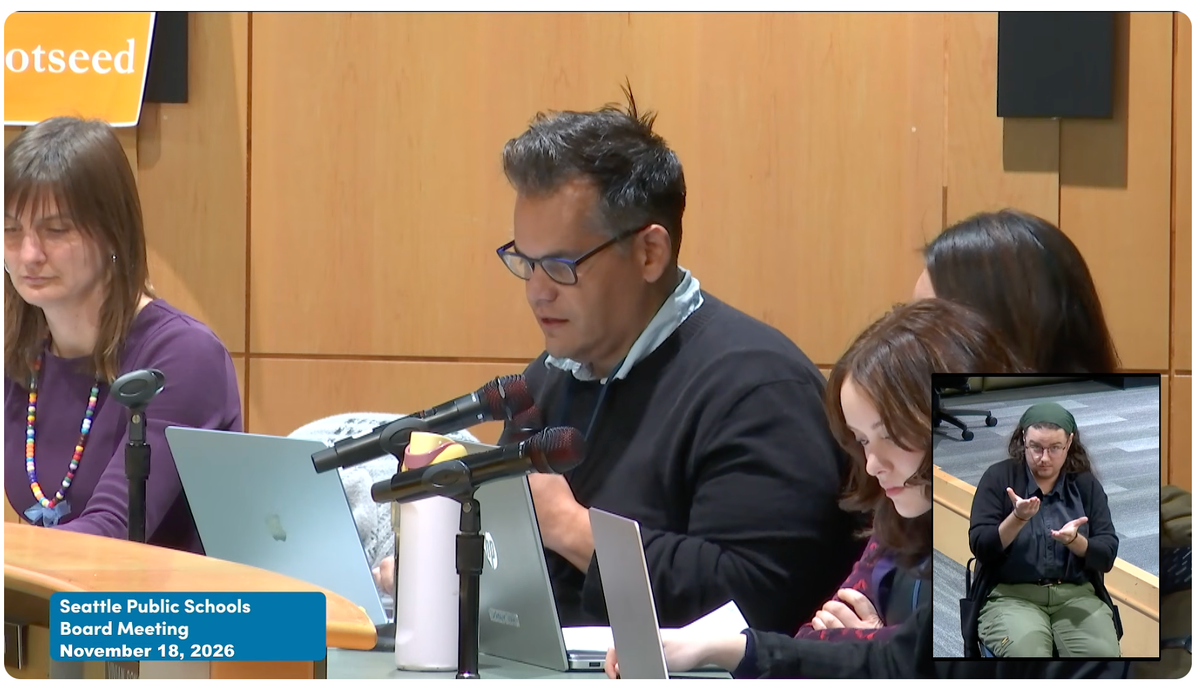
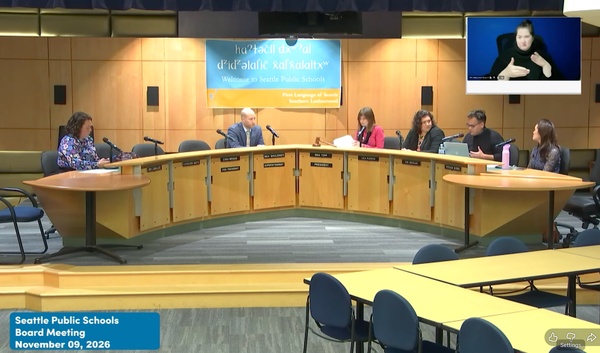
On Wednesday night the Seattle Public Schools board of directors voted to put school closures on a fast track, speeding up the process by shortening the amount of time members of the public will get to review and comment on closure plans.
The board also voted to give the Superintendent new powers to close “instructional sites” without a public hearing or board approval. Several board members raised concerns about this, but the vote passed unanimously. However, the meeting did not provide clarity about how this process would actually work, or what schools and programs would be covered. Even board President Gina Topp said she was “still very confused” by the discussion about instructional sites.
The board meeting’s agenda, video, and transcript are all now available.
The decision to accelerate the closure process amid growing criticism of Superintendent Ben Shuldiner. He had attempted to prevent reporters from the Seattle Times and the West Seattle Blog from attending the community meeting held on Monday night at Highland Park Elementary School to discuss the proposed closure of Sanislo Elementary School and merging it into Highland Park. Attendees at the meeting objected, and the reporters stayed.
Regardless of what the intent behind all of these decisions may have been, the impact is to further limit the role of the public in what is one of the most consequential SPS has faced in several years – and to potentially make it much more difficult to stop school closures.
In this issue:
- Board Puts Closures on the Fast Track
- Board Hands Superintendent Unilateral Power to Close Instructional Sites
- Shuldiner Tries to Keep Media Out of Closure Meetings
- The Fast Track Becomes a Bullet Train
Board Puts Closures on the Fast Track
The school board voted to approve a major revision to its closure policies. The revision had two major components: speeding up the timeline to close schools, and giving the Superintendent unilateral power to close “instructional sites.”
The first component eliminates various steps SPS had added to the closure process that exists in state law. Under Washington State law, districts must wait 90 days between proposing to close a school and taking a final vote to close it. During those 90 days, the school board must hear public testimony about the proposed closure, and must have separate hearings for each school that is to be closed.
SPS had additional requirements, including a 30-day waiting period after an initial recommendation and a 14-day waiting period after a final recommendation. The newly adopted revision to the policy sweeps away those waiting periods, potentially accelerating the current closure process significantly while giving the public less time to review and comment on closure plans.
Directors justified this by arguing their changes would help the public provide input earlier in the process. Director Joe Mizrahi, who introduced the proposed change, defended it by saying:
“We want to hear from the public. So all we're doing is moving forward that waiting period, which only serves for us to be putting an artificial barrier between us and hearing from the public.”
Other directors gave their own variation on that company line. Director Jen Lavallee said the change “allows a little bit more flexibility on that scheduling.” Board President Gina Topp said the change “allows for us to hear sooner from our community, to design the meetings we want, to have the same number of hearings.”
But the board already had the power to hear from the public on closures. None of the directors explained why they had not previously called public meetings to discuss the possibility of closing schools, even though closure discussions have been taking place for months.
Shuldiner said as early as May, shortly after he took over as Superintendent, that he was considering closing schools. Shuldiner acknowledged in his October 25 newsletter that he had been meeting with school leaders and SPS staff for months to discuss possible closures. The board was aware of those discussions as they were happening.
If the board wanted public input earlier in the process, they had every opportunity to gather it. They chose not to. And of course, the public can always email the board or show up to testify at a board meeting. The changes the board just adopted to the closure policy were not needed to facilitate earlier or additional public engagement. Their primary impact is to speed up the closure timeline.
Several directors acknowledged this. Directors Mizrahi and Lavallee both cited the school choice process, which normally begins in February, as a reason to speed up the closure timeline.
It’s not clear when exactly a vote to close schools could happen. Presumably, the 90 day clock in state law began when Shuldiner sent his newsletter on October 25 announcing his intent to close schools. However, that email did not list specific schools that would be closed, and therefore may not qualify as an announcement under state law.
If that email is indeed the beginning of the 90 day period, that means the board could not vote to close schools before January 25. The board would also have to cram in public hearings at each of the 10 schools slated for closure, likely in January.
Some schools are indeed being told that Shuldiner wants the board to vote before February. Friends of Salmon Bay, the PTO for Salmon Bay K-8 (which would “receive” Licton Springs K-8 when that school is closed), said in an email to its members on Saturday that based on what they were told by SPS administrators, “Proposals [for closures] could be brought to the School Board for vote as early as January 2027.”
Whether that October 25 email counts as an announcement to the public and truly began the 90 day clock is likely to wind up as the subject of litigation. In any event, the school board appears determined to vote on closing schools as soon as possible, even at the expense of a robust and complete public conversation.
Board Hands Superintendent Unilateral Power to Close Instructional Sites
The other piece of the revisions to policy 6883 that the board approved gives the Superintendent unilateral power to close “instructional sites.” But the board did not appear to have a clear understanding of what those sites were, or exactly what powers they were handing over.
One Redditor claimed that The Bulletin’s previous article on this subject was “inflammatory” and that the proposal was intended to allow the Superintendent to close down buildings on a campus for safety reasons. But the discussion at the board meeting did not fully support that claim.
The discussion at the board meeting did not provide a specific definition on what an “instructional site” actually was. Shuldiner said he would use the policy to move programs around, sometimes for safety reasons but sometimes not. He said he would not close programs, though the policy itself appears to be written more expansively.
Director Mizrahi argued that this policy could not be used by the Superintendent to close down dual language or HCC programs, because those are “governed by the student transition assignment plan.” He added that the goal of the change was to allow the Superintendent to shut down “instructional sites that might be closed down or moved for all sorts of reasons” and do so without a board vote, though he did not explain why that was a necessary change.
Director Lavallee added that the instructional site policy changes “would piggyback with the policies that we're looking at within the operations committee.” Lavallee did not specify what those policies were. But the most recent Operations Committee meeting, on November 2, included discussion of the “delegation policy” that would implement SOFG 2.0.
That policy includes the following language:
“Except where Board approval is required by law or established in Board policy, the Superintendent is authorized to determine the specific academic programs, instructional practices, organizational structures, staffing models, curriculum implementation strategies, and other methods used to achieve the Board’s Academic Outcome Goals within the expectations of the Board’s Guardrails.”
Combining that language with the new policy giving the Superintendent the option to close instructional sites means one cannot discount the possibility that a Superintendent would be able to unilaterally close a program.
Director Song said she “kind of struggled with the instructional site piece” of the proposed policy change. She mentioned a recent board vote to close a Middle College location and asked whether this instructional site policy would allow similar closures without a board vote.
Shuldiner responded that he sees this policy as facilitating the movement of a program from one site to another, rather than closing it. With the new policy, he said,
“The Superintendent can go to the board and say, look, I'd like to move the Firefighter Academy to a building that's a little bit stronger, a little bit better.”
He cited the Skills Center or Bridges Academy as programs he might move around unilaterally, now that a board vote is no longer required, but that he would not close them. He acknowledged that the only assurance the board had was their own power to vote to stop a Superintendent. Of course, if the SOFG 2.0 policy was adopted, they’d be giving up a lot of that power.
President Topp summed it up when she said:
“I am still very confused as we talk about instructional sites, as we talk about programs, as we talk about services, what and when the board has to approve openings and closings and how that then is all intertwined with the student assignment transition plan.”
However, Topp ultimately voted yes on the policy change, as did all other board directors.
Shuldiner Tries to Keep Media Out of Closure Meetings
On Monday night the first community meeting regarding closures took place. Highland Park Elementary School hosted the event, as Shuldiner proposes closing Sanislo and moving its staff and students to Highland Park.
We’ll cover this meeting, and SPS’s approach to closures, in more detail later this week. You can read an excellent overview of the meeting from Tracy Record at the West Seattle Blog, and Dahlia Bazzaz at The Seattle Times has a good article as well. You can read a transcript of all but the last 10 minutes here.
The meeting began on a controversial note, as Shuldiner attempted to kick Record and Bazzaz out of the room. Shuldiner argued that it was “unsafe” for anyone from the broader public to be there:
“If you're in this room and you're not a family member, it really would be the right thing to do to not be here. I'm concerned that there are people in this room that are not family members, that are not connected to the schools, and I think that will be an unfair and unsafe situation for the folks.”
Shuldiner then referred specifically to Record:
“There is a member of the media in this room. She's sitting right over there. I don't know if that's going to make people feel safe or not. We've asked her kindly that this is a family meeting. She is not leaving. It's up to families. This is your meeting. It's your space. I want you to feel comfortable.”
Record and the West Seattle Blog are beloved members of the larger West Seattle community. Attendees at the meeting very strongly objected to Shuldiner’s attempt to kick Record out, and demanded she stay. Shuldiner relented, and with Record staying, Bazzaz stayed as well.
In her article, Record explained her reasons for attending the meeting:
“As a journalist since age 17, I deeply believe that to the contrary, in a situation like this where elected officials are going to make an impactful decision involving public money, public land, and community members, more information being available – responsibly, accurately, and impartially reported – to more people sooner is actually a “safer” and better thing.”
The Bulletin strongly agrees. So too do other members of Seattle’s media, which condemned Shuldiner’s attempt to keep the meeting closed. Charlie Harger at KIRO Radio strongly rejected Shuldiner’s claims, saying “everyone who pays for Seattle schools has a stake in the decision, and the media has a duty to cover it.” He urged Shuldiner to allow reporters into the room at future meetings.
Instead, Shuldiner might double down. Two sources tell The Bulletin that SPS staff said at a recent PTO meeting that Shuldiner plans to have security at future community meetings to keep reporters and anyone who isn’t a family member out of these meetings. If that happens, SPS should expect a lawsuit.
Shuldiner has worked hard since becoming Superintendent in February to win over the media with an aggressive PR campaign. Until now, it had been working. But the media has increasingly turned critical of Shuldiner and SPS in their handling of closures. Harger pointed out that by shortening the closure timeline, there is “less time to review, and the superintendent doesn’t have to explain himself in public.”
Harger’s colleagues at KIRO, Gee Scott and Ursula Reutin, criticized the school board for speeding up the process and giving more closure power to Shuldiner. They believe the board is “setting Shuldiner up to take the blame” for the unpopular decision to close schools.
The Fast Track Becomes a Bullet Train
The end result of the policy changes and Shuldiner’s desire to limit public engagement in the closure plan is that what was already a fast track to close schools has gotten even faster. To continue the metaphor, closures have become a Shinkansen barrelling down the tracks, and access to the stations is being strictly limited.
The board’s stated intent appears to be to have public engagement earlier in the closure process. But so far, the board has not yet scheduled any of the legally required public hearings. Meanwhile, Shuldiner is trying to kick the media and the wider community out of the meetings he has convened.
Regardless of the intent, the impact of these decisions is that the people of Seattle have less time to consider the pros and cons of closing 10 schools, and less involvement in one of the most important decisions SPS has faced in years.