Issue 51 – SPS Digs In As Community Demands Tech Policy Change
Parents, newly elected state legislators, and some board members call for limits on tech in the classroom. Shuldiner and his lieutenants pushed back, especially on AI.
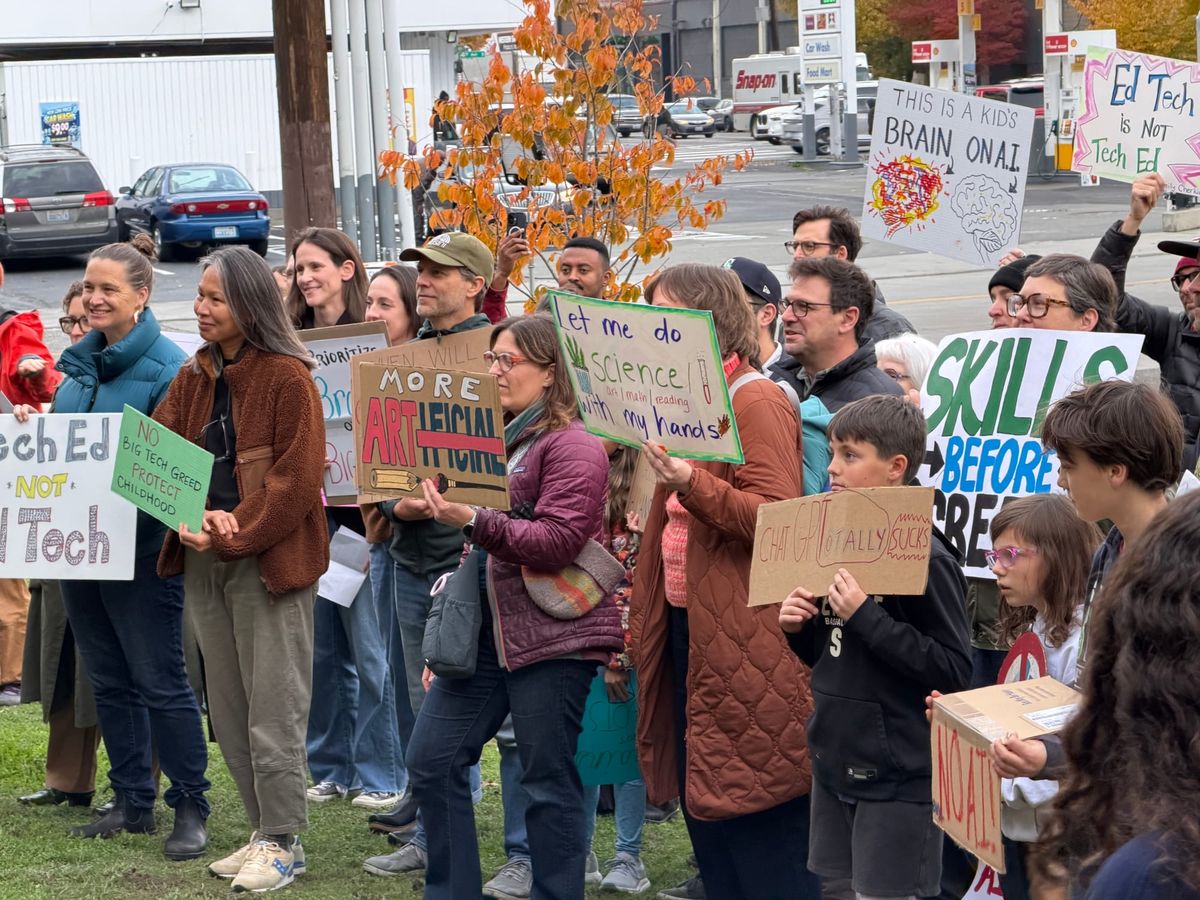
A large crowd gathered on the lawn outside the John Stanford Center for Educational Excellence, headquarters of Seattle Public Schools on Wednesday, November 4, to demand the school board adopt limits on technology in the classroom – including a moratorium on generative AI. They rallied ahead of a special board meeting that included discussion of SPS tech policies.
That same day, Superintendent Ben Shuldiner announced new policies limiting tech in the classroom, including additional screen time limits in elementary grades and bans on YouTube, Minecraft, and Google AI tools.
But SPS administrators appeared unwilling to go further and adopt the full list of intentional tech policies the public sought, especially a moratorium on AI.
Seattle Families for Intentional Tech (SFIT) organized the rally and its leaders spoke. Newly elected state legislators Danica Noble and Kelabe Tewolde were also in attendance.
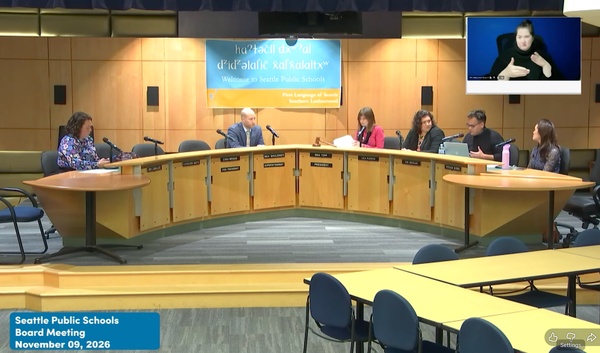
At the board meeting itself, Shuldiner and his administrators delivered a presentation largely focused on defending their use of technology with values language, rather than provide data and research about its impact on SPS students to facilitate a deeper policy discussion. The presentation did not cover in detail contentious tech programs, for example only briefly mentioning the MagicSchool AI program used in many SPS classrooms.
Director Evan Briggs said during the meeting that the presentation was “based on vibes” and slammed its lack of data justifying the use of AI or the district’s current approach to digital curriculum.
SPS administrators defended reliance on digital curriculum, opposed giving schools flexibility in its use, and overall did not show interest in a fundamentally different approach to using tech in the classroom. On generative AI, Shuldiner and his team argued that students needed to be exposed to it and use it. To him, the issue to resolve with AI appears to be whether a specific tool is age appropriate, not whether AI should be used in SPS classrooms at all.
In Shuldiner’s newsletter on November 8, he wrote “it was clear that the district had steered too heavily into an overreliance on technology, especially regarding the percentage of screen time our children were exposed to during the school day,” and touted the newly announced limits as a return to “hands-on learning.” But his actions suggest a less ambitious approach to addressing that overreliance.
Concerns about AI in schools are growing across the country. But judging by the conversation at the November 4 board meeting, it may take the school board to implement substantial changes to ed tech policy in SPS. In Portland their school board responded to intentional tech advocates by actively working on new policies with public input.
Intentional tech advocates welcomed the new announcements, but at the same time raised concerns about the overall direction of SPS policy. In an email sent to supporters the day after the rally, SFIT described ongoing concerns about ed tech policy and said “We’re disappointed that the district seems to be picking away at smaller issues and really seems to minimize concerns about AI.”
Emily Cherkin, who spoke at the rally and stayed for the whole board meeting, summed it up when she said “They aren’t listening to us, but they have realized they cannot ignore us anymore.”
That's the tl;dr: version. Now for the deep dive. In this issue:
- Strong Turnout to Rally for Intentional Tech Policies
- The Board Meeting Finally Gets to EdTech
- SPS Announces Additional Screen Time Limits
- SPS Leaders Defend Digital Curriculum
- SPS Administrators Strongly Defend AI Education
- Election Day is 12 Months Away
Strong Turnout to Rally for Intentional Tech Policies
Speakers at the rally made a strong case against SPS’s reliance on screens and devices, and called for the district to move toward intentional tech policies that are rooted in evidence and facts. Many speakers raised concerns about "cognitive offloading" and called for a moratorium on generative AI, which SPS has so far refused to do.
SFIT co-founder Erica Shutes-David and rally organizer Ashley Worobec both spoke in support of their six asks of SPS. “I send my child to school to learn and for his brain to develop, and these tools are used to shortcut all of that thinking, and it doesn't make sense to me that it's being used in schools during these crucial developmental years,” said Worobec.
SPS parent Corinne Reschenthaler spoke about SPS leaders refusing to let her student opt out of using a digital device to complete their schoolwork. She pointed out that many private schools in the area have been adopting intentional tech policies, but felt she should not have to go private in order for her child to get a good education.
One parent brought a sign referencing a “robot dog” video that SPS families reported was shown to their elementary students in order to get them to embrace AI.

Video reportedly shown to elementary students in SPS
Noble, the newly elected state legislator and former Federal Trade Commission consumer protection attorney who had taken on Big Tech, said “We have more regulations on opening a sandwich shop and providing deli meats than we do on large language models interacting in our classrooms.” Noble’s victory in the 32nd Legislative District, covering north Seattle, Shoreline, and southern Snohomish County, was due in part to her taking a strong position on AI regulation.
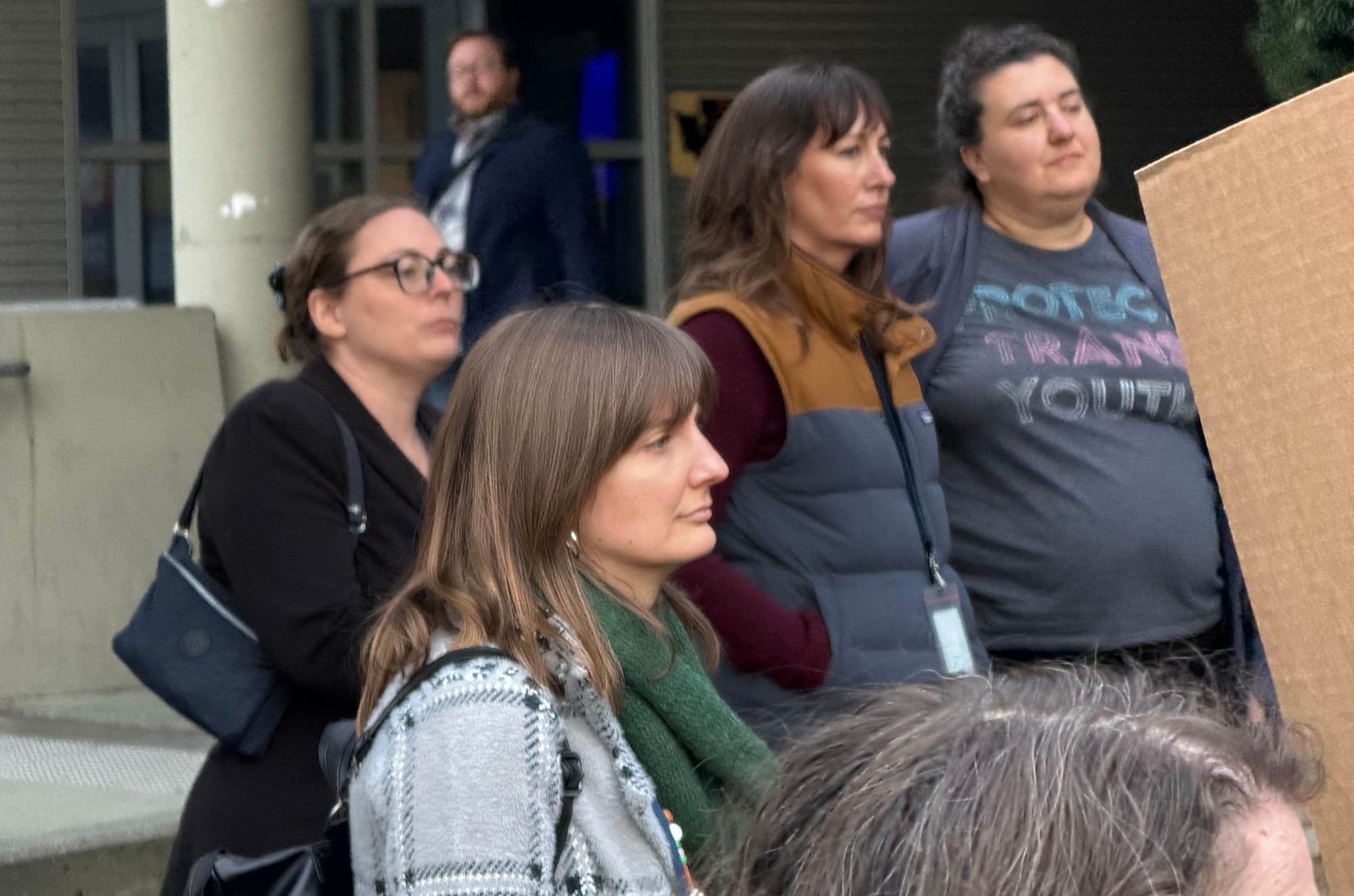
Shuldiner and at least five board directors were in the audience listening at the rally. The rally received extensive media coverage.
The Board Meeting Finally Gets to EdTech
As the board meeting got under way, President Gina Topp announced that the board discussion of tech policy and AI had been moved from 4:30pm to nearly 6:30pm, leading to some frustration among rally attendees.
The presentation, which you can see here, consisted mainly of values-based arguments in defense of tech in the classroom. It was light on research and data and did not provide a clear evidentiary basis for current SPS policies that rely heavily on digital curriculum and devices. The presentation was structured in a way that left little time for board questions.
Assistant Superintendent for Curriculum and Instruction Michael Starosky delivered most of the presentation, with help from Carlos del Valle, Assistant Superintendent of Technology and Optimization, and Debra Knickerbocker, digital learning manager. Shuldiner regularly added his own comments during the presentation.
Starosky has been embroiled in controversy lately, as families who seek to opt their kids out from using digital devices in the classroom report that Starosky has been blocking these requests.
One of the most remarkable parts of the presentation was Starosky’s claim that “I know what students think” about the use of technology in the classroom. Starosky did not present any evidence to back up his claim, even as two student representatives were sitting right there at the table.
SPS Announces Additional Screen Time Limits
The ed tech portion of the board meeting began with the announcement that SPS is now going to block YouTube and Minecraft from SPS devices, as well as Google’s Gemini AI and Google’s AI search results.
The blocks of YouTube and Minecraft, which took effect on Monday, are in part a response to public concerns about students goofing around on their school-issued iPads and laptops. Some educators do use YouTube in class (as a former educator myself, it is often a priceless way to show important videos, in a history class for example). Others have used Minecraft for lessons on design and mathematical properties. Shuldiner said he consulted with educators to ensure legitimate uses can continue, but students will otherwise be banned from using these.
Google has reacted harshly, saying it will block the ability of students to even do a basic Google search if districts block Google’s AI tools. That in turn prompted a furious response from New York City Mayor Zohran Mamdani, a leader in the fight to keep generative AI out of public school classrooms. Mamdani denounced Google’s stand:
Google is trying to use its monopoly power to force AI into our public schools.
— Mayor Zohran Kwame Mamdani (@NYCMayor) November 3, 2026
No corporation should have the power to dictate how we teach our children.
Our public schools exist to serve students, not to grow the profit margins of Big Tech.https://t.co/jfACMS1Sh2
At the board meeting, Shuldiner and Starosky said they did not believe Google’s announcement would impact SPS.
These announcements are a welcome step, but do not solve the larger issues with how students often misuse the 1:1 devices handed out to them. As Cherkin pointed out, “children find the workarounds – always!”
Students as young as elementary school often find ways around SPS’s blocks, seeking access to video games they can play during class. Students trade information about secret URLs so they can do gaming while in class. Parents have asked SPS to “whitelist” certain sites that have legitimate educational use, blocking all others, but SPS has so far said they cannot do this.
The misuse of the 1:1 devices, often a larger distraction in the classroom than smartphones, is a core concern of intentional tech advocates. They’ve asked SPS to end the 1:1 device policy for all grades, as have public schools in LA and NYC. But SPS has so far refused to do so.
SPS did announce in September that they were ending the 1:1 device policy in grades K-2, and is now extending it to grades 3-5. Those policies are slated to take effect in January.
SFIT, as well as some educators, have asked for schools to instead keep these devices on a cart and check them out when needed for a specific educational purpose. So far, SPS has not agreed to this policy, according to SFIT. Principals were told to “check with their executive director” about whether they could implement a cart policy. (SFIT representatives say the Seattle Times article that reported K-5 students would only be issued devices from a cart or a lab is incorrect.)
SPS Leaders Defend Digital Curriculum
It became clear in the presentation and discussion with the board that a major factor blocking SPS’s ability to further limit screens in the classroom is the fact that so many of the district’s curriculum are built on the use of digital devices.
In response to questions from Director Briggs, Shuldiner said:
“We have math curriculum, we have English curriculum, we have science curriculum, social studies curriculum. We have recess, we have PE. We have all these things. The way that they're going to be exposed to screen time should only be through the approved curriculum.”
Starosky argued that a positive example of digital curriculum was that in the new Emerge! Curriculum, students can upload a recording of their reading fluency and – “when the teacher is available” – that teacher can later view and respond to it.
But that flies in the face of accepted research about how students learn reading fluency – by receiving immediate feedback from their teacher in a human interaction.
The battle over screens and devices in the classroom is, it appears, fundamentally a battle about curriculum. With so much of SPS’s curriculum being delivered on screens, moving away from so much screen time means changing how curriculum is used in the classroom. That has been done successfully by districts around the country and around the world, who do not use the adopted curriculum as an excuse to refuse to innovate.
SPS administrators insist on “standardized curriculum” that is taught with “fidelity” – meaning, exactly as the publisher intended, even if doing so clashes with research-backed findings about the use of screens in class. This push for standardization and flexibility does not appear rooted in facts or evidence, but instead in the central office’s desire for control.
Reducing screen time in class, or ending the 1:1 device policy in all grades, requires flexibility in how curriculum is used. SPS leaders won't do this, and have instead been stamping out flexibility in recent months. It is this refusal that is getting in the way of SPS adopting the intentional tech policies community members seek.
The top-down push by SPS for standardized curriculum has had other impacts that have come under criticism from some parents, educators, and students. Shuldiner has cited a desire for elementary schools to have a standardized school day, in part to teach the new K-5 ELA curriculum exactly the way the publisher intended, to justify his new policy capping recess time at 30 minutes. This policy led to cuts in recess time at several schools, with harmful impacts to the classroom and to student learning.
Parents have also begun to flag that district inflexibility on curriculum is preventing SPS from bringing back “walk to math” and other advanced learning programs. Others have pointed out that this inflexibility has even led district administrators to tell teachers they’re not allowed to assign whole books to middle school students.
A policy of “standardized curriculum” is one with major impacts, and therefore it should be adopted and implemented only after extensive public discussion and a board vote. But that hasn’t happened. It’s another trend in SPS, where major decisions with significant impacts are made by administrators, rather than the board or the public. Other examples are SPS’s insistence on digital curriculum, and Shuldiner’s belief that SPS should propose a school closure plan – major decisions made without close examination or a board decision.
Shuldiner made a curious comment at the board meeting about one of the district’s digital-based curriculum. In response to a comment from Director Briggs, who said “there’s no research” backing the use of digital-heavy curriculum, he described the new K-5 ELA curriculum, Emerge!, as “top of the line.”
But that’s different from how he described Emerge! last spring when the board voted to adopt it. At the time, Shuldiner was neutral about Emerge!, pointing out it was brand new and had not been reviewed by EdReports. “I have no indication this is not a good curriculum,” Shuldiner said in March. “My concerns are there isn't necessarily this third-party validator that, in my experience, I would just always use.”
SPS Administrators Strongly Defend AI in the Classroom
One of the main reasons for holding the rally was to raise concerns about generative AI. Shuldiner left this topic to the end of the presentation.
SPS administrators’ comments were rooted in a fundamental belief that students should not only be exposed to, but should be using, AI in the classroom.
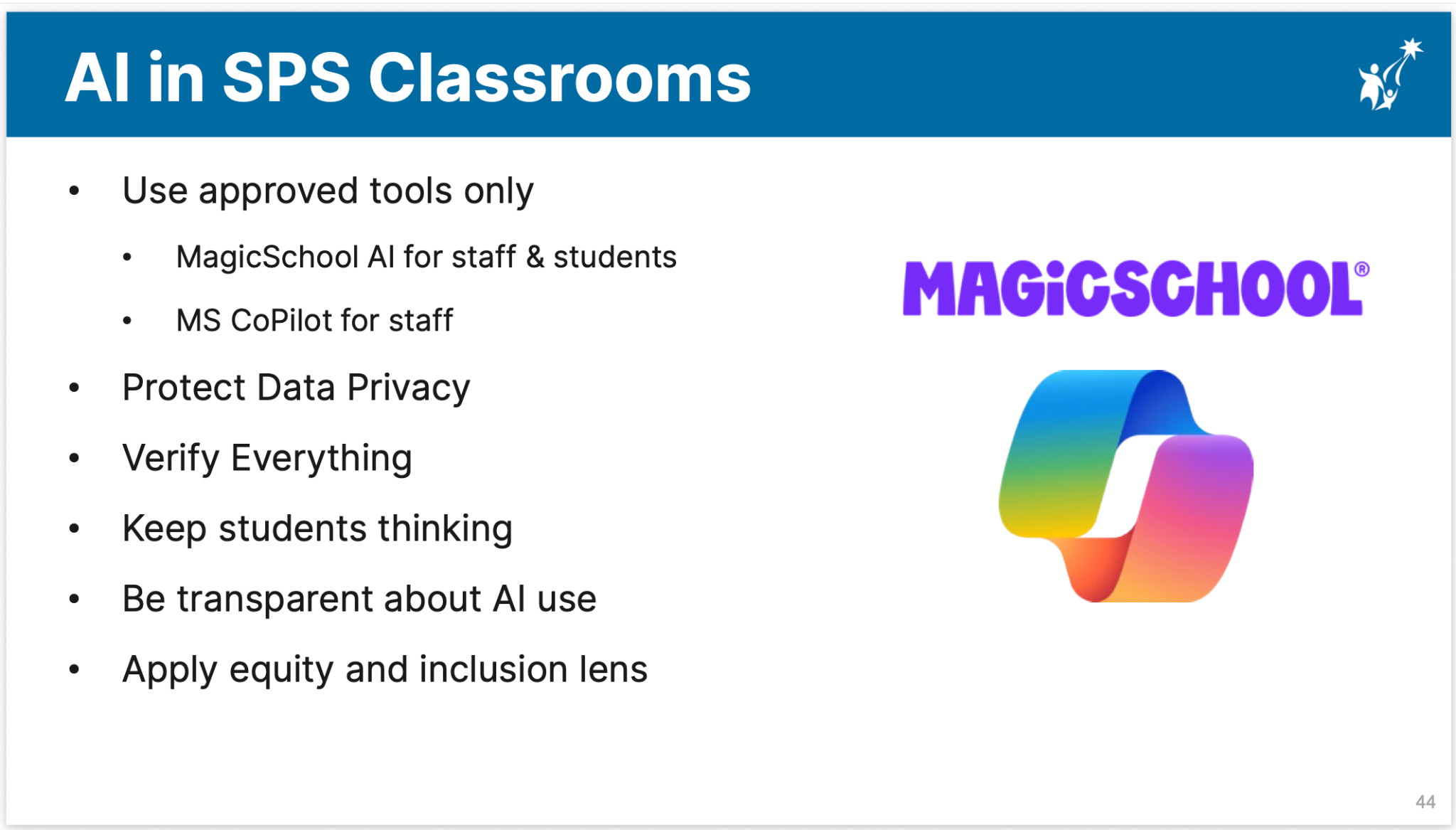
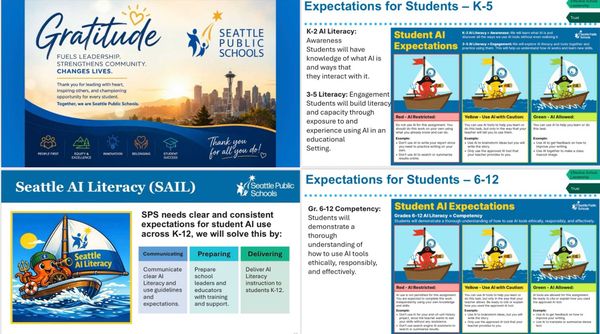
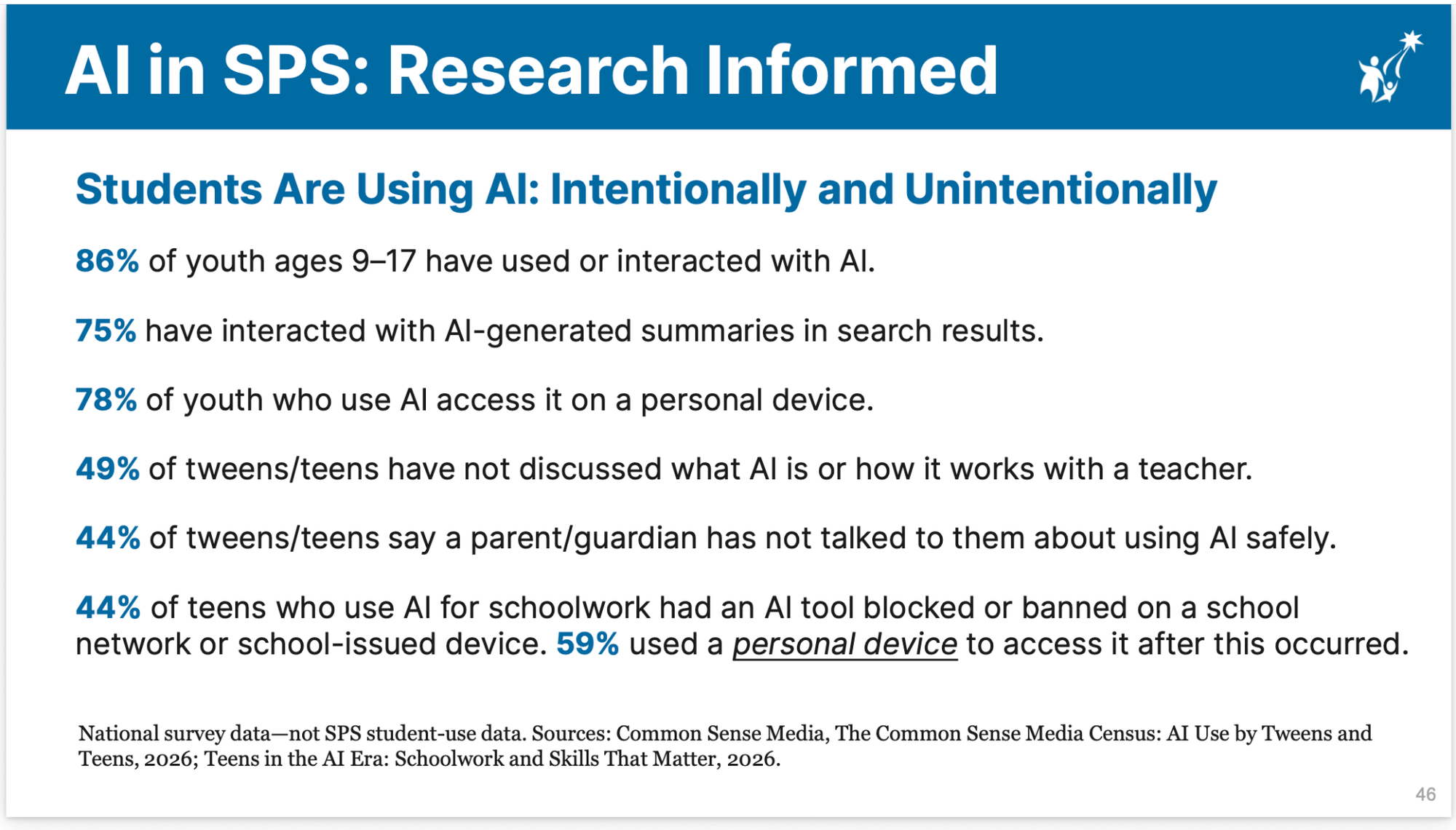
Knickerbocker argued that students are already using AI out in the world and at home, so it would not make sense to keep it out of SPS classrooms. She presented this slide to justify that position:
When one of the student representatives, Josephine Mangelsen, asked for a specific example of how AI would be used as a tool for student learning, Knickerbocker responded by saying “clearly you haven’t used MagicSchool yet.” Mangelsen explained that actually, she had, and that a teacher had used that AI tool to crosscheck an assignment with a rubric.
Knickerbocker then described a class where students interacted with an AI based on a character in a novel they had read. “Their job was to evaluate whether they believed this is how the character would react or not.”
When asked if SPS could turn off features in Microsoft Word that use AI to rewrite sentences students typed, Knickerbocker said they could not.
Students have also reported that teachers are using MagicSchool extensively to grade their work. This was not addressed in the presentation given by SPS administrators.
Shuldiner sparked controversy when he argued that “Not to make a different kind of political point, but ‘abstinence-only’ doesn’t work.” This argument got a strong response from intentional tech advocates, and from board members.
Director Kathleen Smith, who works in AI development for Microsoft, was skeptical about using AI in the classroom. She dismissed Shuldiner’s “abstinence” argument by pointing out that while SPS does not teach “abstinence only” sex education, “you don’t want those [sexual] situations happening in the classroom.”
In fact, the Seattle AI Literacy (SAIL) project posters on display in schools clearly intend for students, including in grades K-5, to be allowed to use generative AI.
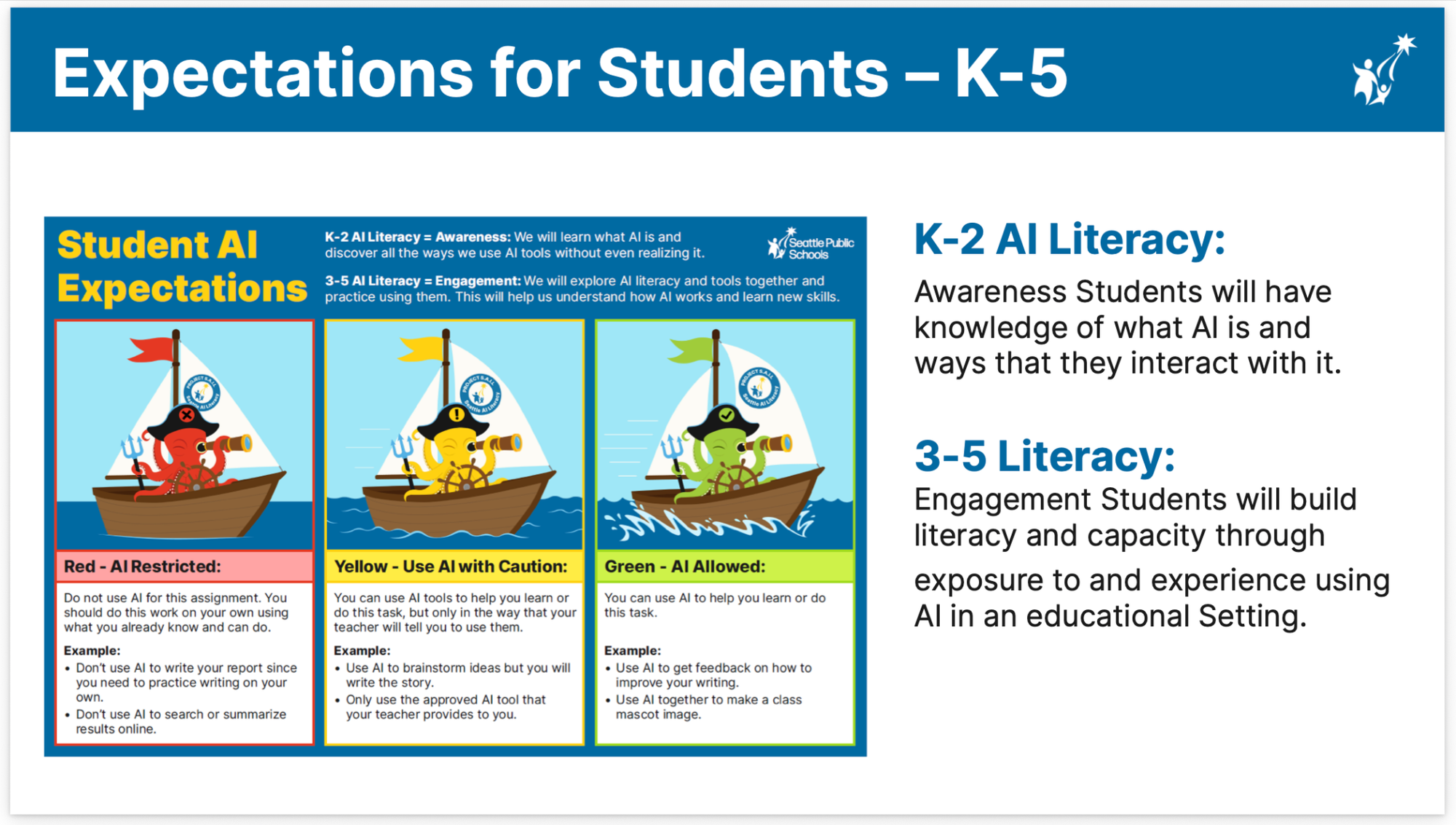
The district’s approach to AI does not appear to be one of abstinence.
Director Briggs slammed the district’s approach to AI and to ed tech more broadly in her comments at the meeting:
“I have seen no data to suggest this is supporting enhanced learning for students. Nowhere in this presentation was there any data that said, well, ever since we've incorporated MagicSchool, reading scores have gone up this percent. We don't know if this is actually enhancing learning, but we're making a lot of assertions that we think it does – when what we do know is that paper and pencil and critical thinking is actually really good for kids' brains.
So I'm still struggling with why we have bought into this when it's unproven and untested.”
Briggs went on to cite the tragic story of a Seattle resident who used ChatGPT to adjust her medications, receiving bad advice that led to her death. She also noted that many Silicon Valley tech workers and executives send their kids to schools that strictly limit the use of AI and digital devices.
Shuldiner responded by arguing this is why students need to be made aware of AI tools and how to use them.
Shuldiner discussed AI on KUOW’s Soundside on Monday, November 9. He equated AI to a Skinner box (a device used to experiment on animals), and once again argued the main issue to decide about student use of AI in schools was the age to introduce it, not whether to introduce it:
“I think it would be really really problematic for a school district who purports to get kids to be career and college ready to not have any skill or any time around AI. But I think the really valid and important concerns I'm hearing from families is around the age appropriateness of it, right? And I think that we have to be very thoughtful around when we expose students to technology in general and then when do we want to start having kids and students learn how to use things.”
SFIT said in an email to their members after the meeting that the district’s approach to AI was “a big lingering concern,” adding “While we hope to continue having conversations with the district, it seems imperative that families contact their board members and support their push for unbiased data and a more cautious approach to AI.”
Cherkin concluded that “it is clear to me they do not understand the concerns being raised and do not really have genuine interest in trying to understand.”
Election Day is 12 Months Away
The rally and the subsequent board meeting suggest a significant disconnect between the public and the district administration on policies regarding the use of technology in the classroom. SPS administrators do not appear interested in a more substantial change to the use of screens in classrooms. They won't scale back the role of digital curriculum or allow schools more flexibility in its use. They are unwilling to suspend student use of generative AI.
With the administration dug in on the fundamentals, it is up to the school board to intervene. After all, it’s their role to set policy, and under state law it is the board that is “accountable for the proper operation of their district” – “whether or not acting through its respective administrative staff.”
Portland’s school board isn’t waiting. They’ve launched a Tech Recalibration Initiative, in response to advocacy from Schools Beyond Screens. The district is conducting family surveys and holding community meetings to develop the policy, led by the school board – which will adopt the new guidelines by June.
So far, Seattle’s school board directors have not yet shown a willingness to act. This seems like a good moment for the board to follow Portland’s lead and develop and implement policies regarding ed tech and especially generative AI. The Superintendent and his staff would certainly be able to advise, but this is a topic where the public and their elected representatives need to make the decisions about how our community wants our kids to learn and how we want them to engage with technology.
With Shuldiner digging in, and the board having not yet acted, it may fall to voters to solve the problem. Four of the seven school board seats are up for election next year. Look for tech policy to become a major issue in the 2027 school board elections.