Issue 30 -- Superintendent Shuldiner Previews Major SPS Budget Changes
Ben Shuldiner puts everyone on notice for big cuts in hopes of averting state fiscal oversight -- and major changes to how SPS spends money.
Watch: YouTube
Read: Transcript (includes video & text)
Agenda & meeting materials: SPS website
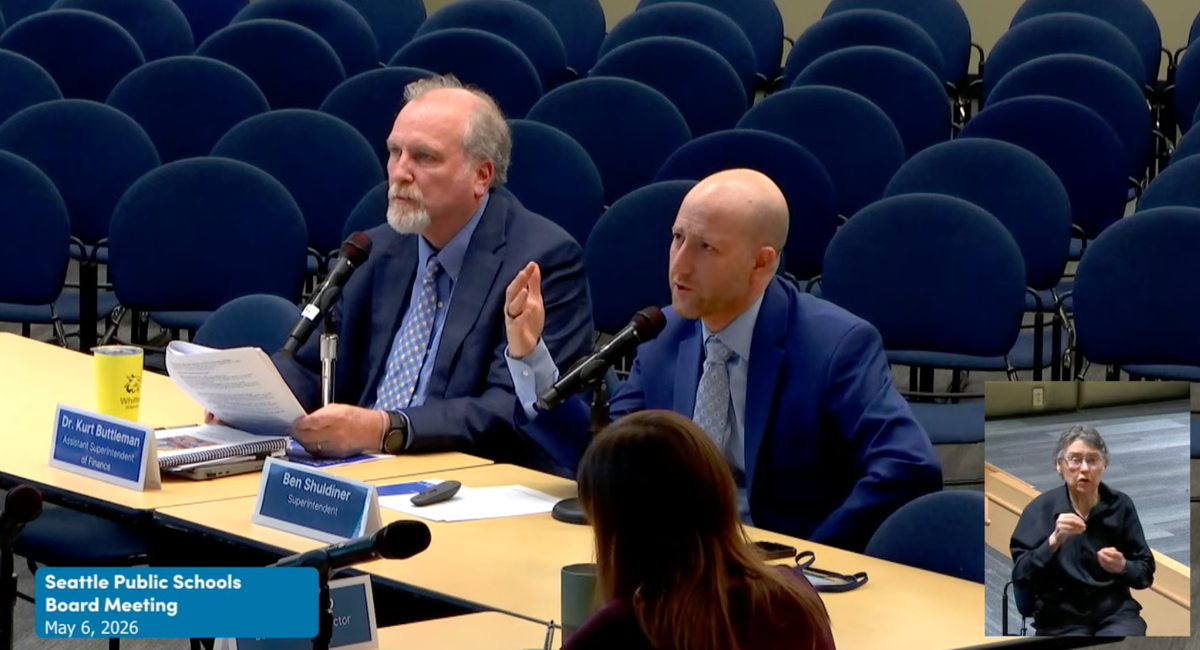
Last week, the Seattle Public Schools board of directors heard an update on the district’s budget from Superintendent Ben Shuldiner. His presentation was clearer and more direct than anything we’ve seen from SPS leadership on the budget in years.
It also foreshadowed major changes to how SPS spends its money.
Shuldiner laid out a path to bring SPS to fiscal sustainability. He emphasized large cuts and a desire to focus spending on three core academic priorities primarily oriented around improving student outcomes, as measured by test scores.
Shuldiner indicated he is not simply balancing the district’s budget for the next school year, but intends to undertake a much larger restructuring of the district budget to spend less money, and spend it differently.
In his analysis, SPS’s budget problem stems from district overspending, and must be resolved by restructuring the district’s operations and policies in order to spend less money going forward. He did not indicate at the board meeting that he sees SPS’s budget woes as stemming from systematic state underfunding that needs to be solved by getting legislators to fulfill their constitutional obligations.
His path may lead him to pushback from families who oppose the cuts and restructuring Shuldiner has in mind. And it is already producing resistance from SPS’s labor partners, especially the Seattle Education Association (SEA), ahead of a contract negotiation this summer.
In this issue:
- Avoiding Fiscal Insolvency, Realigning Spending
- Shuldiner’s Analysis of School Spending
- Multiple Staffing Adjustments Throughout the Year
- Shuldiner's Initial Cuts Show His Hand
- The Crux of the Problem: How Schools Are Funded in Washington State
- SEA Mobilizes Against Shuldiner’s Cuts
Avoiding Fiscal Insolvency, Realigning Spending
Shuldiner and Kurt Buttleman, Assistant Superintendent of Finance, gave the budget presentation. Shuldiner’s core assertion was that on its current course, SPS “will go bankrupt.” If SPS doesn’t pass a balanced budget, the district would enter what Washington State calls “binding conditions,” which is when the Office of the Superintendent of Public Instruction takes increasing oversight and control over district finances.
The Superintendent explained that his goal is to avoid binding conditions and also to rebuild the district’s fund balance, which has been used in the last several years to help balance the budget. “The good news is we have a plan to not get [the fund balance] to zero, and to continue on an upward trajectory after about a year and a half from now,” he said.
“We can't just cut everything right now, but we're going to go down where we still have some money left in the bank and then start to build up.”
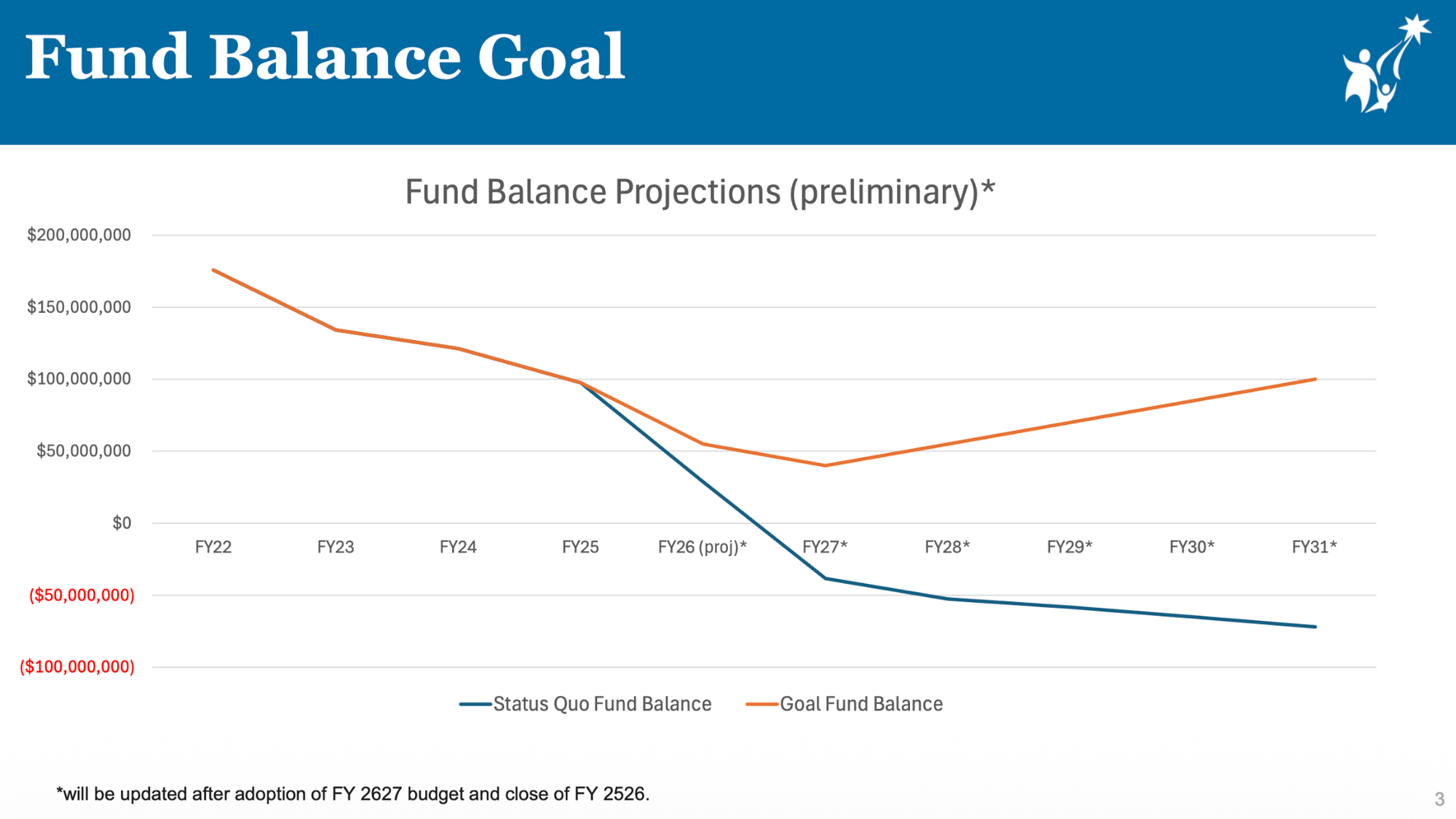
Shuldiner’s goal is to get SPS to have 10% of its $1.35 billion general fund budget in fiscal reserve. “If we can get to $100 million [in fund balance] by FY 31, that will mean we will have solved our structural problem.”
A particularly welcome part of his presentation was the acknowledgment that “it is true that sometimes what happens is the district will project a larger deficit than is reality.” Community member and SPS parent Albert Wong flagged the concern that SPS was “manufacturing a deficit” last year.
In order to achieve Shuldiner’s desired savings, Buttleman laid out a path of future budget cuts: $5 million in cuts in 2026-27 “on top of what we're presenting tonight,” $30 million to $35 million in cuts in 2027-28, and then another $5 million in cuts in 2028-29.
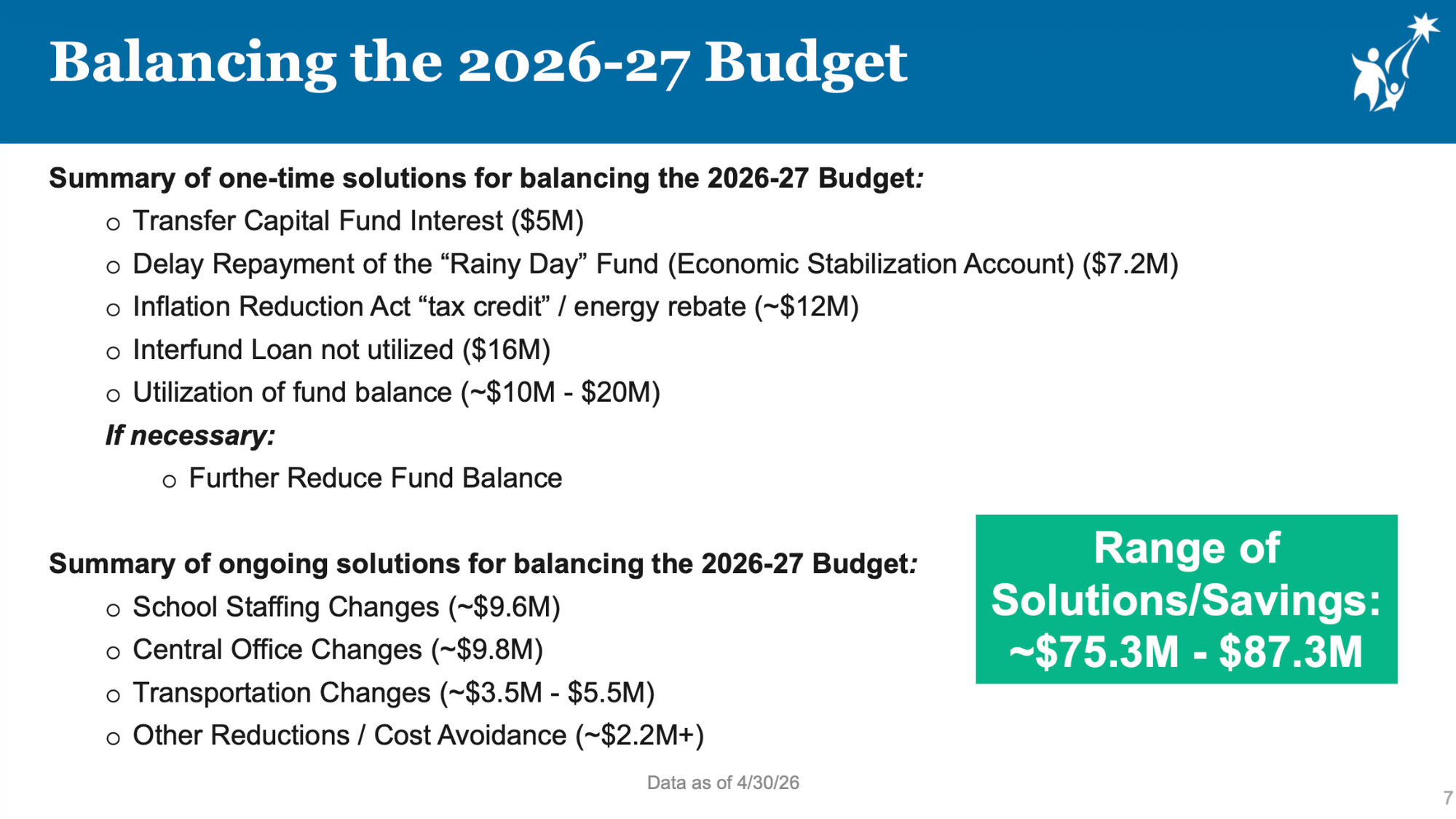
In what may ultimately be the most important part of the presentation, Shuldiner then shared his philosophy of how SPS should realign its spending:
Supt. Shuldiner explains how SPS should refocus its investments.
“We are going to refocus staffing investments on direct student services. More money, or moving the money to people who are in schools, in front of students, in classrooms, wherever in the school. It could be in the hallway — I've seen wonderful learning happen in the hallway.
But the more important thing is we're gonna refocus staff investments onto direct student services.
We're going to prioritize professional development aligned to the new curriculum implementation. We know that fidelity to curriculum is one of the soonest ways to move the needle. We now have a high-quality ELA curriculum, we now need to make sure that our teachers are given the supports to teach them. That will move the needle, I promise.
Reorganization, align departmental structure to improve services to schools and students. We are not a jobs program. We are here for children. We want to make sure that all of our decisions are about what's happening in schools and serving students.
And then we're going to realign centrally funded programs and positions to again, focus on school-level things.”
The Superintendent explained that given SPS’s academic priorities of 3rd grade reading, 6th or 8th grade math, and graduation rates, he wanted to focus spending on these priority goals.
Shuldiner also proposed SPS adopt a “per-pupil funding model.” Sometimes known as student-based budgeting, this model is one in which a school building receives funds based on the number of students enrolled and also weighted by student characteristics such as low-income status, multilingual learners, special education, and so on. This is instead of allocating staff and money for specific purposes, as is done currently at SPS, often according to staffing ratios that are part of a Collective Bargaining Agreement. Student-based budgeting is intended to give principals more flexibility over how money is spent.
These models are controversial. Criticisms of student-based budgeting include not ensuring adequate staffing and creating unfair differences among schools. Chicago Public Schools recently abandoned its student-based budgeting model for a “needs-based” model:
“The needs-based budgeting model is designed to ensure that every school is equipped with the foundational staff and resources necessary to support student success and recognizes that schools face unique challenges and require varying levels of support.”
Shuldiner did not provide details of how a new model would work in SPS. But he did blame “too many hard edges” of SPS’s Weighted Staffing Standards formula and ratios required by the Collective Bargaining Agreement with SEA for what he argued were huge inconsistencies in spending among SPS schools.
Shuldiner’s Analysis of School Spending
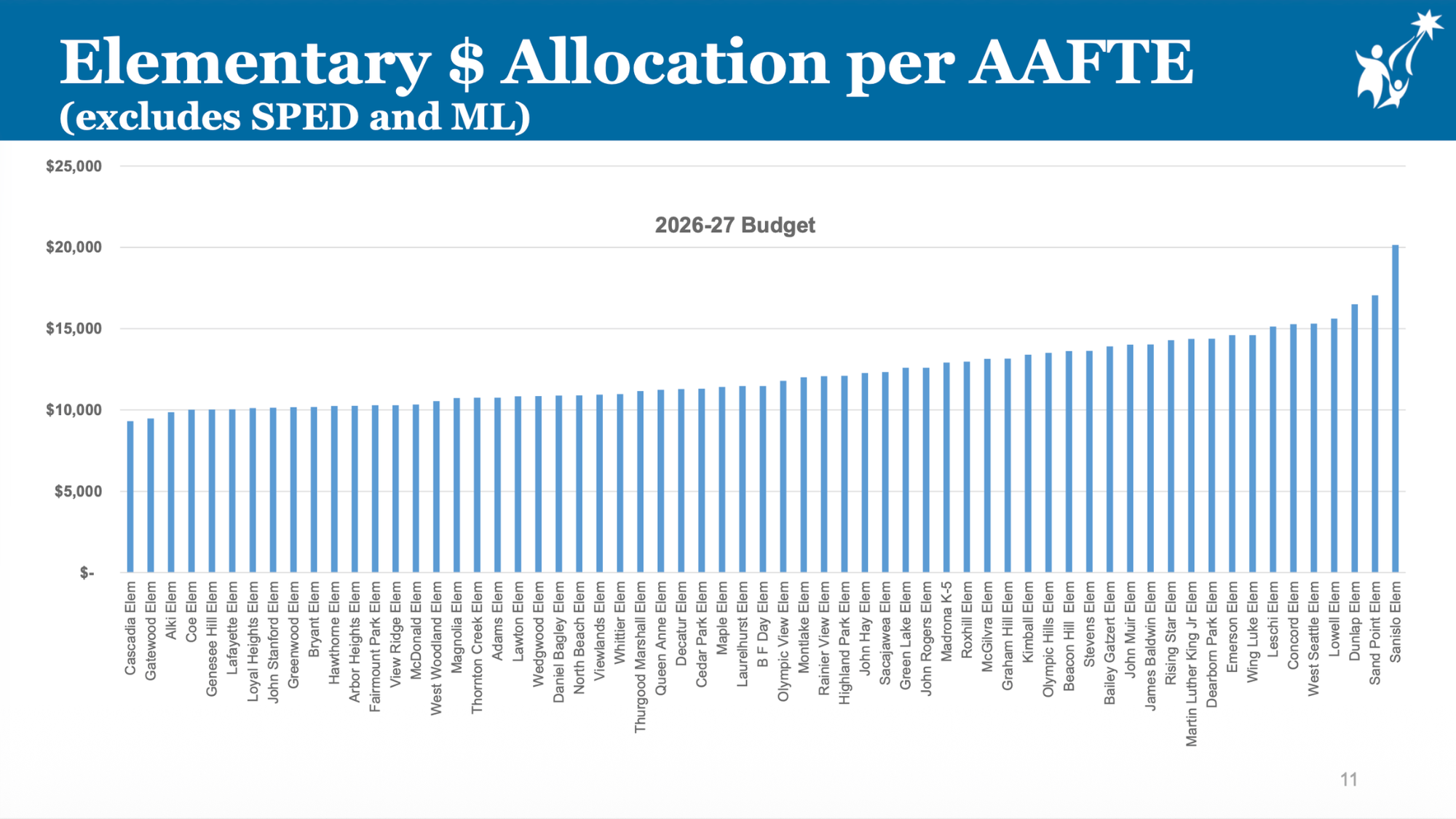
The Superintendent presented slides showing what he argued were wildly disparate levels of general education funding per student at SPS elementary schools:
Shuldiner also kept coming back to what he viewed as an unacceptably high per-student cost at some of SPS’s smaller, nontraditional high schools:
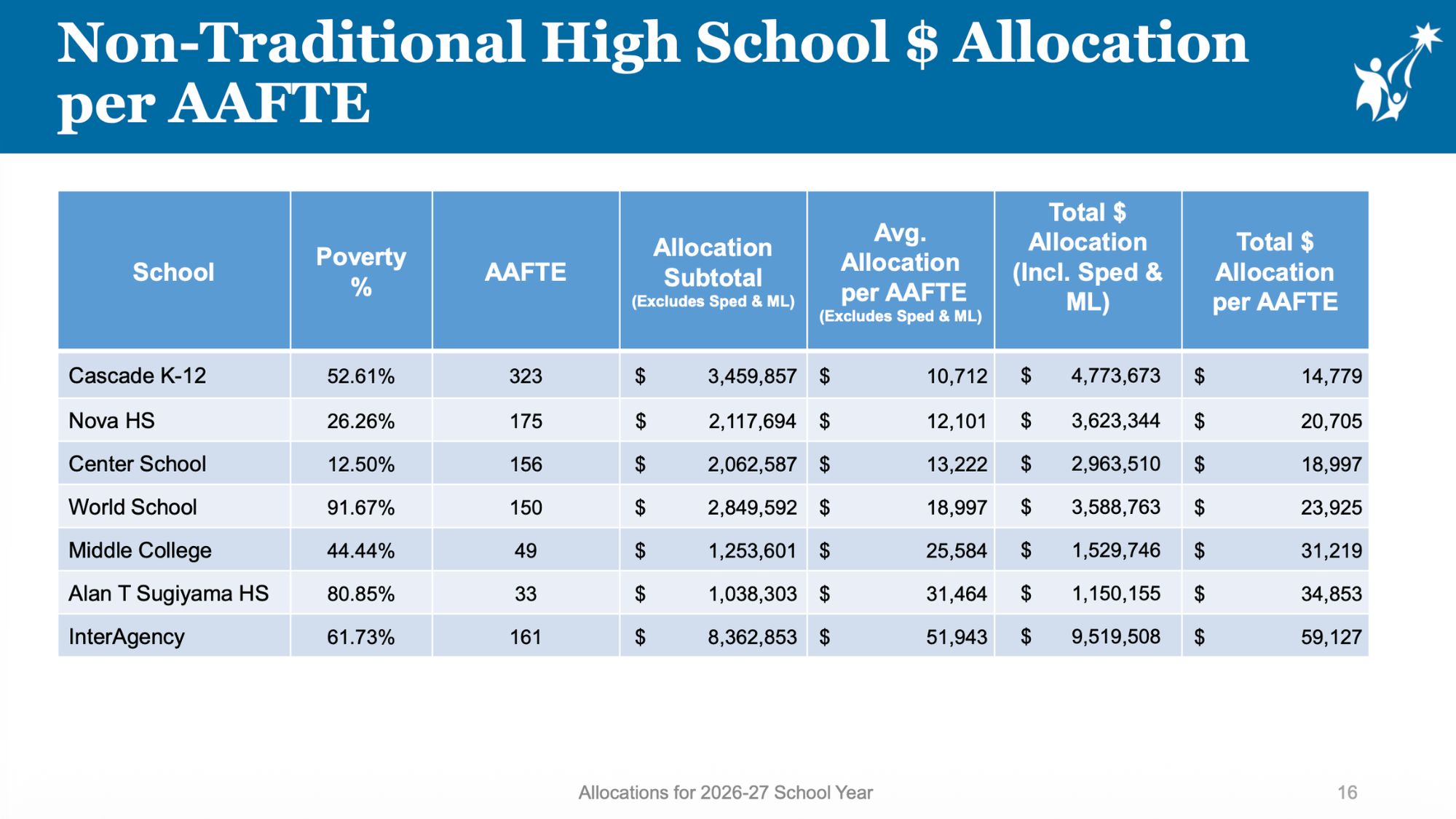
Several times, Shuldiner remarked about the cost of Interagency High School. “Please understand that at Interagency, we are spending $51,000 per child,” he told the board. “When we hear that we're not treating our Alt-Ed programs fairly, just remind everybody that we are spending $20,000 more per child at Interagency than at any other school in Seattle.”
“This is a big reason why we are going bankrupt,” he said.
Interagency High School is an alternative program of small high schools spread across the district that help students whose needs are not getting met in traditional high schools. Shuldiner had proposed cuts to Interagency, as well as Cascade Parent Partnership, earlier in the year, generating strong opposition from those school communities.
Director Jen LaVallee had some comments about this part of the presentation:
Director Jen LaVallee responds about school-level spending.
“I also want to recognize that there are different needs in each of these different schools and some of them do cost more money to get kids to similar levels. Not that the other kids don't deserve it either, they absolutely do and they should be getting more, and these things should be better overall.
But I do want to call out that when we are evening this out to a certain extent that we don't lose perspective on that equity and paying attention to the impacts for students that need that.”
Shuldiner responded that “if there is a child that needs more services because they're ML [multilingual] or because they're special ed, absolutely.” He added that if you look at two children, at the same poverty level, in the same classes and in the same programs, “and one child is having the district spend $20,000 and the other one is $10,000, that seems pretty unfair to the children.”
“It can’t be by vibes,” he added.
Whether this means Shuldiner intends to close schools in the near future is unclear.
Multiple Staffing Adjustments Throughout the Year
Shuldiner and Buttleman then explained a new school staffing process in which the central office would make smaller staffing adjustments more frequently:
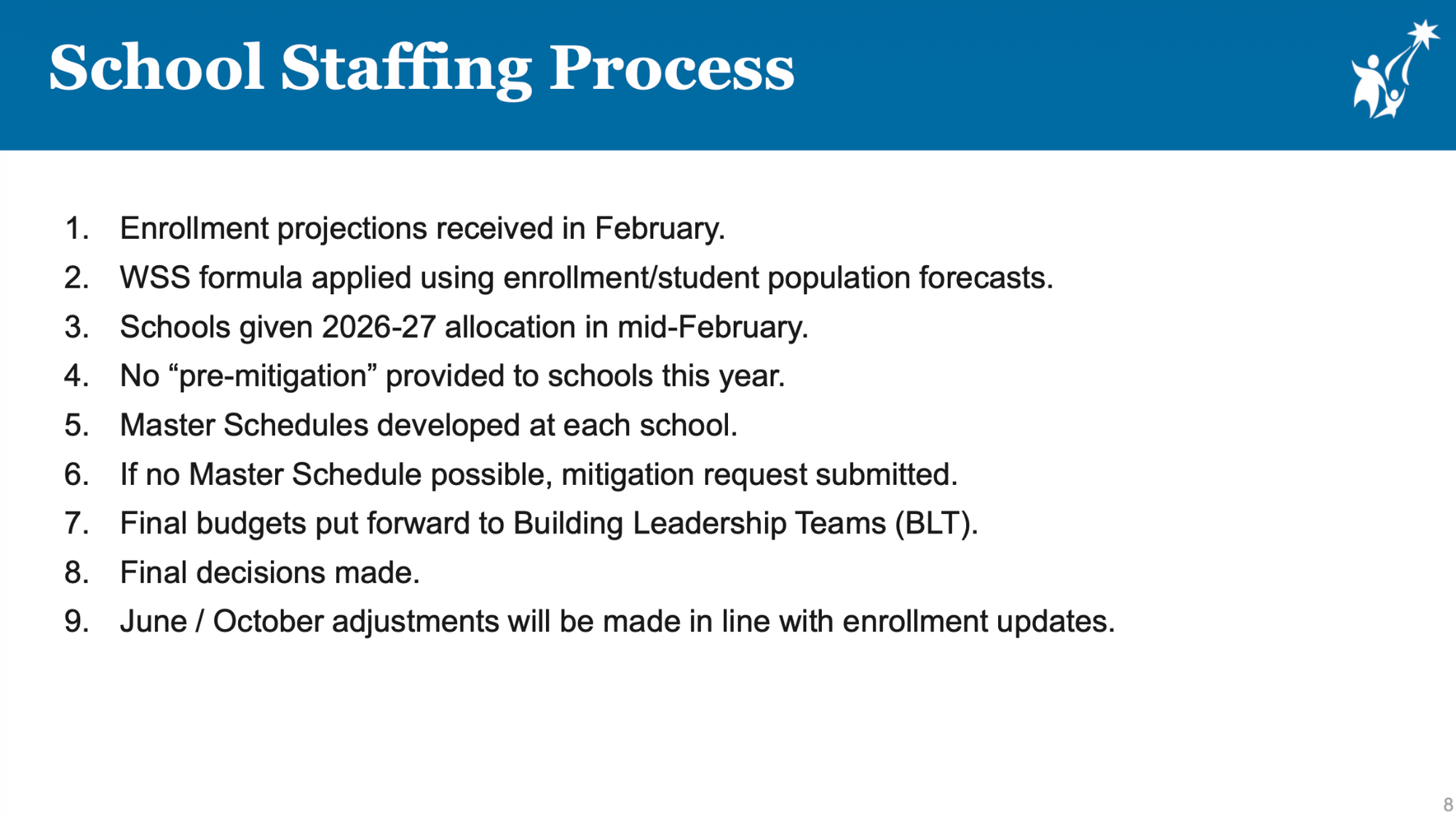
The mention of an October staffing adjustment caught the attention of board members. In fall 2023, a particularly disruptive “October shuffle” impacted classrooms at more than 40 schools across SPS, in which students who had just gotten to know a teacher were suddenly moved to a new classroom with a new teacher. Parents formed All Together for Seattle Schools to push back against the changes.
Director LaVallee, who had been part of the organizing effort in response to the “October shuffle” in fall 2023, asked Shuldiner for a September analysis and adjustment to avoid having “carpets ripped out from under kids” in October.
Shuldiner responded that SPS will be “a little conservative around the initial allocation” prior to the beginning of the school year, as they’d rather add staff to a school rather than reduce it.
Shuldiner’s Initial Cuts Show His Hand
Shuldiner was not simply explaining what he intends to do in the future. He has already begun taking action to implement his new approach to district finances. The following slide demonstrates cuts that have largely already been implemented for the upcoming school year:
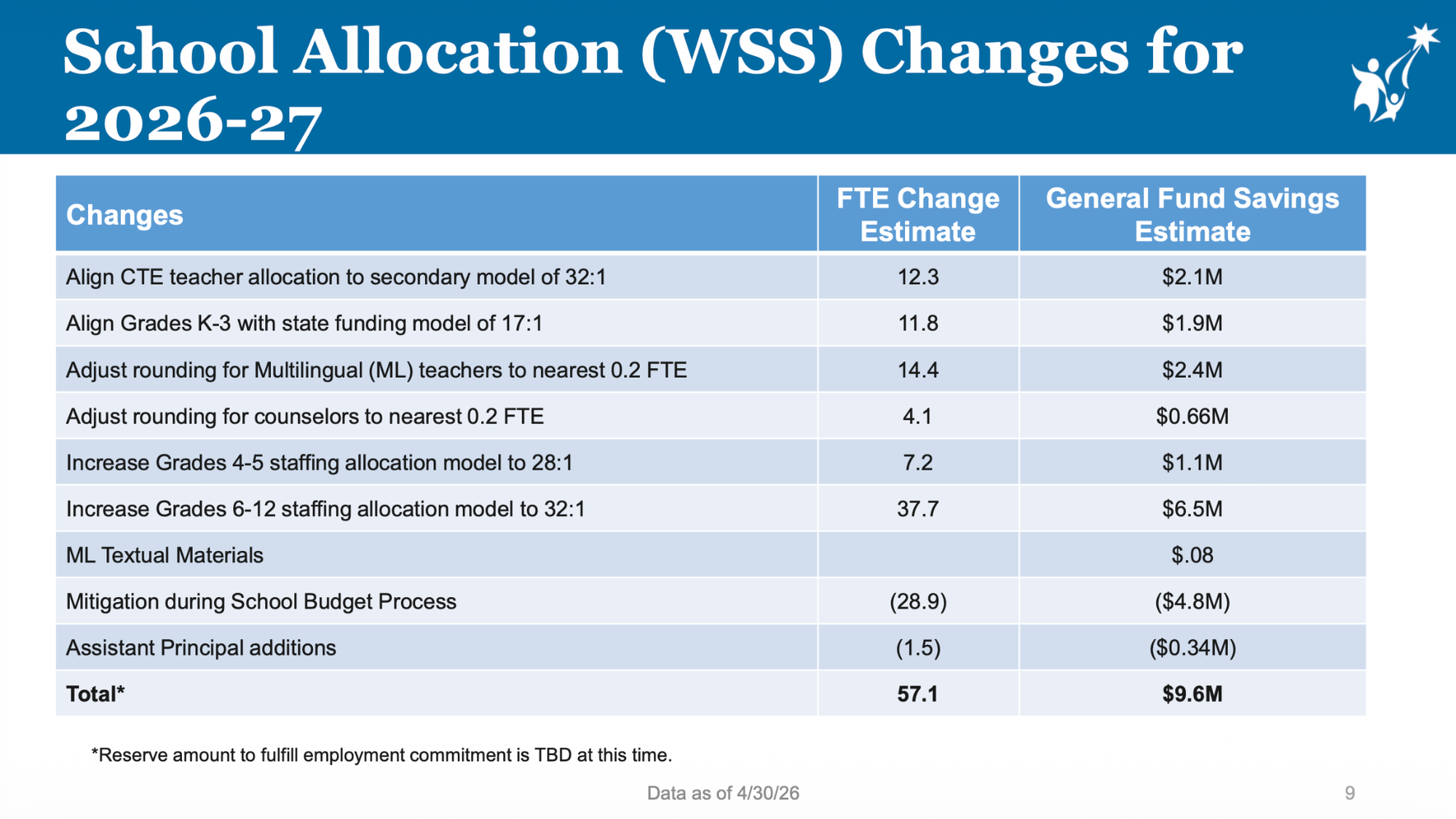
One immediate area of cuts is to Career and Technical Education (CTE). Despite a wider push at the state level for increased CTE programs, many of SPS’s had a lower teacher-to-student ratio than other classes. Rather than advertise and try to fill these courses, Shuldiner has made cuts, and families are reporting fewer CTE course offerings for 2026-27.
Shuldiner is also moving to close programs. Middle College at Seattle Central is slated to close and be consolidated into the Middle College location at North Seattle College. The school board heard this as an introduction item at their April 29 meeting, where Shuldiner said it would affect fewer than 10 students and save the district $483,315. The board will vote on whether to approve the closure at the Wednesday, May 13 board meeting.
The Superintendent is also making cuts in general education classrooms, largely by a small increase in class sizes in grades 4-5 as well as secondary grades (6-12). The impact is that SPS is reducing teaching staff by up to 30 full-time equivalent (FTE) positions, as shown in the chart above. Shuldiner claimed that, with retirements and teachers leaving the district, most teachers would be placed in roles at other schools.
The Crux of the Problem: How Schools Are Funded in Washington State
The Superintendent’s presentation touched on fundamental questions about the causes of, and best solutions to, school district budget challenges in Washington State. Shuldiner argued that SPS’s budget problems come from spending beyond what the state provides:
“The crux is that the way we are funded by the state is not how the district has structured itself… We get money based on formulas from the state. The way we spend money in Seattle is based on different formulas. Those formulas are much, much more generous [than the state’s formulas]. Because of that, we are in deficit and we will go bankrupt.”
It is true that SPS spends more on items like special education, multilingual learning, transportation, and other things. So do many other districts. Seattle residents are not against that. They’re well known for wanting expansive public services, beyond the penurious amounts of funding given to schools by the legislature. They’re also known for being willing to fund it with new taxes and levies.
For most Seattleites, a school district should meet the needs of the whole child, and reflect the fact that children are different people whose needs are not all the same.
The Superintendent and the board have a fiduciary duty under Washington State law to balance the district’s budget every year. When deficits happen regularly, as they are in SPS and many other districts across the state, it raises a larger question: whether to avoid binding conditions by spending less, or by asking the state to spend more.
Shuldiner may assert as fact that SPS’s budget woes stem from overspending beyond state formulas, but it is only an interpretation, and people can disagree with it.
A different interpretation, shared by many across Washington State, is that the legislature underfunds K-12 public education to the point where districts cannot properly provide a basic education to its students without finding extra revenue somewhere else.
In that view, the solution is not for the school district to engage in long-term austerity at the expense of students. Instead the state legislature should provide more funding to public schools.
The “paramount duty” clause of the state constitution states explicitly that “It is the paramount duty of the state to make ample provision for the education of all children residing within its borders, without distinction or preference on account of race, color, caste, or sex.”
For decades, the legislature has failed to do so. In 1977 the Washington State Supreme Court ruled, in a case brought by SPS, that the state was not providing enough funding to schools and ordered legislators to do so. They made a similar ruling 35 years later in the McCleary case.
After five years of resistance to the McCleary decision, the legislature finally produced a solution that the Court upheld. But many districts, including Seattle, argued that the McCleary solution was “designed to fail” and left them worse off financially.
In recent years their concerns have been borne out. Since the end of federal stimulus funding in 2022, the amount of money the state gives to school districts has declined, especially when adjusted for inflation. A growing number of schools are facing insolvency as a result. State Superintendent of Public Instruction Chris Reykdal has argued Washington schools are underfunded by $4 billion per year. Reykdal and others are now talking about a “McCleary 2.0” case.
The result of all of this is that SPS, like all other districts in Washington State, is systematically underfunded. It’s not possible to provide a good education to every child in our city on what is essentially poverty wages from the legislature.
Shuldiner needs to clean up opaque budgeting practices and save as much as he can in the central office. But nobody should be under the illusion that doing so will solve SPS’s budget woes, or provide students the resources they need. Only the Governor and the legislature can achieve that by providing more funding. Shuldiner's proposal instead suggests SPS will make lasting long-term cuts.
Looming over this discussion is the uncertain future of the new millionaires’ tax. It is uncertain for two reasons. First, an effort has been launched to ask voters to repeal it at the ballot box. Second, even if it is upheld, it is unclear how much of revenue generated by a millionaires’ tax would go to K-12 public schools.
The Superintendent’s approach to budgeting also risks undermining the push for more enrollment. Families who choose not to enroll their children in SPS look elsewhere largely out of a belief that another school will more effectively meet the needs of their child. Private and charter schools often recruit families with promises of more programs, more individualized attention, and smaller class sizes.
At a previous board meeting Shuldiner expressed his desire to improve the “capture rate” of Seattle students. But that is unlikely to occur if class sizes rise and program offerings are cut.
SEA Mobilizes Against Shuldiner’s Cuts
The Superintendent’s plans are already sparking a collision with the district’s labor partners, including SEA.
SEA is mobilizing this week against staffing cuts and planning a rally at the John Stanford Center for Educational Excellence (SPS HQ) at 3:45 p.m. on Wednesday, May 13. SEA argues these cuts “worsen unsustainable class and caseload sizes” and are caused by SPS consistently underprojecting enrollment at its schools.
Shuldiner revealed some of his views on the matter of staffing ratios at the board meeting. Director Kathleen Smith mentioned that she’d been hearing SPS has a much higher ratio of counselors to students in its schools than is recommended.
Shuldiner dismissed the concern, responding that “the professional organization of counselors has a ratio that is what the professional organization thinks is best. The reality is that we have a strong ratio when you compare it to other schools, but not necessarily we don't hit the recommended one by their professional organization.”
SEA has also just elected a slate of new officers backed by the Seattle Caucus of Rank-and-File Educators (SCORE), who are more inclined to fight back strongly against cuts and against budget austerity as a whole.
(One of those officers, SEA president-elect Ibijoke Idowu, was placed on leave by SPS prior to the election in response to allegations she physically abused a child.)
Nearly every contract expiration between SPS and SEA went to a strike, or a strike authorization, since 2012. The one-year extension to the 2022 contract in the summer of 2025 was the only exception. The 2022 strike lasted a week. Its end was controversial among SEA members, with a large contingent arguing unsuccessfully for rejection of the tentative agreement and continuing the strike.
A strike in September 2026 may loom, especially if Shuldiner continues on his current course.