Issue 38 – Is a Strike Looming for Seattle Public Schools?
Negotiations are coming down to the deadline between SPS and SEA. But there’s still time left for both sides to settle.
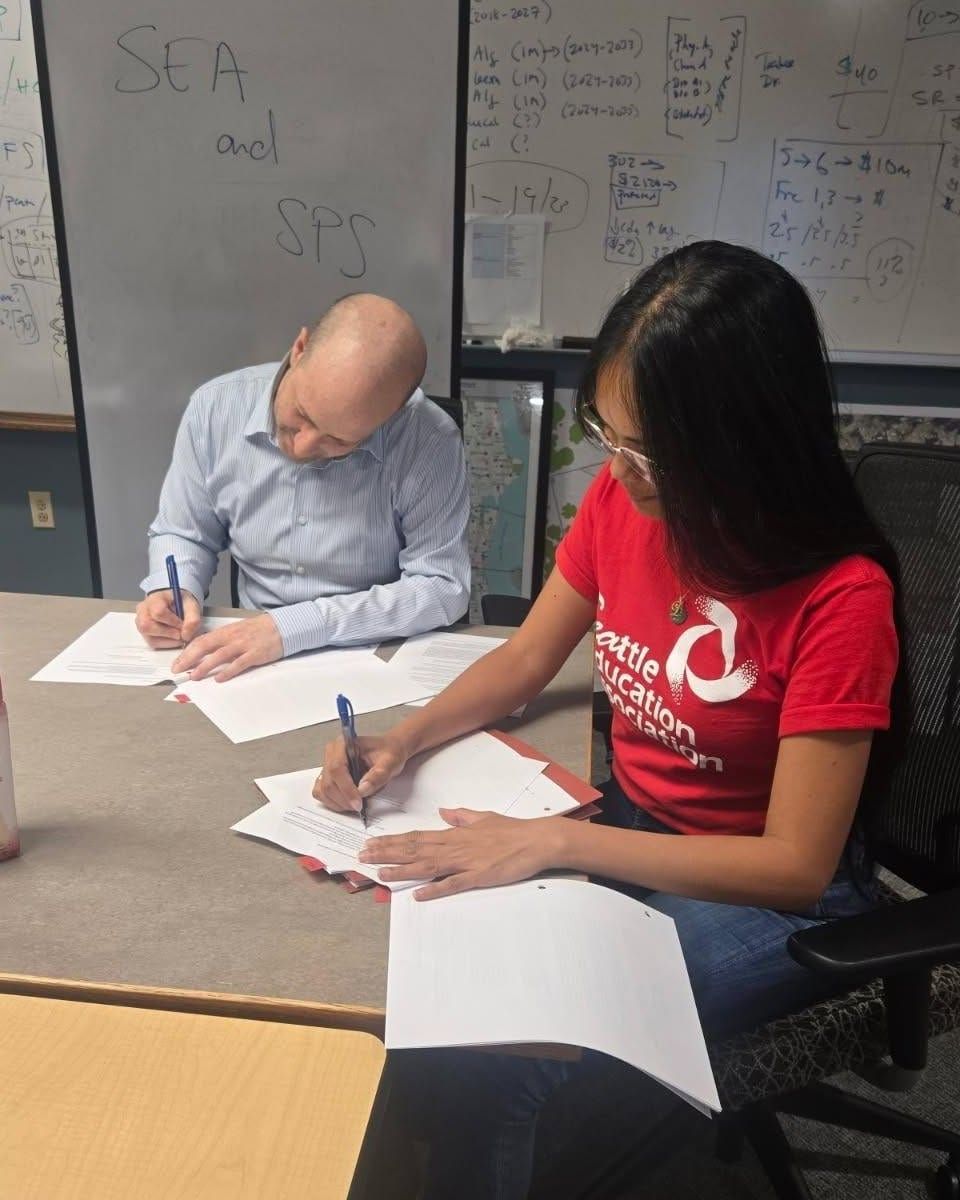
With just over a week until the first day of school, concern is starting to build about a possible strike, as major issues between Seattle Public Schools and the Seattle Education Association remain unresolved at the bargaining table. Despite what you may see in the media, however, it is still too early to tell whether a strike will actually happen.
As of this weekend, the two sides had reached agreement on 7 out of 57 issues, according to SEA. Those include new agreements on the right to return after displacement, timekeeping, safety for immigrant students and families, ASL interpreters, and Artificial Intelligence. The content of these agreements is not yet public.
SEA is seeking raises for their members to help keep up with the constant increases in the cost of living in Seattle – but says that their asks are smaller than in previous contract negotiations:
“Under SEA's proposal, educators would receive additional salary increases of 1.5% in 2026-27, 2% in 2027-28 and 2.5% in 2028-29, on top of annual inflationary adjustments [2.6% for 2026-27] funded through the state's compensation formula. That's notably more modest than the agreement reached in 2022, which included a 7% raise for the first year.
The union says the proposal is intended to help educators keep pace with the high cost of living in the Seattle area while allowing the district to remain competitive in recruiting and retaining staff.”
According to an August 20 bargaining update sent by SEA to the wider public, bargaining is “moving too slowly”:
“The district is not being responsive on the subjects that hold the greatest weight for our students and members: pressurization and wages. When we say pressurization, we mean relief from the increases in caseload, class size, and workload that take our time and focus away from students and lead to burnout. And when we talk about wages, we mean making sure all SPS employees can afford to live in the city where we work—with larger wages for lower-paid workers—to help create more continuity and stability for students.
We understand the district has budget problems, but it also has budgeting problems. Budgets are moral documents that show who matters, and who doesn’t. The spending on highly-paid administrators paints a clear picture of priorities that don’t align with what our students need, and this is just one example. SEA is digging into the district’s annual $1.3 billion budget and finding that part of the problem is state funding. And part of the problem is the district’s misplaced priorities.”
Superintendent Ben Shuldiner told the Seattle Times on Friday that SPS is “dedicated to achieving an agreement that serves our students, supports our employees, remains fiscally prudent, and positions our schools for a successful year.”
A parade of state and local elected officials have stopped by the bargaining sessions at the John Stanford Center for Educational Excellence to show solidarity with SEA, including key legislators such as House Majority Leader Joe Fitzgibbon (who represents the 34th Legislative District, in West Seattle), 46th Legislative District Representative Gerry Pollet, several City Councilmembers, and representatives of Mayor Katie Wilson.
SEA has scheduled a General Membership Meeting for Wednesday, August 26 at the Seattle Convention Center, where members will either vote on a tentative agreement if one has been reached, or authorize a strike.
If SEA members authorize a strike, that does not mean a strike is sure to happen, as there would be another week left to reach an agreement. SEA members nearly struck in 2013 and authorized a strike in 2018, but both times a tentative agreement was reached right before school began. In 2015 and 2022, SEA members went out on strike.
It is still too early to tell whether a strike would actually happen. It is unfortunately common for these negotiations to either come down to the last minute. At this point, it does seem like families, students, and educators are in for a week of uncertainty between August 26 and September 2.
What’s Likely to Happen?
What follows is my own analysis of the situation, offered not as “who is right” but more as “what I think will probably happen.” Feel free to treat it with as much or as little seriousness as seems appropriate.
It is difficult to see why SPS would refuse to settle before September 2. SEA holds most of the cards, and is likely to have broad public support as they have in past years. SPS is unlikely to get better terms or significant savings from a Collective Bargaining Agreement (CBA) reached during a strike than they’d get from a CBA reached before a strike.
The argument that the 2022 SEA contract was “unaffordable” has taken root among public opinion, whether or not it is accurate. SEA has responded by scaling back their wage requests, handing a significant win to SPS. But it’s unrealistic to expect SEA to not ask for some kind of wage increase, even above the 2.6% the state mandates, given the high cost of living.
If teachers can get better pay elsewhere in the Puget Sound region, they’ll often take it, making it much more difficult for SPS to staff the classroom with qualified and experienced educators.
SPS has ongoing budget deficits and, like most school districts around the state, faces the possibility of binding conditions due to the state’s ongoing refusal to amply fund public education as the state constitution requires. SPS therefore does not have extra money to pay for wage increases.
But they do still have money, and some of it can be used for higher salaries. It just has to come from something else that’s already being funded. It’s a question of prioritization, and paying teachers well to avoid them leaving for other districts would seem to be a priority.
SEA’s current bargaining stance, asking for a much smaller wage increase than they did in 2022, makes it a lot more difficult for SPS to argue that educators are being unreasonable. Would SPS really want to disrupt the school year with a strike rather than grant an additional 2.5% raise on top of what the state mandates? That’s unlikely to go over well with the public, even with SPS’s current financial situation.
SPS is not going to get SEA to completely abandon their wage demands, and has made no public statements suggesting they are trying to achieve that. SPS would therefore not be able to save much money in a CBA agreed to during a strike over what could be agreed to before a strike. That will make it even more difficult to convince the public a strike is worth it for SPS finances.
Wages and benefits are not the only issue at stake here, but that just bolsters SEA’s position further. Would SPS really want the disruption of a strike instead of compromising on what SEA calls “pressurization” issues related to working conditions? It’s hard to see the public believing this is worth SPS forcing a strike.
Seattleites historically side with SEA, and with unions more broadly. It’s common for unions to seek pay increases, common for management to say they can’t afford them, and for the public to side with the workers. (This is how the Seattle General Strike of 1919 came about.)
It’s clear that SEA would have strong support from many local elected officials if they struck, putting SPS in a challenging position and potentially making the district even more unpopular in Olympia.
In recent strikes, SEA benefited from widespread public perception that SPS was not being fair or reasonable, in bargaining or in overall district management. Shuldiner has proven to be a popular superintendent and has built trust with the public. But that merely brings SPS back to neutral, rather than starting in a hole of unpopularity.
No SPS superintendent, however popular, is likely to convince Seattleites to abandon their historic support for workers, especially teachers, in a strike. Shuldiner risks losing a lot of his public support if a strike takes place, especially if it lasts more than a few days.
Given all these factors, it is hard to see how a strike benefits SPS. Shuldiner is unlikely to get better terms from SEA after September 2 than he would before that date. Even if public support for SEA somehow turns out to be lower than in 2015 and 2022, SPS would still take a significant PR hit and a disruption to student learning.
But SPS is not the only one at the table. Does SEA feel a need to settle before September 2? Their public communications suggest that they do. Most SEA members likely want to avoid a strike and the disruption to the school year and to students.
There is growing militancy among local labor unions and within SEA. Boeing engineers represented by SPEEA just rejected a tentative agreement, believing they can get a better offer from management. But their contract does not expire until October 6, so they have over a month to continue bargaining before a possible strike. SEA faces a deadline in just over a week.
Recent SEA elections were won by the Seattle Caucus of Rank and File Educators (SCORE) slate, who might be more willing to strike. But SEA members have repeatedly voted to authorize strikes before, regardless of who is in leadership. Ultimately it’s the SEA membership as a whole that has to decide whether to accept a tentative agreement or go on strike.
Only the SEA bargaining team and SPS senior leadership know how likely a strike really is, and whether there is room to settle before September 2. Considering all the factors, one would think a settlement before September 2 is still a stronger possibility than a strike.
If a strike does happen, it will probably play out the way it has in the past: with most members of the public siding with teachers and demanding SPS settle on terms favorable to SEA.