Issue 44 – No More October Shuffle
Shuldiner puts an end to the disruptive dislocations in SPS classrooms every October. And school bus drivers may soon go out on strike.
Before we get into the news early this week, we want to thank the more than two dozen new subscribers who have signed up for The Bulletin this month. Special thanks to those of you who have signed up as paying subscribers – thank you for helping keep the lights on!
As always, if there’s something you’d like us to write about, drop us a line: tips@thebulletinsea.org.
In this issue:
- The End of the October Shuffle
- Bus Drivers Strike Looms
- Superintendent Community Meetings Kick Off Tonights
The End of the October Shuffle
For years, families and educators lived in dread of the “October Shuffle.”
SPS regularly found that actual enrollment in the classroom in October was far off of the projections they had used to assign teachers and students to those classrooms. They responded with a disruptive, dislocating shuffle in which numerous teachers were reallocated, sometimes to entirely different schools, to reflect actual enrollment. This often happened five or six weeks into the new school year, meaning young students who had already bonded and settled in with their new teachers were ripped away from those teachers. The district upended students’ education to solve their own bureaucratic failures.
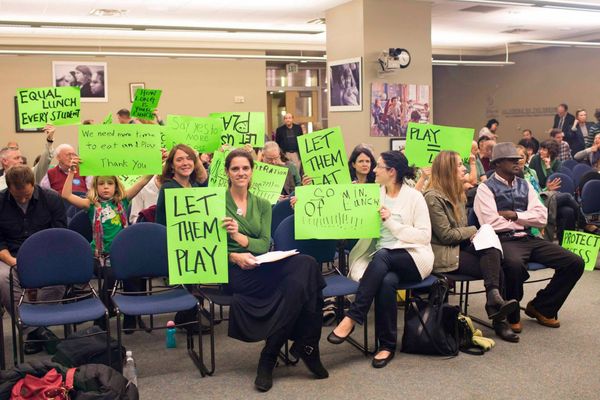
The shuffle in October 2023 was particularly disruptive, impacting 40 of the district’s 106 schools. Teachers and parents packed the school board meeting that month, demanding an end to the practice. That organizing sparked the creation of All Together for Seattle Schools, which fought that year's disruptions and sought reforms to the process. ATSS went on to take a leading role in stopping SPS’s school closure plans in 2024.
This year, however, the October Shuffle is no more.
Superintendent Ben Shuldiner announced in his regular Sunday email to the SPS community that this had become a “September Shuffle” – and that thanks to careful advance planning, the impact will be minimal:
“For our ‘September Shuffle’ (yes, we are moving even quicker), we are only removing 3 General Education FTE (full-time equivalent) classroom teachers from their current classroom, and we are adding 4.8 FTE for a total net change of only +1.8 FTE. Of course, I wish it was zero and that no one would have to move, but please put this in context: a district with over 100 schools and almost 50,000 students being staffed in a way that, at least right now, we don't have to remove more than 3 general education educators is a pretty good win.
For Special Education, we are adding 2.5 FTE certificated staff and removing 1 FTE, and we are adding 3 FTE Multilingual certificated staff during the ‘September Shuffle.’
I do want to be clear that these numbers are much more dynamic. We do staff adjustments every two weeks for Special Education because IEPs and individual needs can change so rapidly. But the large-scale balancing is now finished.”
There appear to be a few other factors that helped make this shift possible. One is the adoption of a “June Adjustment” that we covered over the summer. That’s where SPS took results of the choice process, new enrollments, as well as methodological changes to produce updated enrollment projections beyond the numbers produced the previous February. This also meant changes to school staffing. At the time, it was hoped that a June Adjustment would prevent, or at least significantly reduce, the impact of an October Shuffle.
And that’s what appears to have happened. There was some heartbreak in June when a few educators suddenly learned they wouldn’t be at the same school in the fall. But a fall shuffle that removes only 3 teachers from their current classroom definitely seems worth it.
Hopefully future adjustments and shuffles will be similarly limited. Moving the school choice process to earlier in the school year gives SPS more time to make accurate projections. And the methodological change made between the February and June estimates to how the district estimates enrollment appears to have succeeded in minimizing disruption.
It’s a big victory for community advocates, and a good example of a long overdue, sensible change to SPS’s management practices to center the needs of students and teachers over the needs of bureaucrats.
Bus Drivers Strike Looms
A battle over retirement contributions is at the center of a possible strike by Seattle school bus drivers.
Bus drivers in Seattle are represented by Teamsters 174, and their members have authorized a strike against Zūm Transportation. Drivers want to be able to contribute to the Teamsters pension plan, whereas Zūm wants to pay retirement contributions into an Individual Retirement Account.
The Teamsters accuse Zūm of refusing to bargain in good faith and that they chose to “pick a fight with the union” instead. They argue paying into the Teamsters fund won’t cost Zūm any extra money, and brings the drivers’ pensions into alignment with state law regarding benefits.
This is a dispute between drivers and Zūm, with SPS as a very interested bystander. There’s no date given for when a strike might take place, but if it were to happen, it would be soon.
This is the first school year in which Zūm is providing most of SPS’s yellow bus service. In recent years they had shared that role with First Student, the result of significant controversy over the awarding of the bus contract in 2022. Zūm filed a protest that year against SPS’s intention to award the contract to First Student, after a state investigation found hundreds of violations against First Student. Ultimately, the district split the contract for the next four years. First Student still provides bus service, mostly in West Seattle.
Superintendent Community Meetings Kick Off Tonight
Tonight (Tuesday, September 29) is Shuldiner’s first community meeting of the year. It’ll take place at Thornton Creek Elementary School in Northeast Seattle and is scheduled to go from 6:30PM to 8:00PM.
According to Shuldiner’s Sunday email:
“The Sept. 29 meeting will focus on three topics identified as priorities through last year's engagement process: academic rigor, school design, including neighborhood schools, option schools, dual language programs, and Highly Capable services, and school safety and security. Feedback gathered during these discussions will help inform future conversations and district planning.”
Some parents and educators will attend in hopes of raising concerns about district-mandated schedules in elementary schools and their negative impact on student wellness and on teacher morale. Others will be there to call for an expansion of different school models, including more option and dual language schools.
Shuldiner’s community meetings are scheduled throughout the school year, with the next one taking place on Tuesday evening, October 27 at Robert Eagle Staff Middle School.
This issue has been updated to note that First Student still provides some bus service for SPS.