Issue 47 – SPS Takes Microsoft Money to Push Generative AI in Classrooms
SPS accepted a $75,000 Microsoft grant and three years of Copilot for teachers, staff, and high schoolers while other districts hit pause. Who benefits when the free offer ends?
Since ChatGPT’s release on November 30, 2022, generative artificial intelligence has become pervasive in our digital lives, and widely used by students in Seattle Public Schools.
A coalition of researchers, doctors, child development experts, and parents joined non-profit Fairplay to call for a five-year pause on generative AI in PreK-12 schools, citing risks to “children’s development, mental health, privacy, and overall educational experience.” Among the many concerns raised is that generative AI enables “cognitive offloading,” preventing students from developing important creative and intellectual skills that are essential to learning.
In September, the two largest public school districts in the country implemented 1-year pauses covering most student-facing generative AI, including chat bots and AI tutors.
New York City banned student-facing generative AI after swift community backlash to preliminary guidelines. The ban goes through 8th grade, with limited generative AI usage in high school.
Los Angeles Unified’s generative AI moratorium covers PreK all the way through high school. Both districts will still teach AI “literacy” to students, which includes lessons on bias, misinformation, and basic AI usage, and builds on strict screen time policies.
Our similarly-sized neighbor to the South, Portland Public Schools, has also taken action to pause generative AI. They laid out a roadmap including short-term and 2-year goals to buy time “to develop a more official and durable policy.”
In contrast, SPS is inconsistent in their student-facing AI policies, guidance, and student experience, scrambling to keep up with an industry that is constantly changing.
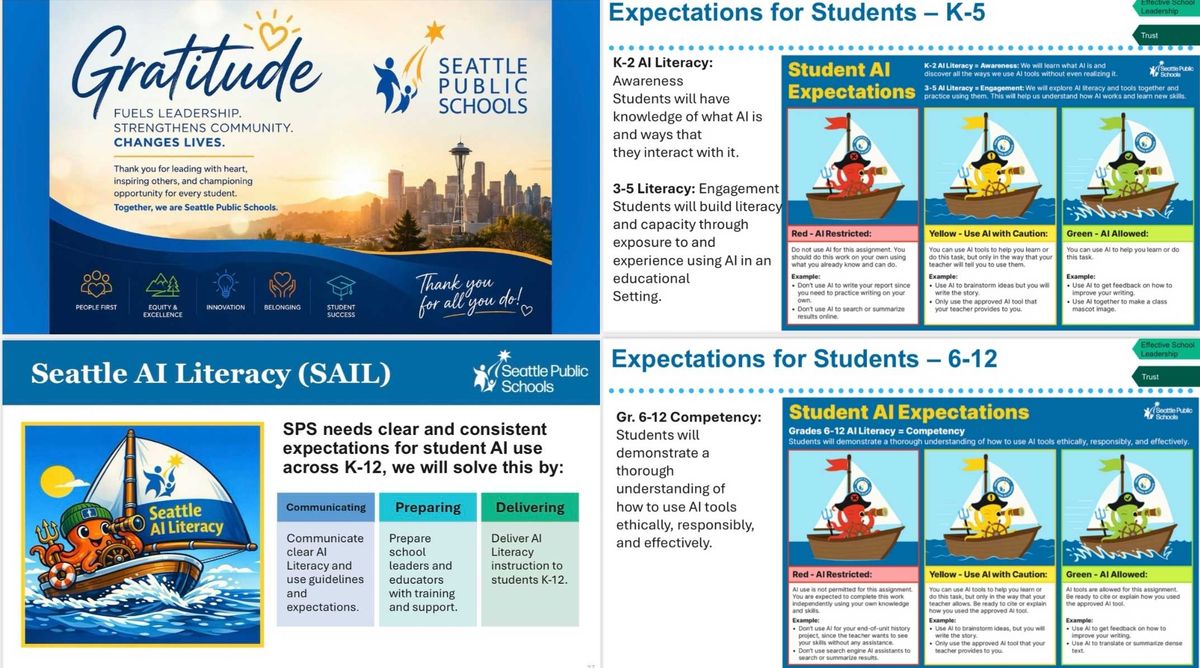
In August SPS rolled out a new curriculum titled Project SAIL (Seattle AI Literacy), funded through Microsoft’s Elevate grant. This new curriculum was shared with teachers and admin, but not the wider public, and still doesn’t appear on the district website.
When Superintendent Ben Shuldiner announced a ban on 1:1 devices in grades K through 2 in September, he was asked by KUOW’s Soundside whether he would adopt a ban on generative AI as LA and NYC schools had done. Shuldiner said he wants to “see how it works in reality” before calling for a ban in SPS.
Let’s take a closer look at how generative AI is being used in SPS – and what parents can do about it.
In this issue:
- What’s Happening in SPS Classrooms
- Move Fast and Break Things
- What the Research Shows
- Community Concerns and Comments
- Move at the Speed of Trust
- How to Advocate
What's Happening in SPS Classrooms
Walking into the front office at Salmon Bay K-8 you’re greeted by a poster featuring a pirate octopus navigating a ship through red-, yellow-, and green-light AI-usage examples. The poster is front and center, taped to the acrylic divider at the front of the desk.
Debra Knickerbocker, SPS Digital Learning Manager, told us via email that “the intent of the AI Literacy Classroom materials is not to prioritize AI use in K-5,” while the posters required on the walls of every classroom in the district say otherwise.
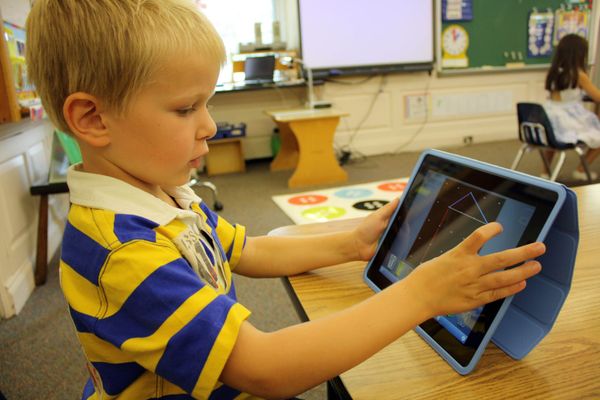
For grades K-5, the poster’s examples include using AI to “brainstorm ideas but you will write the story” or “make a class mascot image.” It’s exactly the kind of cognitive offloading that researchers have flagged as a major concern: replacing the creative thinking that younger children need by handing it off to technology.
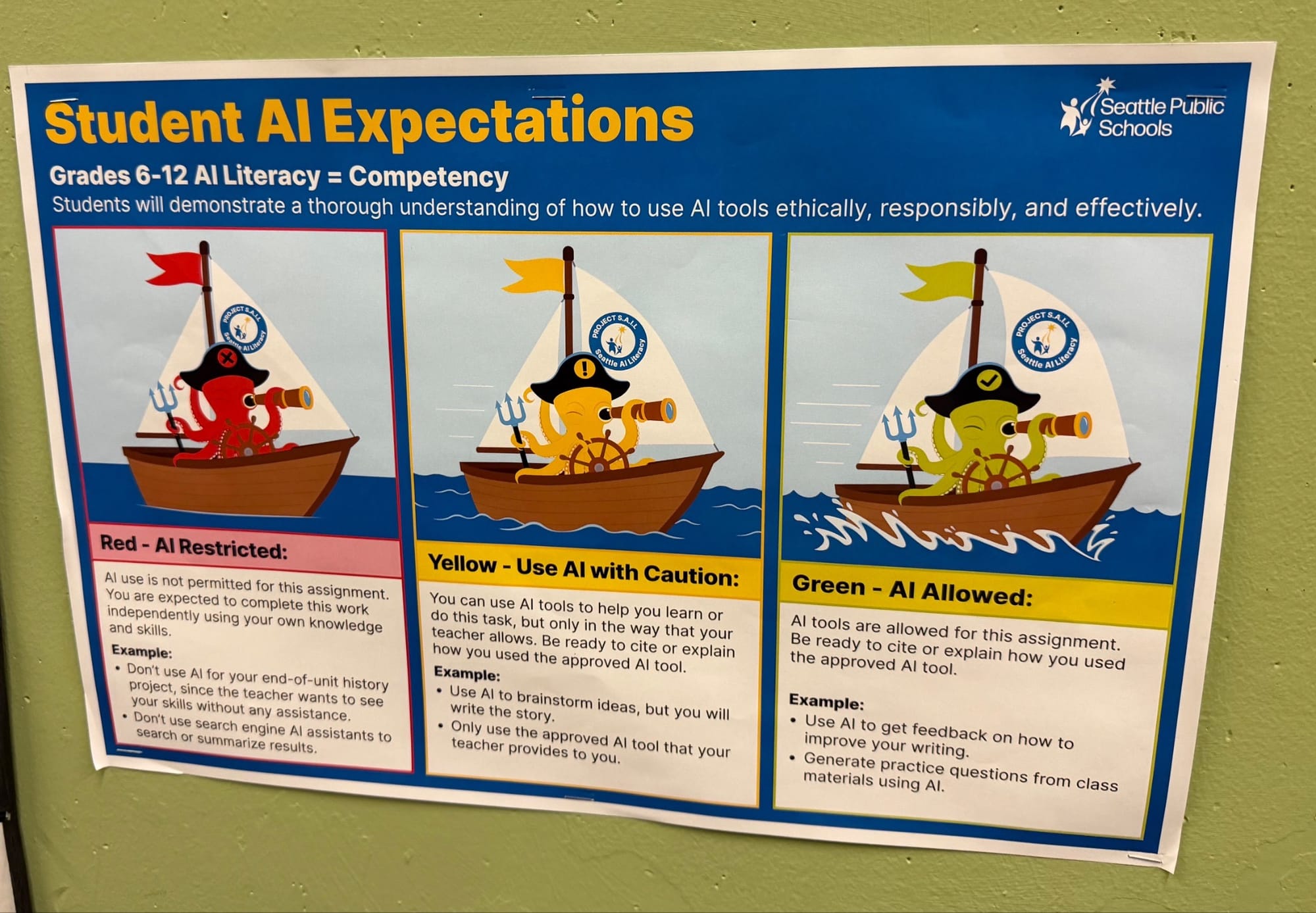
For grades 6-12, students working on “green” assignments are allowed to use AI to “get feedback on how to improve your writing” or “generate practice questions from class materials” – activities that would normally be done by an educator or the student themselves.
Actual student usage varies by school, educator, and student. Some teachers are encouraging use, excited by new learning tools, while others consider it a low priority and have deliberately chosen not to use it with their students.
Families have reported their students were using generative AI in classrooms to do their schoolwork:
- A teacher from Viewlands Elementary shared in their September 2026 newsletter: “At times, we may use SPS approved apps including our AI student platform called Magic School … at choice time.” Last spring Magic School AI was used by students to write group plays that students then memorised and performed. Parent Sierra Nelson writes: “we were aghast and brokenhearted about AI being used for this creative writing opportunity, and as we started to inquire further … were told we could not opt out.”
- A middle school student in north Seattle told their family that they were expected to submit their essays to Magic School, which would then grade the assignment, in their 6th grade ELA class in the 2025-26 school year. The student added that they were told to use AI to help generate writing prompts. This school year, the student said that they have not been told to use AI, but that AI agents for both Magic School and Google’s Gemini remain freely accessible on their SPS-issued device.
- SPS parent Emily Cherkin, a former middle school teacher and an internationally-known leader in the intentional tech movement, confirmed the report that AI agents were freely accessible on district computers – and shared numerous other troubling examples of AI usage in SPS and in other school districts around the country.
Some parents have taken to social media to share their concerns:
Day three of fourth grade and my child was presented with a school district (SPS) approved presentation about how using AI to generate ideas, brainstorm and do research is fine. I feel like I’m going to blow a gasket.
— Nora Kenworthy (@kenworthy.bsky.social) September 4, 2026 at 6:50 PM
It’s clear that generative AI is widely used in SPS classrooms, but is lightly regulated. The constantly changing tech is difficult for the district to keep up with, feeling like a game of Whac-A-Mole.
In emails to some parents, the district has stated that “Students remain responsible for their own thinking and learning. AI should not replace original student work, critical thinking, creativity, problem-solving, or the learning an assignment is designed to measure.”
The responsibility should lay with the district and other governing bodies, especially as tech companies who make these products have different stakeholders, and design products to maximize engagement and increase profits.
SPS has green-lit generative AI without assessing the whats, whys, and hows of using this technology with students. District leaders are trusting tech company marketing over our knowledge of brain development and the purpose of WA schools.
SPS isn’t alone in this. Districts across the country have been swept up in the tech craze, starting with the push for coding in 2013. “In other disciplines, we don’t have industry driving K-12 curricular or policy decisions,” Bryan Twarek, vice president of education and research at the Computer Science Teachers Association, told Natasha Singer, author of Coding Kids.
Move Fast and Break Things
Tech in Schools
The AI push into schools contains echoes of the social media and smart phone experiment on kids, except it’s incorporated directly into school devices and edtech curricula, adopted en masse by districts.
As described in an excerpt from AI for Good, about the creation of Khanmigo – the AI tutoring bot by Khan Academy and OpenAI, the pace is set by getting products to market, not quality or efficacy. Author Josh Tyrangiel wrote, “if organizations this thoughtful, this careful and this well-resourced only barely pulled it off, that should tell you something about what to expect from everyone else.”
Tech companies benefit greatly by getting their products into the hands of students:
- As part of a landmark social media addiction lawsuit involving Meta and YouTube, internal documents from Google revealed how their video platform’s use in schools could create a “pipeline of future users” and “creators.”
- Companies like Google market their products directly to districts, schools, and teachers, offering free teacher trainings that include guidance on how to speak with AI skeptics, including parents and other educators.
- Research, organizations, and initiatives are often funded by tech companies and their owners. According to Common Sense Media’s last annual report, The Bezos Family Foundation (Amazon) donated $5 million+ to the organization, while the Chan Zuckerberg Initiative (Meta) contributed over $2.5 million.
Microsoft Elevate
In July 2025, Microsoft announced the Microsoft Elevate “business unit,” which aims to “integrate AI into teaching and learning.” They claim that “in tomorrow’s economy, those who understand and use AI will do better than those who don’t.”

Their Washington State AI “diffusion” map shows the percentage of working age population using AI, by county. Unsurprisingly, counties heavy in tech companies – like King and Snohomish – are leading AI usage at 30-35%, while many rural counties drop “well below 10 percent.”
In an effort to reverse what they call a “troubling trend,” Microsoft Elevate is providing:
- $4 billion total in grant funding to K-12 schools, colleges, and non-profits,
- “$25,000 in dedicated technology consulting to help [teachers] build and deploy AI agents tailored to their teaching and workplace needs” to 10 school districts and 10 community colleges in WA State,
- Up to three years of Copilot Studio to “Washington State’s 295 school districts and 34 community colleges free of charge,” for all certificated teachers, instructional assistants, and administrative staff to build custom AI agents, and
- Up to three years of Copilot Chat and other Microsoft products for free to high school students.
Seattle Public Schools was a selected recipient for $75,000 in grant funding, $25,000 worth of consulting, and gets three years of Copilot for teachers, admin, and high school students. (SPS's website states Copilot is currently available only to staff.)
While Microsoft is providing funding and support under the guise of equity, the result is teachers and admin who become reliant on Microsoft’s proprietary AI products, likely committing districts to unknown AI licensing fees a few short years down the road. Microsoft is likely to see the potential for future users in students, as with Google and Meta in the example above.
SPS may be signing itself up to spend significant amounts of scarce funds on generative AI in our classrooms.
What the Research Shows
As Jared Cooney Horvath, neuroscientist and author, summarizes: “nearly every study looking at the impact of AI within K-12 settings reports something bad: decreased learning, decreased creativity, decreased critical thinking, decreased confidence and self-efficacy.”
As generative AI is a fairly recent development, research is still growing and long-term impacts are as yet unknowable. Of the research and reports that have been published, the picture isn’t looking good.
A big takeaway from OECD’s PISA 2025 is that “students who use AI generally score worse at school.” While the results are nuanced, the report’s authors state that even if generative AI can support learning, it “frequently fails to do so in practice.”
A study published in 2025 measured the brain activity of students writing essays, comparing groups using LLMs (large language model, a form of generative AI), search engines, and “brain-only.” LLM users consistently underperformed, struggled to accurately quote their own work, and had the lowest self-reported ownership of their essays.
Colleges around the country are reassessing what education is for. MIT’s report titled AI and Education said they’re seeing signs that AI is “challenging decades of distinctive MIT community norms and values about rigor, the creative friction required for learning, collaborative problem solving, and personal integrity.” They summarized this as “cognitive surrender.”
A big thing to note is that while the PISA study was done with 15-year olds, participants in others are generally older. If outcomes are this alarming for teens and adults, how is the district even considering student-facing generative AI at all for 3rd–5th graders, while their brains are developing their logic, planning, memory, and attention?
Community Concerns and Comments
In the meantime, teachers, students, board members, and families are frustrated that SPS is swept up in a common narrative posed by big tech – keep up or get left behind.
In August, Project SAIL slides were sent to Seattle Families for Intentional Tech (SFIT) by an SPS high school teacher, who said “I was hopeful we'd get screen time limits or a moratorium on practices. The reality it seems is they want us talking about AI to kindergarteners and actively using it with students throughout the day.”
In September, we emailed SPS Board Directors about Project SAIL, asking about board-level discussions and their stance on student-facing AI:
- Director Evan Briggs expressed “serious concerns about student-facing AI and what appears to me to be a largely fatalistic approach to tech and AI in SPS,” and is continuing to “push staff to provide a coherent, evidence-based framework for how SPS will handle technology use and AI in our district going forward.”
- Director Kathleen Smith is looking forward to policy coming through the Policy Committee, and that she works “with/in AI and definitely [has] some opinions on its appropriateness for children.”
Concerns about AI are also being voiced by students, as shared by Student Board Director Eliana Faunce during the October 7 board meeting. She said AI is one of the top two concerns heard from the student body, and that students want “clear and consistent guidelines around artificial intelligence, specifically for student use as well as teacher use.”
As families grapple with their own understanding of the technology, they are finding themselves forced into ill-prepared conversations with their children. One middle school parent called out the lack of transparency around student-use of AI, comparing it to sex ed: “teachers have to email me so I could choose to opt my child out of sex education curricula. I was never asked about these [AI] tools, even though I have far far greater ethical and moral objections.”
In 2027 Washington State legislators will take up an “away for the day” policy on smartphones in K-12 proposed by Governor Bob Ferguson. They’re also looking at adopting guardrails on AI – but at this time, they do not appear to be pursuing a moratorium or ban on using generative AI in schools. According to the Seattle Times, one proposal would focus instead on privacy and security around AI tools used in the classroom.
Move at the Speed of Trust
With a technology that is changing day-to-day and little to no understanding of long-term impacts, it is not reasonable to expect a school district to provide, as SPS claims, an “educational [AI] experience for all students while prioritizing student well-being, privacy, and security.”
Policies often take years to implement, and with the large differences in concern among parents, students, and district leaders, pausing generative AI in order to assess whether and how this new technology fits into our public schools, with student and community involvement, is critical.
As students will encounter and use AI outside of school, SPS should be teaching AI literacy: what AI is (and isn’t) and how it works; algorithmic biases; human and environmental impacts; and possible benefits and harms – all of which can all be taught without using generative AI directly.
In addition, SPS needs to think critically about the implications of being tied into one AI model, and instead select a platform that does not restrict usage to a single provider, and budget responsibly for ongoing AI expenses once free offers expire.
In the Soundside interview Shuldiner admitted: “we’re forcing onto families a technology that maybe they don’t even want, that’s something that we really need to address.”
So let’s address it.
How to Advocate
The November 4th Special Board Meeting is focused on edtech issues, including AI. Board Director Joe Mizrahi said that while there is currently not a proposed edtech or AI policy, now is the time to elevate concerns.
SPS claims they are working towards “intentional and developmentally appropriate technology use, clear expectations for AI, stronger software governance, student data privacy, and greater transparency for families,” but all of these things require being proactive, not reactive, and the current state of AI is not creating the appropriate conditions.
It seems clear from the evidence that now is the time for SPS to follow the lead of public school districts in Los Angeles and New York City and pause the use of generative AI, so the district can follow through on their stated intentions to approach AI in a way that centers our students – not Microsoft, Google, or other tech companies.
Here are some specific action steps you can take:
- Email your school board director and CC Superintendent Shuldiner. Make it personal by including your child’s grade along with incidents, impacts, or concerns. Mizrahi suggested requesting questions be asked “on the record,” to ensure community concerns are heard during the November 4th meeting.
- Superintendent Ben Shuldiner: boshuldiner@seattleschools.org
- Email the School Board: schoolboard@seattleschools.org.
- All directors are elected citywide, and are thus all accountable to all members of the public. But they also must live in and represent one of seven districts. You can find the SPS Board Director for your neighborhood here: Director district map
- Attend the Wednesday, November 4: Special Board Meeting on EdTech and AI. At John Stanford Center for Educational Excellence (map)
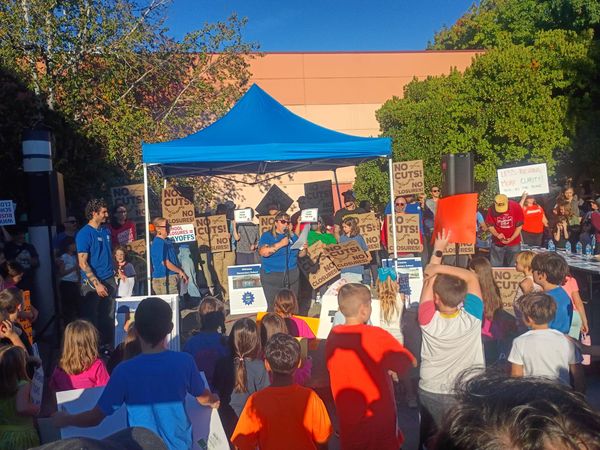
- Rally at 4:00pm: Bring signs and your concerns.
- Meeting at 4:30pm: Agenda posted by Tuesday, November 3 around 4:30pm.
- Testimony may be available depending on the agenda.
- Speak out at the Wednesday, November 18: Regular Board Meeting. At John Stanford Center for Educational Excellence (map) Meeting at 4:30pm: Testimony sign-up for this meeting opens at 8am Monday November 16th.
- Join Seattle Families for Intentional Tech. Explore resources and information, sign-up for updates, and connect with others in your school community.
You can also find the sources and reading list we used for this article here in this shareable, public Google Doc.
Ashley Worobec is an SPS parent and the Advocacy Chair of Friends of Salmon Bay. Robert Cruickshank is an SPS parent and the publisher of The Bulletin.