Issue 46 – Residents Across Cascadia Mobilize to Stop School Closures
Despite clear evidence showing school closures don’t save money or improve student learning, districts insist on pursuing them. Seattle could be next.
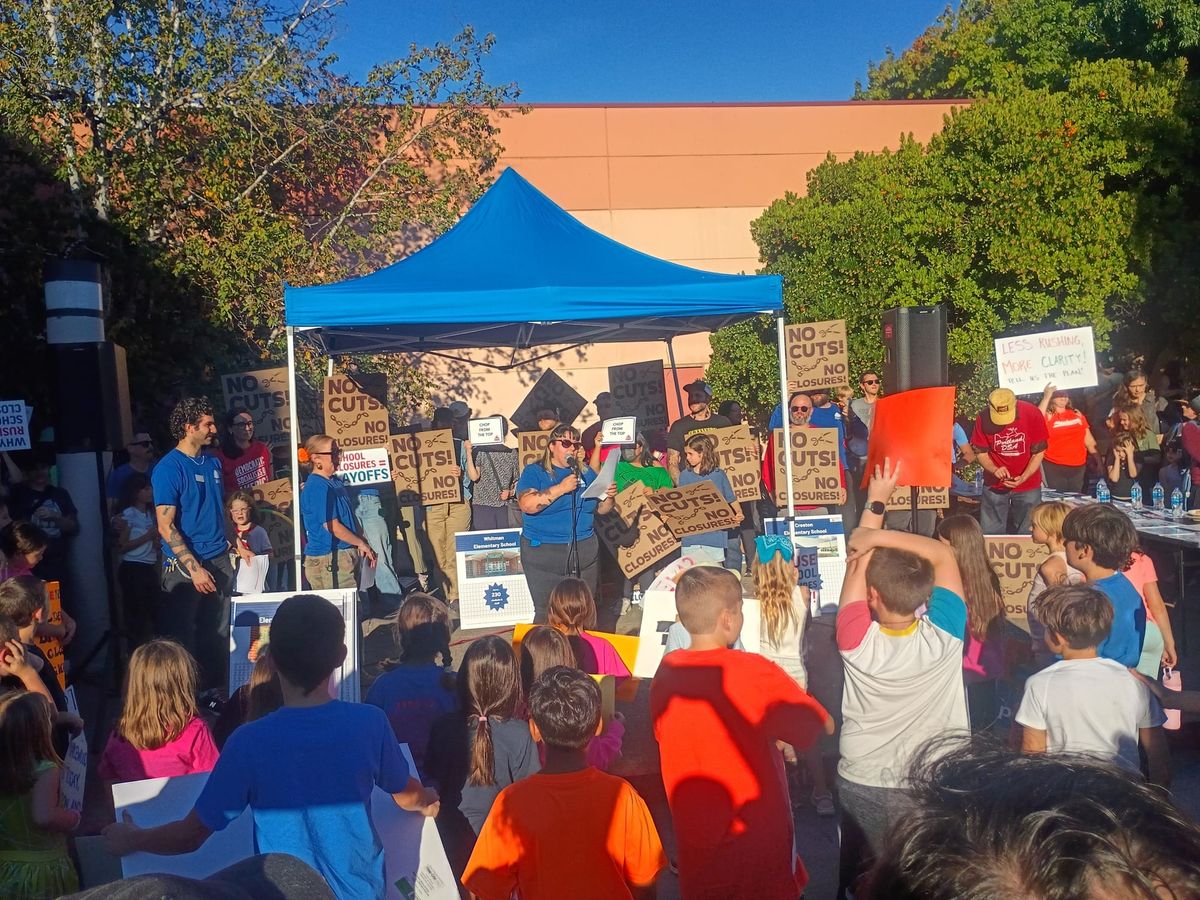
Across Washington State and Oregon, communities are mobilizing to stop plans by district leaders to close their public schools.
After the covid pandemic, enrollment in many public schools dropped below 2020 levels. Some school buildings have significantly less students than before, with some having less than 200 students in the building. At the same time, state governments have become stingy with education funding, fueling school district budget deficits.
District administrators claim closing schools can help save money and balance budgets. Others in the public argue that closing schools is simply a necessary step to achieve efficiency amidst lower enrollment.
But the idea that closing schools will save money or help students learn falls apart on closer inspection. And it flies in the face of years of research conclusively demonstrating that closing schools doesn’t save money – but does cause lasting harm to student learning. They also leave gaping holes in neighborhoods, ripping out a key part of a thriving community.
Despite these facts, public school districts in Bellingham, Olympia, and Portland are proposing to close public school buildings – and stoking a massive public backlash.
Last week, loud and angry protests broke out at a Portland school board meeting shortly after district leaders proposed closing as many as 14 schools, part of a wider public mobilization against closures that includes parents and neighborhood residents, the Portland Association of Teachers and Portland Democratic Socialists of America.
Families in Bellingham and Olympia have also mobilized to fight closures there. School advocates in these cities have all looked to Seattle for inspiration and guidance, after residents here successfully stopped Seattle Public Schools from closing as many as 21 schools in 2024.
But SPS may be also preparing to try again to close schools. The battles unfolding up and down the I-5 corridor may be coming here, and we need to be ready.
Below we take a look at the research that clearly shows closures don’t save money or help students learn, and suggest some ways Seattle can address underenrolled schools and financial needs, rather than embark on another closure attempt.
In this issue:
- Closing Schools Doesn’t Save Money
- Closing Schools Harms Student Learning
- Efficiencies and School Size
- Licton Springs K-8 as a Case Study
- SPS Needs a Larger Conversation About Its Future
- Stepping Off the Roller Coaster
Closing Schools Doesn’t Save Money
Closing schools doesn’t save money. That is the clear conclusion of nearly 20 years of research on the topic from public school districts across the country. But this reality has not fully sunk in among decisionmakers or some members of the public.
A new report out of Stanford University reinforces the fact that districts should not expect to save money by closing schools. The report looked at public school districts in California that had closed schools between 2011 and 2019:
“These findings indicate (1) closures that occurred during the post-recession, pre-COVID decade did not, on average, improve the financial standing of California school districts; and (2) that the fiscal returns to closure were limited by closure-induced enrollment decline.”
Notably, “the findings were consistent across districts of all sizes, locations, demographic makeups, and financial conditions before they decided to close schools,” according to an article in EdWeek about the Stanford report.
“The assumption is just so baked into the logic of closure decisions that it’s assumed closures will save money, so it can be really hard for leaders to combat that thinking,” said Mara Tieken, a Bates College education professor as quoted in the EdWeek article.
In Arkansas, then-Governor Mike Huckabee signed a bill in 2004 to merge school districts with less than 350 students, leading to the closure of 105 schools across the state. New research presented two weeks ago by the University of Arkansas showed that these mergers didn’t save money:
“Reductions in administrative overhead were offset by rising costs for transportation and instructional staff.
‘I think we should be cautious about recommending school consolidation,’ said Josh McGee, an economist at the University of Arkansas and a co-author of both the new cost analysis and the earlier study of academic outcomes. ‘I think the potential benefits have not materialized as envisioned and there are real potential harms.’”
These are just the latest reports in a long series of research that reached the same conclusion, that closing schools doesn’t save money or improve district finances. A 2011 report by Pew Charitable Trusts, based on data going back to the mid-2000s, found that:
“The money saved as the result of closing schools, at least in the short run, has been relatively small in the context of big-city school-district budgets, with the largest savings achieved when closings were combined with large-scale layoffs.”
The most notable example of a city closing public schools this century was in 2013, when Chicago Mayor Rahm Emanuel directed the Chicago Public Schools, which at the time the mayor oversaw, to close 50 public schools in the city.
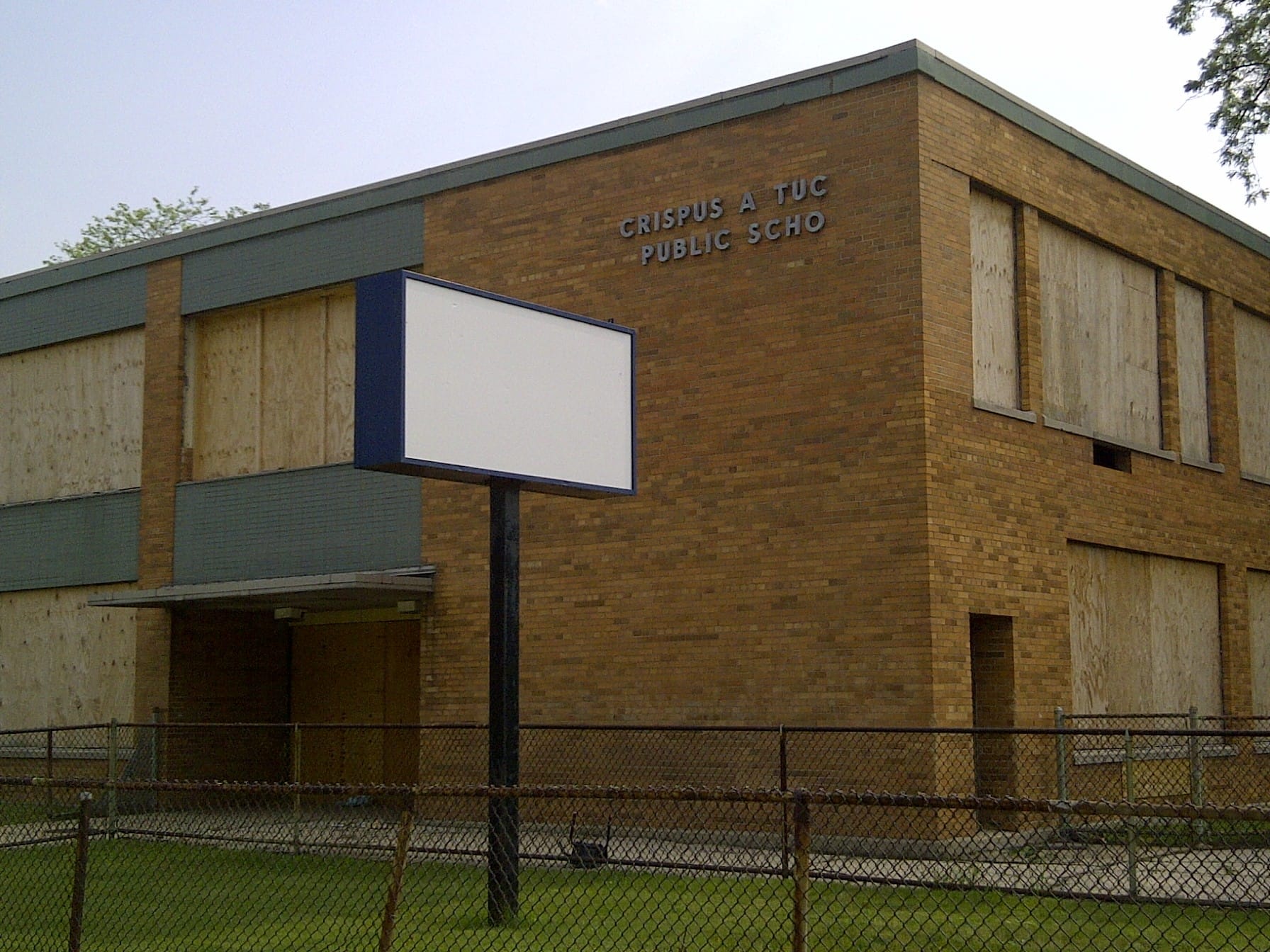
Years later, it became clear that the district was worse off financially. The savings did not materialize, and enrollment collapsed.
The experience led researchers to conclude that “Closing under-enrolled schools may seem like a viable solution to policymakers who seek to address fiscal deficits and declining enrollment, but our findings show that closing schools caused large disruptions without clear benefits for students.”
Given these facts, why do district leaders and some members of the public continue to support closing schools? It may stem from a misunderstanding of how the corporate world operates. Companies aren’t usually closing stores because they’re unprofitable or because they generate significant savings through closure. Instead, they do it to boost their quarterly numbers and their stock price.
Last month, Starbucks announced it was closing 250 stores across the country. But notice the word the company used to describe these stores: “underperforming.” It’s not that these stores were losing money. Instead, Starbucks has sales growth targets it is trying to meet in order to impress investors on Wall Street. Closing those stores helps them meet those targets, even if the stores were turning a profit. They’re not pursuing efficiency, they’re pursuing dividends and bonuses.
Closing Schools Harms Student Learning
Closing schools not only fails to save money or solve districts’ financial problems – they also do significant harm to student learning.
Research conducted in 2018 by the University of Chicago found that Chicago students whose schools closed had worse grades, and that students in both closed and “welcoming” schools saw long-term drops in test scores. A 2023 analysis by the Chicago Sun-Times and WBEZ found that students from closed schools also had lower SAT scores, lower graduation rates, and higher dropout rates. Many students whose schools closed “never had a stable school situation again.”
A similar story unfolded after San Antonio closed several schools in 2014. A report by University of Texas-Austin professor Dr. Terrance L. Green found that students whose schools closed had worse academic outcomes than students from a similar demographic background whose schools remained open. He specifically found students who were entering 5th grade when their schools closed had the most harm done to their learning.
A 2024 study conducted by a University of Houston researcher looked at students from 470 Texas schools that closed between 1998 and 2015, and found lasting harms done to students from those schools:
“By age 26, the students who experienced school closures were 4.8 percent less likely to have attended college, 4.7 percent less likely to have completed college, and 1.3 percent less likely to be employed than their peers in schools with similar demographics and in similarly sized cities who did not experience a school closure. Annual earnings for those students from ages 25 to 27 were also 3.4 percent lower than their peers’.”
Given these facts, school districts should treat closures as an absolute last resort. Instead, district leaders in Bellingham, Olympia, and Portland appear to treat them as a preferred option.
Efficiencies and School Size
School closure proposals in 2026 are usually sold as a drive for efficiency amidst declining enrollment. The argument goes that when a school drops below a certain size, it cannot provide the same resources to students as a school with more enrollment, and should close.
That’s a real issue to address. Yet closures still fail to save money or improve student learning. They still come with potentially major costs to the district’s budget and to student outcomes.
Let's take a closer look at Seattle's situation.
SPS’s enrollment of 47,196 is still below its 2019-20 peak of 52,198. Most of the decline took place in the early 2020s and has slowed since then, but SPS is still slightly smaller in 2026-27 than it was in 2025-26. Its current enrollment is roughly at 2010-11 levels, when SPS was in the process of reopening a handful of schools it had closed just a few years earlier.
According to research by Albert Wong, SPS is also "capturing" a declining share of Seattle's school-age students. 77% of Seattle's school-age kids were enrolled in SPS in 2020, compared to just 69% in 2025. There are 2,000 more school-age kids in Seattle today than in 2020, and 10,000 more than in 2010, so it's not the case that we're losing families in the city overall.
This data suggests SPS has a significant amount of work to do to bring families back to the public schools. Closing schools is unlikely to achieve that goal.
It is unclear what will happen to SPS enrollment from here. Seattle's experience over the last 20 years shows significant shifts have taken place that confounded district assumptions. In the mid-2000s, SPS closed several elementary schools amidst assumptions of stagnant or declining enrollment – only to reopen them in the early 2010s when enrollment grew.
In the late 2010s, assumptions of limitless future enrollment growth was a justification for SPS building "mega-schools" like Loyal Heights, Viewlands, Montlake, or Kimball – only for enrollment to drop in the 2020s.
Enrollment declines have not impacted schools evenly. The monthly P223 data shows that as of September 2026, nine SPS elementary and K-8 schools have an enrollment below 200 students: Cedar Park, Licton Springs, McGilvra, Queen Anne, Rainier View, Sacajawea, Sand Point, Sanislo, and Stevens.
It’s worth noting that smaller schools don’t cost SPS state funding. The state’s prototypical school model is simply a formula that provides a block grant of money to school districts based on its district-wide enrollment. The actual enrollment at each school is not a factor in this formula.
The prototypical school model assumes an elementary school has 400 students. But SPS doesn’t get less money if an individual school has less students than that. State law is explicit that the funding formula should not be used by districts in determining actual enrollment at their schools. (After all, the prototypical school model assumes high schools would have 600 students – every comprehensive SPS high school has far higher enrollment.)
Those underenrolled schools do make a tempting target for closure. But doing so runs into the same problems identified in the research: it won’t save money, and it will cause lasting harm to student learning. It rips the heart out of many neighborhoods. It could also cause families to leave SPS, costing the district money. And it risks putting more cars on the street near schools as students have to travel further to get to class once their neighborhood school is closed.
In 2024, SPS was unable to demonstrate that closing schools would provide new resources for the remaining schools. Still, the argument that fewer schools means more resources for the remaining schools remains a strongly held belief, despite a lack of evidence.
Julie Letchner took a look at this topic in her five-part series last month examining school closures in Seattle. Responding to SPS Superintendent Ben Shuldiner’s argument that closing schools could mean more art teachers at the remaining schools, she wrote:
“What that narrative omits is the fact that the full-time art teacher is now serving double the number of students that each half-time art teacher did. The amount of art teacher time available to each student has not increased.
This is not better resourcing!
Similar logic applies to administrative roles like principals and office staff. Eliminating a principal role via a closure saves money, but it’s certainly not better resourcing. The affected populations are getting a principal whose attention is spread across twice as many families and staff as before.”
Letchner is a parent at Sacajawea Elementary School in northeast Seattle, a school that was slated for closure in the fall of 2024 and then spared. Its enrollment has continued to decline since then, in part due to parent assumption that it remains marked for closure.
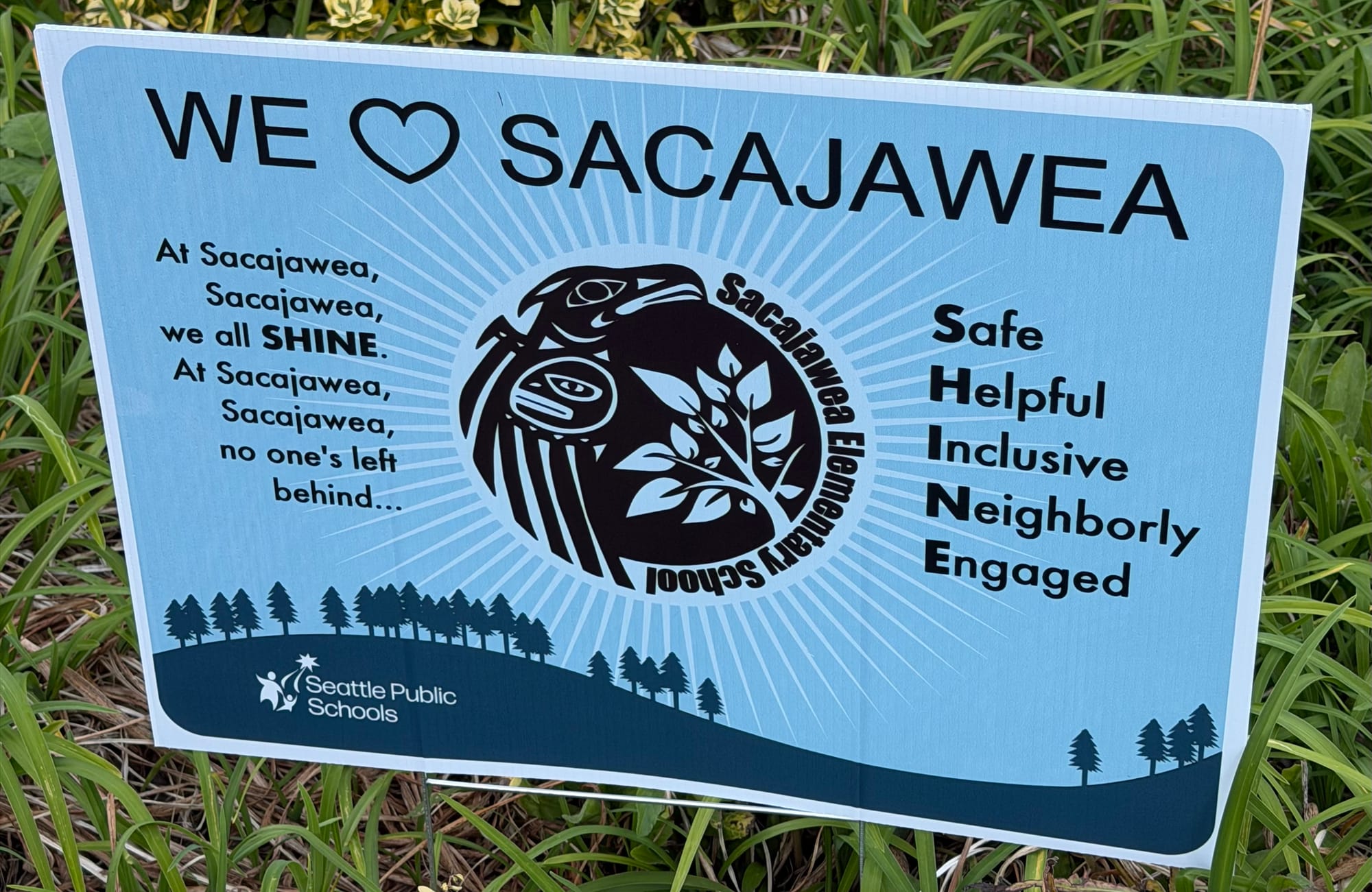
Sacajawea has an aging building that lacks investment, and has not been given new resources that would attract enrollment. One result is that Sacajawea has a lot of split classes – which sometimes causes more families to send their kids elsewhere.
Letchner examined whether closing the school would help address that issue:
“It is true that closing Sac and absorbing our students into larger schools would reduce or even eliminate the split-grade problem. That would genuinely be better resourcing for these kids. Split grades are not best practice, which is why we only see these classes created when there is no alternative.
It’s also true that this version of improvement-via-closure is possible only because Sac is under-resourced today. We are not allocated enough teachers to serve our student population without split grades. (Staffing to avoid splits is more expensive at small schools, so SPS has chosen not to do this.)
Put another way: Sac’s split-grade problem could be solved by allocating one more homeroom teacher to the school. That solution is even better for the students since it would result in smaller class sizes.”
Of course, there’s no guarantee that a school with a larger enrollment would avoid split grade classes. Because closing schools doesn’t save money, the remaining schools won’t necessarily have more resources to provide to its students, especially amidst ongoing budget deficits. And if closing schools causes families to leave the district, as it did in Chicago, that just worsens the problem.
Letchner’s whole series is worth reading. She’s open to the idea of closures, writing that “Such losses may indeed be worthwhile if they create gains elsewhere in the system,” but concludes “I don’t see evidence (yet?) that there would be any system-wide upside to closures.”
Licton Springs K-8 as a Case Study
Some schools have truly low enrollment. Licton Springs K-8 is an example. Its enrollment is now down to just 34 students as of the September 2026 enrollment report. Five years ago, it had 91 students enrolled. This makes it an obvious target for closure to those who think small schools shouldn’t remain open. But SPS would be better off examining the future of the program and the building, with closure being just one of many possible solutions. That's particularly important given SPS's own role in undermining the school.
Licton Springs K-8 was created over 10 years ago out of a merger between Pinehurst K-8, originally founded in 1970 as “Alternative Elementary School,” and Native American leaders seeking a lasting home for a Native-centered curriculum and program.
Licton Springs K-8 was given that name out of a historic connection to the sacred ground of the springs themselves, as well as its location at the new Robert Eagle Staff Middle School located one block south of the springs.
That school was built at what had been the Wilson-Pacific school site that for decades had housed the American Indian Heritage School. (That’s why the school building on North 90th Street has murals depicting Native American leaders – and Robert Eagle Staff himself had been principal of the heritage school.)

But once Licton Springs K-8 opened, it experienced a lack of support from, and sometimes the open opposition of, district leaders. Robert Eagle Staff Middle School’s first principal, Marni Campbell, now the district’s Assistant Superintendent of School Operations, was widely regarded by Licton Springs K-8 families as being hostile to their program. Some families also felt the district was not providing resources to the school or marketing it properly.
In 2020, SPS moved Licton Springs K-8 away from its site in the Licton Springs neighborhood and placed it in Ballard at the newly remodeled Webster building. Community members had fought this move for years, as it severed the connection to the historic community and location. Enrollment fell rapidly in the years after the move.
Licton Springs K-8’s current enrollment raises important questions about the future of the school. But closing it should be just one of many solutions. Should SPS have a Native-focused option school? If so, why is Licton Springs K-8 underenrolled? What steps could be taken to improve its enrollment? Should it be returned to the Licton Springs neighborhood, absorbed into another program, discontinued entirely, or have some other outcome?
To simply look at the school’s enrollment and decide to close it without conducting that kind of deeper examination seems a bad way to run a district – and is potentially racist, given the school's history and the overall context of the Native American experience in Seattle.
SPS Needs a Larger Conversation About Its Future
That in-depth analysis of SPS programs, buildings, and enrollment is what the district needs. Instead, it may get another attempt to close schools.
Shuldiner has been clear that he is open to closing schools. In a May 2026 interview with KUOW’s Soundside he said closures should be on the table as a possible financial savings tool – but then repeated the same talking points used by SPS in the 2024 closure process about creating better resourced schools:
“‘It’s not really about budget,’ he said. ‘It’s about what’s best for kids and teachers.’
To Shuldiner, it’s more of a resource issue — something he believes more than ever that Seattle could benefit from evaluating, now that he’s visited all 106 of the district’s schools.”
So far, Shuldiner hasn’t engaged the wider public about whether closing schools is a good idea. Here in mid-October, time is running out to launch a closure process for the 2027-28 school year in order to satisfy state law and district timelines for choice enrollment and budgets. A rushed closure process conducted without deep public collaboration would be a bad way to run a district – and certain to trigger a massive public response.
Even with a slower and more deliberate process, it's unlikely Seattleites would back another attempt to close schools. A 2024 poll funded by Washington Families for Public Education, a PAC that I co-founded, showed that Seattleites strongly opposed closing schools. Opposition was strongest in central and south Seattle.
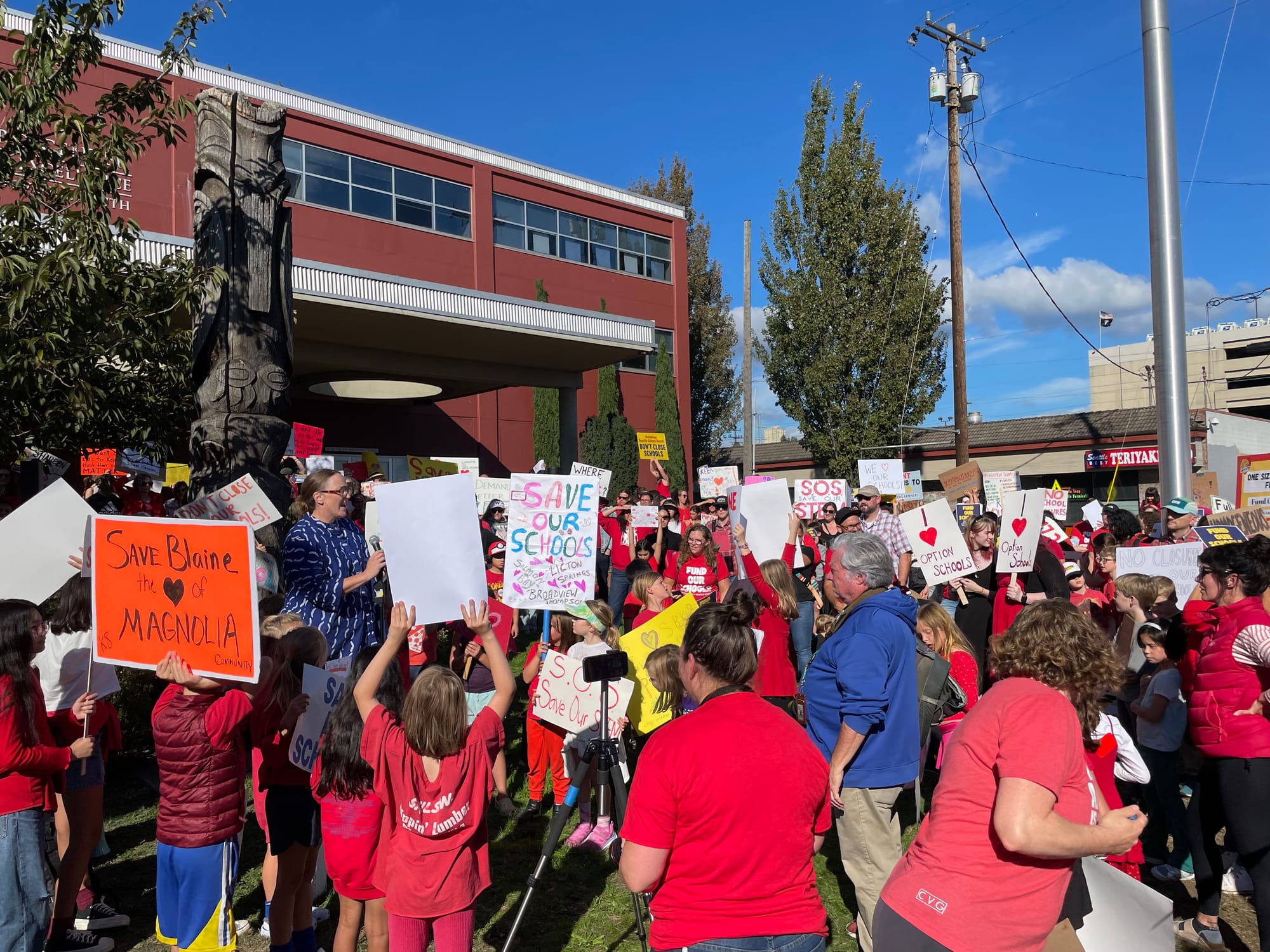
One should expect that the same mass mobilization against closures that is happening in Bellingham, Olympia, and Portland will happen again in Seattle. Just as importantly, another closure attempt would also be an unnecessary distraction from other, more important work that should happen to address SPS’s future.
Here's what that work could include. SPS needs to update its school attendance boundaries, which it has not done in a comprehensive way since 2014. Julie Letchner made a strong case for this approach in her recent series on school closures.
Seattle’s population has grown by nearly 20% since then, and could grow further in the coming years. Even if that doesn’t happen, the 2014 boundaries no longer reflect shifts that have taken place in the last 12 years in birth rates, housing construction, and where families have chosen to live.
Boundary updates have often triggered angst and strong feelings among the public. But the response is nothing like the massive opposition to closing schools. A well-run district regularly revisits and updates its boundaries.
A boundary update also gives the community an opportunity to look at program offerings and consider new programs to help encourage enrollment growth. This could include new dual language programs, schools focused on the arts or the sciences, or even trying to bring programs like a maritime high school to SPS.
After all, many of SPS’s current option and choice schools exist as part of efforts to keep a school building open during previous closure rounds.
This process would also let the community consider what other programs could be housed in SPS buildings, from child care to adult education and other neighborhood services. That could also generate more revenue for SPS through rent.
Such a holistic, inclusive, collaborative process would be constructive and could provide smart solutions that grow enrollment while also helping address the district’s financial needs. It’s certainly better than alienating the public again with a damaging, destructive closure attempt that won’t improve SPS’s finances.
Seattleites should keep in mind that state law gives charter schools the right of first refusal to rent or buy a closed school building. Even if the existing cap on charter schools remains in place, it would be tempting for an existing charter school to want to move into an SPS building.
Stepping Off the Roller Coaster
In a recent conversation, an SPS parent shared the sentiment that being in the district is like “being on a roller coaster” – with constant changes that create uncertainty for families and students. This parent wanted off that roller coaster, and hoped for stability and predictability that could keep them in SPS for years to come.
It’s a common sentiment, and a reasonable one. Constant change can wear on families, students, and educators, especially as the disruptions of the covid pandemic still impact us in Seattle. Change is sometimes necessary, especially when there’s still so much work to be done to improve student learning. But that change should be focused, limited, and above all, done in full collaboration and partnership with families, students, and educators.
SPS has made improvements to district operations under Shuldiner, though there have been some notable setbacks as well. District leaders have a long way to go to fully rebuild public trust that was lost in recent years. A school closure plan won’t rebuild that trust, and would likely erode recent gains.
Rather than put the public back on the roller coaster by conducting another top-down closure process, SPS should instead sit down with the community and engage in a more sensible approach to assessing the district’s programs and buildings. It should focus on sustaining what we have and addressing issues of low enrollment but with closure as a last resort. That needs to be led by the public’s vision for our schools, not by what administrators think is best.
After all, this is our school district. Not theirs.