Issue 41 -- Shuldiner Scales Back Recess for Many SPS Kids
Over a decade after families and educators won protections for lunch and recess times, Ben Shuldiner reopens the fight by slashing recess time at several elementary schools.

Students at some elementary schools across Seattle returned to school this month to discover they would have less time for recess than they had last year.
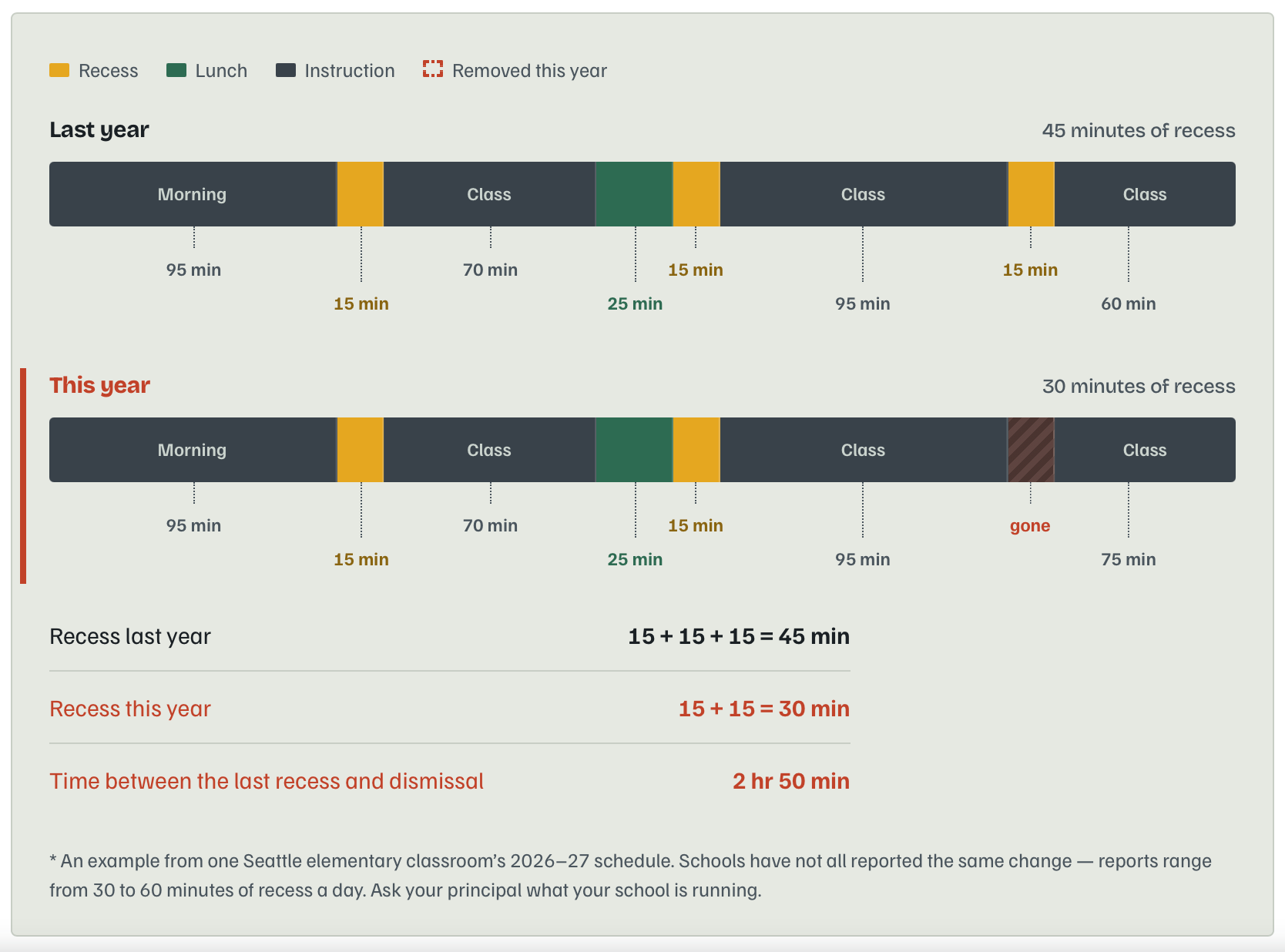
Superintendent Ben Shuldiner directed elementary school principals to limit the amount of recess time to 30 minutes in order to fit in more academic time. Principals can seek a waiver around this, but Shuldiner suggested in a KUOW interview they’ll be hard to come by.
Some students have reported they still get three recesses a day, but the number of schools offering it are now very few in Seattle Public Schools. Others have reported they're also getting less time to eat lunch. Some families have raised concerns about the impact of less recess time to students who need behavioral supports.
By pitting academic time against recess time, the Superintendent has reopened an issue many felt was settled. He’s also stoked opposition from parents and teachers, seeking more recess time across all SPS elementary schools.
Pediatric research demonstrates that students need regular recess breaks in elementary grades, and that 45 minutes of recess is best. One 2025 study found that "the implementation of 45 min of daily recess, defined as unstructured outdoor play, showed that children need at least three 15 min breaks a day to de-stress. Thirty minutes daily does not seem to be enough."
After months of parent advocacy against SPS cutting lunch and recess times, Seattle Education Association members won a guarantee of 30 minutes of recess every day in their 2015 contract with SPS, though their original ask was for a minimum of 45 minutes.
These efforts helped spark a statewide push that led legislators to pass a bill in 2023 with a 30 minute recess guarantee, similarly scaled down from an original version mandating 45 minutes, but with language encouraging schools to offer more.
The Superintendent’s directive also comes a year after SPS triggered a massive student walkout by dividing many high school lunches into two segments.
Shuldiner’s new approach treats the 30 minute recess rule as a cap, rather than a floor. He justifies this by saying elementary schools must offer certain minutes of instructional time per subject, but does not explain why those specific amounts of time are necessary. Instead, it appears to be an ideological belief that more instructional time is simply better, despite pediatric research that shows recess time helps students learn more effectively. As a result, students are being treated more like widgets rather than kids.
Below, we take a look at what’s going on with recess in SPS, how we got here, and how the public is responding. We also have an announcement about a great new venture by one of our contributors.
In this issue:
- Pediatric Research Shows Recess is Key to Student Academic Success
- How Seattle Parents and Educators Won a Major Battle to Protect Lunch and Recess
- Shuldiner Reverses Course, Citing Instructional Minute Needs
- Parents Mobilize to Protect Recess – Again
And two Bulletin-related items:
Pediatric Research Shows Recess is Key to Student Academic Success
Although some may believe that more time focused on an academic subject rather than time spent playing is good for a child’s education, pediatricians have known for years that kids, especially young ones, need regular breaks and unstructured playtime in order to be healthy – and to do well in school.
The American Academy of Pediatrics published a policy statement in 2013 that cited extensive research on the subject, and concluded that “minimizing or eliminating recess may be counterproductive to academic achievement, as a growing body of evidence suggests that recess promotes not only physical health and social development but also cognitive performance.”
Their 2013 statement did not suggest a minimum amount of time, but did note that “In other countries, such as Japan, primary school-aged children have a 10- to 15-minute break every hour, and this is thought to reflect the fact that attention spans begin to wane after 40 to 50 minutes of intense instruction.”
In May 2026 the American Academy of Pediatrics updated their policy statement. They reiterated their research-backed conclusion that recess is important for student learning. “Recess represents a temporary suspension of cognitive effort, which helps to maintain efficiency and concentration while managing stress,” they wrote.
Recess creates a state of “wakeful rest” that “allows the neurons comprising the memory trace to be reactivated” – in other words, it gives students a break that allows their brains to regenerate the capacity to store new knowledge.
This time, the American Academy of Pediatrics offered a statement about minimum recess times, emphasizing the importance of multiple breaks per day:
“Peer-reviewed studies indicate that multiple breaks with a minimum of 20 minutes every day is optimal to realize the full cognitive, physical, and social benefits of recess for students. At minimum, recess should occur often enough and long enough, with a variety of options for students, in order to mitigate stress and allow students to regain focus before resuming classroom instruction. The academic value of recess can be reinforced by including recess time as instructional minutes.”
The statement is unclear as to whether each break should be 20 minutes or whether the overall minimum per day should be at least 20 minutes. But the policy statement is clear that 20 minutes is a bare minimum that should be built upon, not a ceiling or the preferred amount. It also cites research showing positive benefits in schools where kids get 40 to 50 minutes of recess time per day.
This statement is likely a response to schools that offer little to no recess at all, and to arguments that recess is unimportant, rather than an attempt to address the question of how much recess time to give that is currently at stake in districts like SPS.
The key takeaways, however, are that “multiple breaks” are desirable, and that more recess time is beneficial for student learning.
One researcher in Texas put this to the test. By providing an hour of recess each day, she found students are better regulated, with fewer behavioral problems, and do better academically. She also got strong pushback from Texas education officials who did not value recess time.
Her research informed the 2025 study that further justifies 45 minutes as the ideal standard for elementary school recess, and explicitly states "thirty minutes daily does not seem to be enough."
How Seattle Parents and Educators Won a Major Battle to Protect Lunch and Recess
Despite this research, in the early 2010s SPS scaled back the amount of time kids had to eat and play, in order to fit in more academic time. This happened without regard for student well-being or their academic needs.
In the 1960s SPS offered 95 minutes for recess. Since then, recess times had been cut for a variety of reasons, including the challenge of managing long student recesses, budget cuts that made it harder to staff recess, and by the 21st century, a growing push for academic time even at the expense of recess and lunch.
Across America, recess declined by an average of 60 minutes since 2001, with the test-centric approach to education initiated by the No Child Left Behind law signed that year often cited as a major cause.
By spring 2014, recess time in many SPS elementary schools had shrunk dramatically, with some schools no longer providing scheduled recess at all. A KUOW investigation found that “schools with less recess have more low-income students and students of color.”
When students returned to school in the fall of 2014, some of them found their time for both lunch and recess had been cut again. Parents at Whittier Elementary School in northwest Seattle learned that their kids were being given less than the 20 minutes required under district policy to sit and to eat lunch, which wasn’t enough for most kids. UW researchers confirmed that, on average, students in SPS were only getting 13 minutes to sit and eat lunch.
Students were coming home hungry with lots of food left in their packed lunches. Parents volunteering in the lunchroom saw leftover food being thrown away because kids didn’t have time to eat it. They even discovered that kids waiting in the hot lunch line got their food without enough time to even sit down to eat it.
These parents raised concerns with the school principal, who told them that it was a district mandate. The parents then went to the regional Executive Director, Jon Halfaker, who dismissed their concerns and refused to change course. At this point, out of options, they began to organize.
At the time I had an infant at home in Greenwood and lived in the Whittier boundaries. I heard from Whittier parents about these issues with lunch and recess time, and volunteered to help get local media to cover the issue to put pressure on the district to act.
Whittier parents also connected with other parents across SPS and found many of them were experiencing similar problems at their schools. That included parents who had been raising concerns about inadequate recess time. Together, they launched a new organizing effort, Lunch and Recess are Essential, to push SPS to change course.
Despite a broad public mobilization, extensive media coverage, and packing the school board meeting, district leaders refused to budge. Superintendent Larry Nyland would not add more time for lunch or recess, and school board members would not intervene. They did create a School Wellness Taskforce, but refused to make any promises or minimum guarantees.
Educators took notice and decided to act. In the summer of 2015, SEA members were bargaining a new contract, and included a demand that elementary schools guarantee at least 45 minutes of recess each day. After a weeklong strike that included other issues, SPS settled with SEA, and the resulting agreement included a 30 minute minimum for recess time.
Shortly thereafter, in response to taskforce recommendations the school board adopted a Student Wellness Policy that required schools to provide “adequate time to obtain and consume meals” and “adequate opportunities to be physically active before, during, and after school.”
SEA’s intervention produced a high-profile victory that inspired other parents across the state, and even the country, to advocate for the restoration of adequate lunch and recess time. Recess for Washington, a project of the King County Play Equity Coalition, mobilized to push state legislators to codify into law protections for student time to eat and play. They sought a minimum of 45 minutes a day for recess.
After years of advocacy, in 2023 the legislature finally passed a bill sponsored by State Senator T’wina Nobles to guarantee a minimum amount of recess time to elementary students. The original version of the bill called for a minimum of 45 minutes of recess each day. State Senator Jamie Pedersen from Seattle, who also serves as the Senate Majority Leader, expressed skepticism about the bill, and it passed in a scaled back version.
Like the SEA-SPS deal reached in 2015, the final version of the bill only offered a 30 minute minimum rather than the desired 45 minute minimum. But the bill emphasizes “school districts are encouraged to exceed this requirement.”
Just last month, Axios Seattle said “recess makes a comeback” in Washington State, reflecting years of successful advocacy. While many were dissatisfied that district and state policies mandated just 30 minutes rather than the desired 45 minutes, and still had concerns about inadequate lunch times, the protections were considered to be an important baseline.
There things stood in SPS – until now.
Shuldiner Reverses Course, Citing Instructional Minute Needs
Under new Superintendent Ben Shuldiner, SPS is now treating the 30 minute recess requirement as a cap, when it was always intended as a floor that should be exceeded. As a result of Shuldiner’s actions, kids at several schools have had some of their recess time taken away.
In June, Shuldiner told the school board that he intended to standardize the elementary school day across the district. This included providing only 30 minutes of recess time.
As we’ll discuss below, this decision has triggered significant public backlash. In recent days, Shuldiner and SPS leaders have stepped up their defense of this decision.
Shuldiner went on KUOW’s Soundside on Wednesday, September 9 and was asked about the cuts to recess time. His main defense was that SPS has to meet minimum requirements for academic time in specific subjects, and that this means recess has to be limited to 30 minutes.
He said 75% of SPS elementary schools were already offering just 30 minutes of recess, meaning 25% of elementary schools were providing more than that. It’s students at those schools who saw their recess times cut this fall.
Shuldiner went on to make the discredited argument that academic time and recess time come at each other’s expense, telling listeners “we also have to make sure we're teaching enough math, English, and science, because that's our job too.”
Late on Friday afternoon, SPS sent an email to families with students in K-5 and K-8 schools defending the cuts to recess. The message was signed by five SPS leaders: Dr. Mike Starosky, Assistant Superintendent of Academics, Dr. Rena Deese, Executive Director of Elementary Schools, Dr. Jessica Conte, Executive Director of Elementary Schools, Dr. James Mercer, Executive Director of Elementary Schools, and Justin Hendrickson, Executive Director of K-8 Schools.
The email introduced a new argument for the cuts: that it was needed to provide “equity”:
“Approximately 75 percent of our elementary schools already meet the recess expectation. What is different this year is that all schools are expected to fully implement them so that students across Seattle Public Schools have equitable access to the same learning opportunities, student supports, and experiences throughout the school day.”
It was a return to the lowest-common-denominator approach to equity that SPS had seemingly turned away from, as chronicled in a recent and widely-read article by Sandeep Kaushik. Rather than give more students more recess time, SPS appears to once again think the equitable solution is to give everyone a worse experience.
The SPS argument also reframed 30 minutes of recess as an “expectation” that needed to be met, failing to explain that the other 25% of schools had gone beyond the expectation – as the state intended. It was an Orwellian statement that flew in the face of the clear intent of state law.
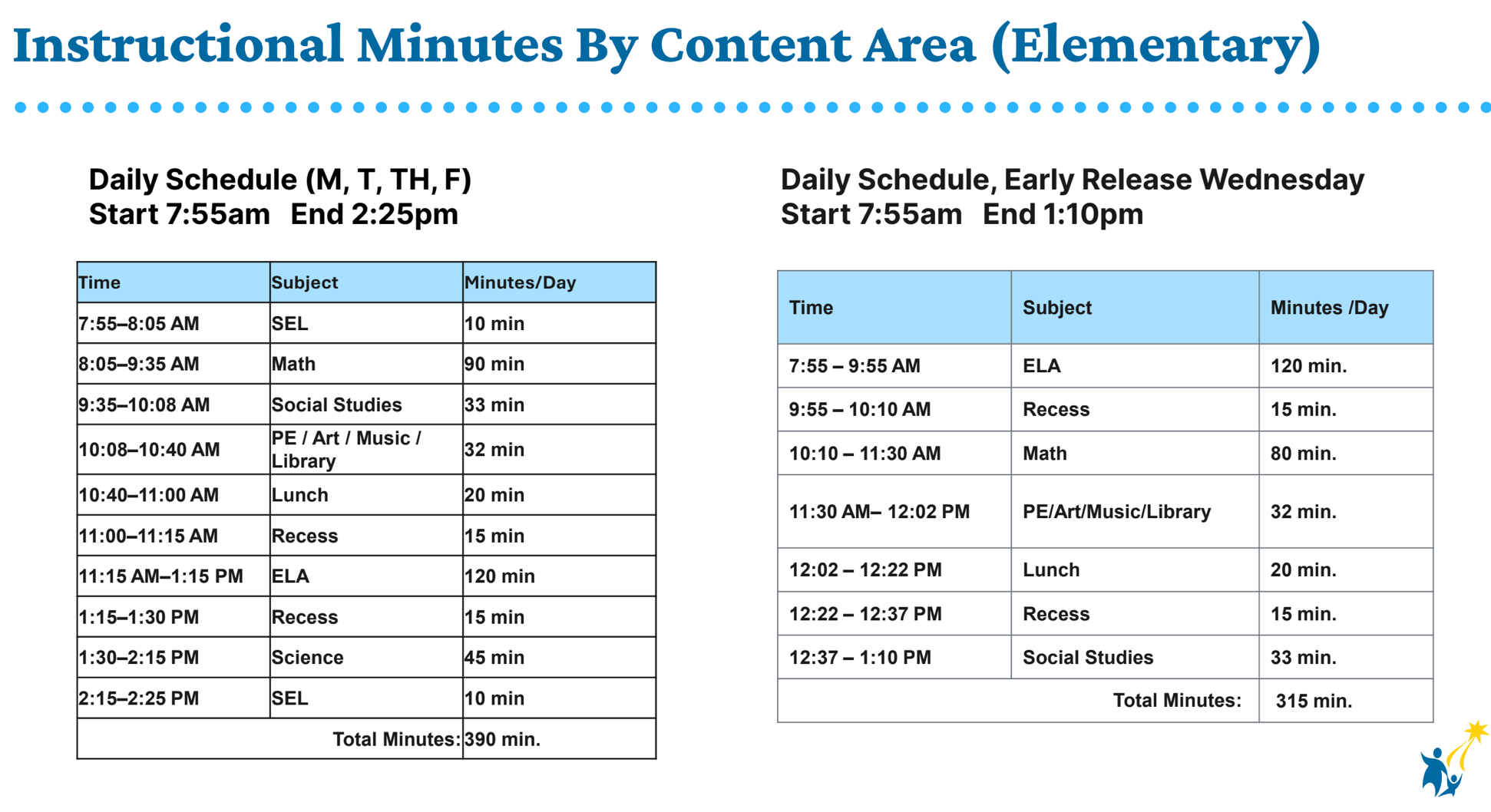
The message also made the same arguments Shuldiner did on KUOW, that cuts to recess time were needed to achieve specific instructional times:
• English Language Arts: 120 minutes daily
• Mathematics: 90 minutes daily
• Science: 45 minutes daily
• Social Studies: 33 minutes daily
• Social-Emotional Learning: 20 minutes daily
• Specialists (Art, Music, Physical Education, and Library): 32 minutes daily
• Recess: 30 minutes daily
• Lunch: 20 minutes daily
But notably, the message acknowledged these are “district expectations.” It did not explain the reasons for choosing these amounts of time for each subject.
There are no state laws nor binding OSPI directives defining minimum academic minutes per subject. Nor are there state laws governing the length of the school day – only that students in grades K-8 get at least 1,000 instructional hours per school year. Of course, there’s also the aforementioned state recess law encouraging schools to go beyond 30 minutes of recess in elementary school.
On KUOW, Shuldiner specifically called out that the controversial new K-5 ELA curriculum, Emerge, calls for teachers to take 120 minutes a day to teach it. That appears to be the sole source of the “district expectation” for 120 minutes of ELA time in elementary schools. But a curriculum ought to be implemented with flexibility, and shouldn’t override other priorities, such as recess time – especially given the importance of recess to student learning.
These rigid expectations also fly in the face of the pediatric research described earlier in this article. Students need regular play breaks in order to rest and refresh their brains in order to receive new information. Yet educators report that SPS has told them in professional development that the 120 minutes of ELA be provided straight through, with only short and occasional breaks.
And although the email from SPS leaders says “teachers already take ‘brain breaks’ and use other pauses in the instructional day,” this can be inconsistent and lacks the assurance given by regularly scheduled recess time.
Whereas pediatric research is consistent and clear that kids need ample recess time, educational research is much less clear about whether long blocks of academic time help kids learn. Some studies say it does, others that it doesn’t, and still others claim the results are mixed and highly dependent on the student and the school.
Ultimately, it seems that rigid bureaucratic imperatives and for-profit curriculum publisher suggestions are overriding what research demonstrates is best for kids.
Parents Mobilize to Protect Recess – Again
Parents have begun to mobilize against these backsliding changes to recess time, inspired by the successful advocacy of the mid-2010s and by teachers who are concerned by these changes but cannot speak out publicly.
A group of parents put together an information page and call to action at SPSforKids.org, urging district leaders to reverse the changes and facilitate additional recess time across all SPS elementary schools. The website also points out that concerns are back about lunch times as well. (This page on recess is hosted at the same site that also shared information and mobilization around proposed changes to special education services during SEA-SPS negotiations.)
According to Esther Stifano, hundreds of SPS parents felt they were in the dark about the changes – she created the site to educate the community based on teacher and staff feedback to help parents understand where and when to focus their advocacy efforts. Hundreds of SPS parents have sent emails to the Superintendent and school board through the site.
The next school board meeting is on Wednesday, September 16. According to the agenda, Shuldiner plans to address recess in his comments. Some parents are also likely to give public comments opposing his recent changes.
It remains to be seen whether Shuldiner will reverse course, or plow ahead with these changes.
Now, for a few items related to The Bulletin itself:
Julie Letchner Launches New “Passing Notes” Site
We’re excited for one of The Bulletin’s contributors, Julie Letchner, to launch her own newsletter – Passing Notes! Julie has collected some of her own writings there dating back to January 2026. And she’s launched it with a four-part series looking at the possibility of another school closure effort.
Letchner makes some excellent points about closures, including that research shows closures usually don’t save money. She also makes a crucial insight about claims that students will have more resources if there are fewer schools:
“Let’s look at the example that Shuldiner repeats most frequently, including last week to King5. It’s the example of the full-time art teacher vs. the part-time one. Sometimes it’s a librarian, or PE teacher, or music teacher, but the story always goes like this:
By merging two schools that each have a half-time art teacher, we are able to place all students in a school with a full-time art teacher. Full-time art for everyone! Hooray!
What that narrative omits is the fact that the full-time art teacher is now serving double the number of students that each half-time art teacher did. The amount of art teacher time available to each student has not increased.”
Go read the whole thing, and make sure to subscribe to her newsletter!
What’s Happening With AI in the Classroom?
Finally, The Bulletin is working on an article about growing concerns with student and teacher use of AI in the classroom. Do you have a story about how AI is being used or misused in SPS? Share it with us at tips@thebulletinsea.org. We won’t publish anything you send us without your approval.
Note: This article was updated after it was emailed to subscribers to add a quote from Esther Stifano.