Issue 37 – SEA and SPS Start Bargaining New Contract
With just over a month until school starts, bargaining is going slowly, with major issues still unresolved.
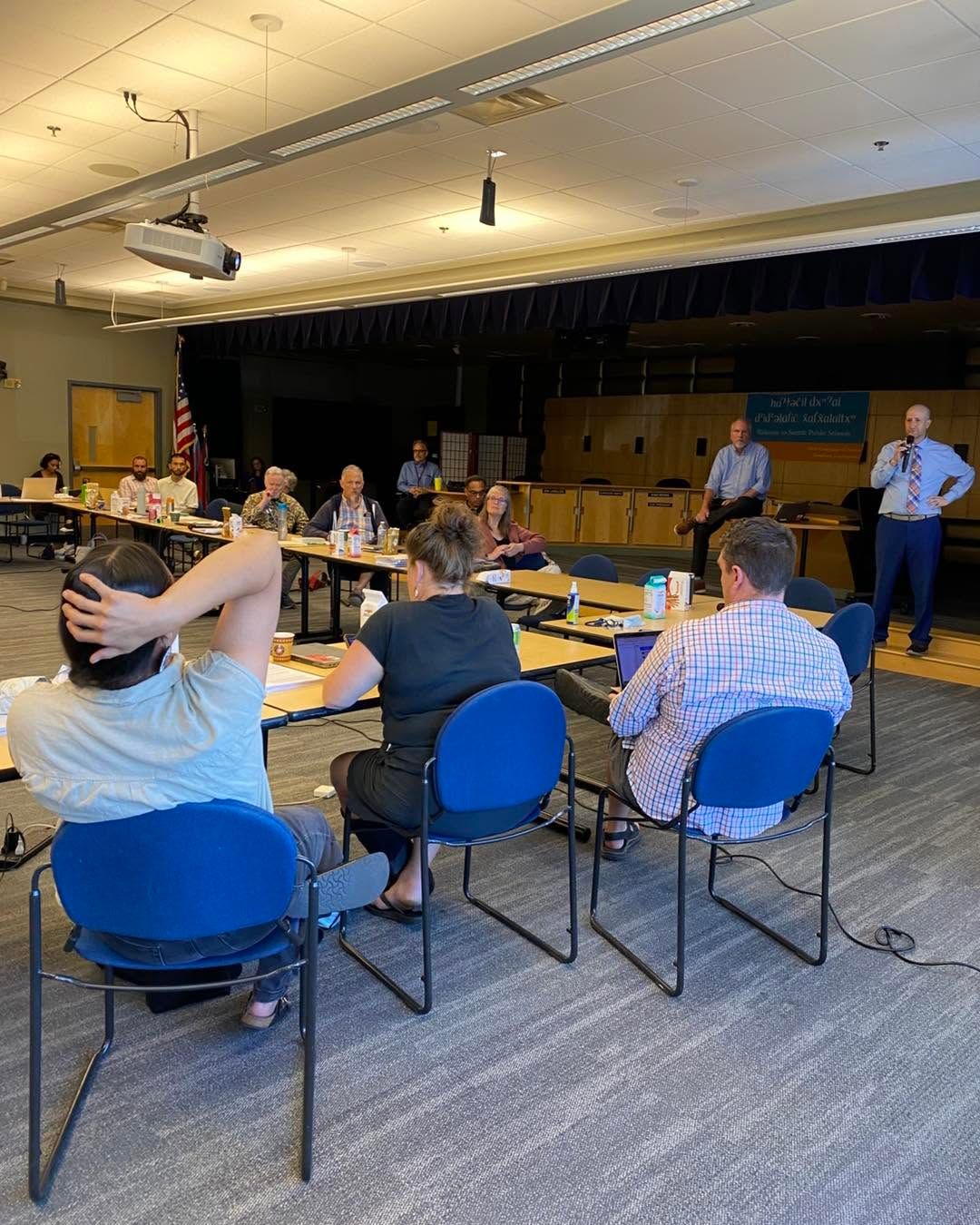
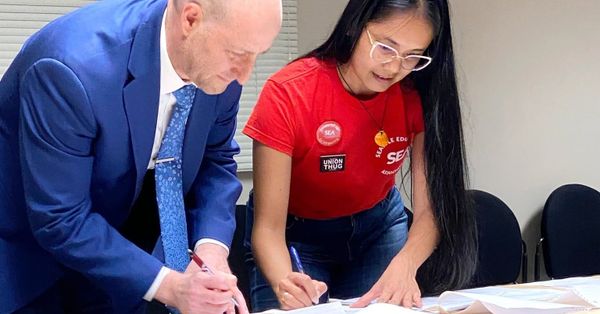
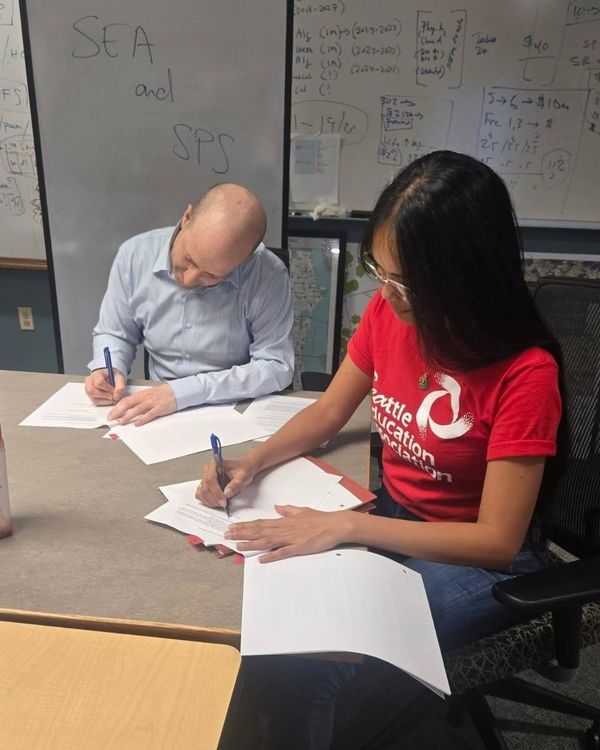
Right after school ended in June, bargaining teams from the Seattle Education Association (SEA) and Seattle Public Schools (SPS) began regular meetings to hammer out a new contract between the district and its educators. Meetings continue into August, as we are a month away from the start of school.
Since at least 2012 nearly every negotiation between SEA and SPS has led to a strike authorization vote, with an actual strike taking place in 2015 and 2022. Last year, SEA and SPS agreed to extend the 2022 contract by another year, but that is unlikely to happen this time.
It’s too early to tell whether another strike will happen in 2026. Bargaining is moving slowly so far, with major issues unresolved, including educator salaries.
Here’s what we know about this year’s bargaining process. In this issue:
- What’s Under Discussion at the Bargaining Table
- The Lingering Impact of the 2022 Contract
- So…How’s Bargaining Going?
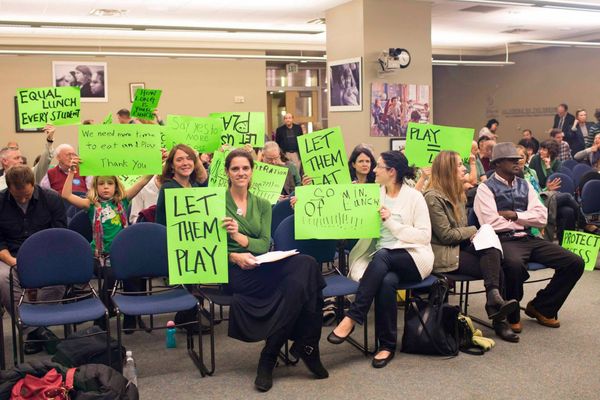
- Seattleites Historically Side with SEA
- New SEA President Faces Possible Legal Charges
What’s Under Discussion at the Bargaining Table
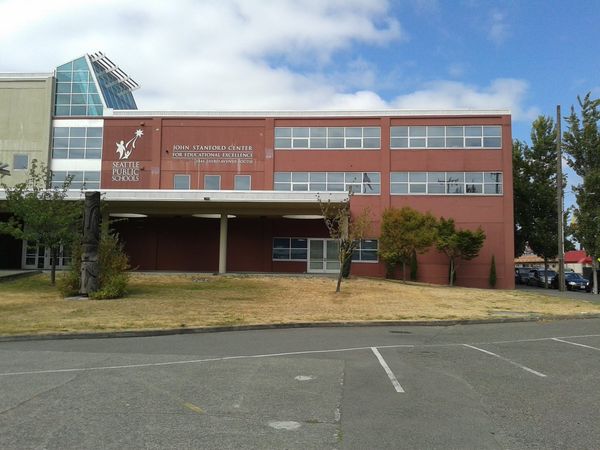
Bargaining between the sides takes place behind closed doors at the John Stanford Center for Educational Excellence. Superintendent Ben Shuldiner is actively participating and attending some sessions.
SEA posted their bargaining proposals publicly in June. These were “conceptual” proposals, and it’s normal for specific, detailed proposals to be shared in the room with SPS’s bargaining team.
SEA’s proposals were developed through surveys filled out by SEA members, as well as a public survey of SPS families.
SEA says their proposals around wages and benefits seek to balance “what SPS can afford, how SEA’s contract compares with others in the area, and how it compares with the cost of living in King County.” They call for “competitive wages” for all employees covered by the contract, as well as higher percentage increases for Office Professionals and Paraprofessionals.
Their proposals are also designed to help educators meet student needs. They seek smaller class sizes, access to “adequate physical, social, behavioral and emotional supports,” and more support for co-teaching in special education. With ICE activity ramping up dramatically this summer, they also call for SPS to declare that the building and grounds of SPS schools are sanctuary spaces for students, families, and educators.
Last week, the two sides also discussed student safety. According to SEA, they discussed “common standards for student discipline, building/program climate, and harassment, intimidation, and bullying.”
Because the contract is legally binding and enforceable in the courts, it is one of the few tools educators have to legally hold SPS accountable, and ensure better conditions in the classroom.
Reflecting growing public concern about the use of tech in the classroom, SEA also made specific proposals limiting the use of AI. They want SPS to commit that they “shall not implement, utilize or promote AI Systems that eliminate, reduce, or replace work traditionally performed by bargaining unit members without prior written agreement.”
SEA also wants to prevent AI from being used to evaluate or discipline its members, and that they will never be required to use AI “as part of their delivery of whole class or small group instruction.”
SPS did not publish its bargaining goals, and does not provide regular updates to the public about bargaining. SPS media relations did provide this statement to The Bulletin:
“We are hard at work bargaining on a near-daily basis with our partners in SEA and are glad to be making real progress, having already reached multiple tentative agreements that move us closer to completed negotiations.
Our approach is focused on meeting our students' needs and supporting our staff while responsibly sustaining our limited public dollars over the long term. This is consistent with direction from the School Board through a resolution adopted in July, which directs the district to bargain in good faith, with mutual respect, and in a manner that supports the district's long-term fiscal health. That is exactly what we are doing. Bargaining works best between the parties, in good faith, at the table, and that is where our focus remains. We are glad to be working alongside our partners and are optimistic about what we can accomplish together.”
The Superintendent oversees the bargaining process for SPS and has participated in bargaining sessions. School board directors are legally prohibited from participating in bargaining and cannot themselves reach out to members of SEA’s bargaining team.
However, as the Superintendent’s bosses, they can urge him to reach an agreement and make his handling of bargaining part of his evaluation. Directors can also authorize him to seek legal action against a striking union, though as we discuss below, this has proven extremely controversial in the past.
At the July 8 board meeting, Director Joe Mizrahi proposed a resolution regarding bargaining. The resolution calls for the Superintendent to "continue to engage in collective bargaining in good faith and in a manner that reflects mutual respect, transparency, and a collaborative approach with the District’s labor partners.” It also calls for the Superintendent to “negotiate agreements that advance the District’s long-term fiscal well-being” to tackle the district’s budget challenges.
Mizrahi’s resolution passed unanimously.
The Lingering Impact of the 2022 Contract
Though SEA received strong support from school communities in 2022 as in past years, the resulting contract generated controversy with some SEA members and with some community members. Affordability and special education were two key areas that drew attention.
SEA’s meeting in September 2022 to ratify the contract was contentious. One group of members urged that their union continue the strike in hopes of winning more concessions from SPS. They were narrowly outvoted after an eight-hour-long meeting, and the contract was ratified shortly thereafter.
The contract offered teachers a 7% raise in the first year, and annual raises after that. For the 2025-26 school year, teacher salaries ranged from $74,730 to $123,125, depending on a teacher’s years of service and educational level. You can find the salary schedules in the SEA collective bargaining agreement starting on page 151.
SEA and their supporters argued that due to growing inflation and Seattle’s high cost of living, teachers needed a raise. Without it, experienced and qualified teachers would leave for districts with a lower cost of living or better salaries.
Critics immediately argued the raises were unaffordable — including SPS leaders themselves, who claimed even before the contract was ratified that they couldn’t afford the deal they’d just made. A year later, Director Liza Rankin later told the Seattle Times she felt “nauseous” when voting to approve the contract.
The Seattle Times has repeatedly argued that the 2022 contract “pushed the district into the red” and was a “self-inflicted” wound.
SEA claimed that SPS could afford the 2022 contract by using money it had in extra fund balance. SEA has made similar arguments this year. This summer they published a Seattle Public Schools: Financials at A Glance one-pager, sharing their perspective on SPS’s budget position.
In that document, SEA argues that “reprioritizing the district’s expenditures” could “free up resources.” They claim that:
“Spending across purchased services has increased $27.2 million or 17.9% since 2022-23. The majority of the increased spending is on agency/contracted or non-district-hired Special Education staff to serve the needs of our students. Hiring these staff types directly, rather than using staffing agencies, would save the district from paying costly agency fees and overhead, and would allow the district to spend that money on students.”
Last week, Superintendent Shuldiner and SPS leaders presented their own budget analysis to SEA. This is how SEA Vice-President Davina Diaz described what SPS shared:
“As we already knew, the district is financially insolvent and went into a negative fund balance on June 30. [Superintendent Shuldiner] also shared:
The district is projecting it'll lose about $50M on Special Education services and $29M on Multi-Lingual education in 2026-27. The district is also paying 77% more for student transportation than the state funds. In short, every student enrolled costs more than SPS is funded for.
The $180M in Contracted Services includes student transportation, legal costs and insurance costs, tuition for running start, and Special Education services for students whom the district can’t serve, among other expenses.
The Superintendent helpfully pointed out a few laws that we could work in Olympia to change that would help SPS’ finances. It will be critical that we show up during the legislative session to advocate for our students.
The news isn’t great but we never thought it would be. We know there will be legislative funding increases that will improve the picture. But all told this means we have to remain flexible and creative as we move through this bargain.”
The state legislature’s failure to amply fund public schools as the state constitution requires means SEA and SPS have to figure out how to provide teachers adequate compensation to support retention while also addressing other needs.
Another major issue in the 2022 contract involved how SPS delivers special education services. SPS had proposed to eliminate student-to-educator ratios for special education, raising concerns among teachers about their ability to successfully meet student needs as more students are taught in general education classrooms. SPS eventually relented on that demand.
Shuldiner has called for reforms to special education, and told the school board in May he wants a “per-pupil funding model” for SPS. We don’t know yet what role those issues will play in the 2026 bargaining process, but should expect it to come up this month.
So…How’s Bargaining Going?
SEA posts weekly updates on its website about the bargaining progress, as well on its Facebook and Instagram accounts.
On July 23 SEA described “mild frustration” at the pace of negotiations:
“At the end of our 8th bargaining session we’re feeling mild frustration that we haven’t yet moved past these ‘easy’ 18 issues and into the more difficult subjects. After spending more than 50 hours at JSCEE we have no tentative agreements with the district. We’re aware that we’re scheduled to welcome students back to our schools in just under 6 weeks and we’re committed to reaching an agreement that gets us back to school with more of what our students need.”
According to SEA’s update from July 28, progress has been slow, though agreement was reached on two minor issues: “staff roles in building access and managing doorbells” and “laptops for paraprofessionals.”
SEA also reported in the July 28 update that SPS appears interested in trying to reduce the role of educators in helping make decisions impacting their school. For example, SPS proposed to neuter Building Leadership Teams, offering a proposal that would “strip staff of site-based decision-making power, making votes ‘advisory’ to the principal and giving principals and managers the ability to override staff votes.”
Building Leadership Teams are made up of the principal, teachers, classified staff, and parents and make decisions and recommendations regarding a school site’s program, funding, and policies. This change would reduce the role of SEA members in helping to make decisions that impact their school.
“We hope these proposals aren’t a sign of what we can expect from SPS in this bargain and know SEA members are ready to mobilize if bargaining starts heading in a bad direction. Most of today’s bad proposals don’t save money; they are just a turn away from the solutions we’ve proposed to SPS. We hope the Superintendent begins to use his leadership to stop his team from lobbing these bombs.”
Apparently SPS got the message. In a video update provided by SEA late last week, bargaining team member Susan Talley said that SPS “did recognize the impact” those proposals had and pledged to come back with “something better.” That’s a hopeful sign, as it will be more difficult to resolve financial questions if SPS is pushing to reduce the role of educators in budgeting and district operations.
Recent SEA bargaining updates have also included a call for picket captains at each school, but that shouldn’t be taken as a sign a strike is likely. Unions usually go into bargaining with picket captains identified just in case a strike does happen, so that they don’t have to scramble at the last minute.
It’s simply too early to tell whether we are headed toward a strike in September. In high-stakes labor negotiations it’s common for negotiations to go down to the wire, with both sides using the threat of an imminent strike as reason to offer last minute concessions.
Yet that is also not how labor negotiations are usually done at large districts in the Puget Sound region.
Districts in Everett, Tacoma, and Bellevue regularly reach contract agreements with their educators without a strike, and often do so early in the summer. In Seattle, by contrast, every contract negotiation since at least 2012 has come down to the last minute or gone to an actual strike, with the one-year extensions in 2021 and 2025 being exceptions.
Seattleites Historically Support SEA
SPS leaders have often hoped that the public, especially parents, will turn against SEA and its goals during a strike, but they’ve been proved wrong every time. Instead, public opinion in Seattle has historically and strongly been with the teachers.
During the 2015 strike, the first teacher strike in Seattle in 30 years, a massive community effort that called itself Soup for Teachers emerged to bring food and supplies to striking educators. A similar mobilization in support of teachers took place during the 2022 strike.
In 2022, thousands of community members signed an open letter urging SPS to settle the strike on terms favorable to SEA. (Disclaimer: I wrote that letter.)
It’s likely that the public would show that same level of strong support for educators in the event of a potential 2026 strike, but that cannot be assured. Seattle has been a pro-union city for over a century, and has repeatedly stood by its teachers. Ben Shuldiner is a popular superintendent and appears to have broad public goodwill. It’s unclear whether that would be enough to shake strong public support for teachers.
Hopefully, the collaborative approach intended in Director Mizrahi’s resolution prevails as bargaining reaches its conclusion, and we can avoid a strike.
Courts have held that teacher strikes are illegal in Washington State. But those provisions are deeply controversial and not easily enforceable. Attempts to do so come with a high political cost, especially in a pro-union city.
During the 2015 strike the school board voted to give then-Superintendent Larry Nyland the ability to seek a legal injunction against SEA to end the strike. The board was widely condemned for doing so, including by the school board candidates who won their elections that fall, even though Nyland did not ultimately go to court.
Contract bargaining is something that necessarily happens only between the two parties, in this case SEA and SPS. Families who want to ensure that school starts on time and that a reasonable deal is reached should push both SEA and SPS leaders to work quickly to reach a tentative agreement.
New SEA President Faces Possible Legal Charges
Looming uncertainly over the negotiations is the fact that SEA’s newly elected president, Ibijoke Idowu, is facing potential charges after an SPS investigation determined it was “more likely than not” that she physically harmed an autistic and partially verbal student in her special education classroom.
According to Claire Bryan at the Seattle Times:
“The district’s investigation concluded that Ibijoke Idowu, a special-education teacher at Rising Star Elementary in South Beacon Hill, likely did grab a student’s arm multiple times, one time so tightly she caused bruising, and that she threw a marker at the student. The investigation also found that Idowu tossed a book at a different student, which hit that student in the stomach. The report also states that she would yell “I don’t care about your crying” at students who cried in class, and that students would “flinch” when Idowu walked past them. Other allegations, including that she grabbed the hair or wrists of two other students, could not be substantiated, according to the district’s report, shared with The Seattle Times by the parents of the student whose arm was grabbed.”
At least three witnesses described this conduct, and said that she was “rough” with students.
Idowu was quoted in the article denying the allegations. She was placed on administrative leave in December, shortly after the parents made their initial report.
According to the Seattle Times, the student’s parents filed a report with Seattle police, who referred the case to the King County Prosecutor. That office declined to file felony charges against Idowu. Police then referred the case to the Seattle City Attorney, who has yet to decide on whether to file lesser charges.
The parents also filed a tort claim in King County Superior against Idowu in late July, according to KUOW, which has more details on what the student’s family claimed happened.
Reports of the investigation into Idowu’s conduct broke after most SEA members had voted in their officer elections, but before balloting had closed. Many SEA members therefore did not know about these allegations when they voted.
Several SEA members are urging a recall vote to remove Idowu. They’ve launched a petition demanding a recall that has 500 signatures.
Others have launched a petition in support of Idowu, to protect her from what they describe as “targeted harassment, intimidation & cultural bias.” That petition has nearly 600 signatures so far.
By itself, this investigation doesn’t impact bargaining. SEA’s elected bargaining team conducts negotiations with SPS, and determines when they have reached a tentative agreement. The SEA membership then ratifies or rejects the agreement. The SEA president is not part of that bargaining team, nor do they decide alone whether to ratify an agreement or authorize a strike.
But a union’s president is also its leader and its most visible public figure. If negotiations with SPS break down and a strike is called, it remains to be seen whether Idowu’s alleged conduct would impact public perceptions of a strike.