Issue 39 – SPS Plays Hardball in Hopes of Forcing Acceptance of Controversial Special Education Changes
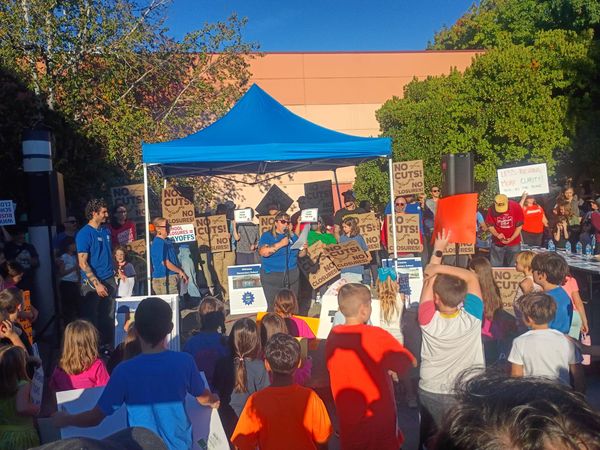
In a rather stunning development, Seattle Public Schools has reportedly “walked away” from the bargaining table with the Seattle Education Association just four days before the first day of school. That's according to SEA, and SPS has not commented. If the district does not return to the table, they’ll be forcing SEA to strike and guaranteeing disruption to student learning.
The two sides had been making slow progress in recent days since SEA members voted overwhelmingly on Wednesday night to authorize a strike, reaching agreement on five smaller issues. But there has been little movement on the big issues.
Those big issues appear to be salaries, as well as major changes to how SPS delivers special education services that the district proposed during the summer bargaining process. These changes have proven highly controversial with SEA members and with the general public.
School districts across the state are reaching agreements with their educators on new contracts in time for school to begin. But in what has become a depressingly common situation, SPS is headed in the other direction: toward a strike. Let’s take a look at where things stand – and why we’re in this mess in the first place.
In this issue:
- SPS Proposes Sweeping Changes to Special Education
- Parents Mobilize Against Proposed Changes
- SPS Labor Relations Needs an Overhaul
SPS Proposes Sweeping Changes to Special Education
Although the two sides have not yet agreed on salary increases, the bigger sticking point appears to be the district’s insistence on major changes to special education services.
Because bargaining is a closed process, and the two sides share specific proposals only with each other in the room, we in the general public do not know details of what the two sides have proposed. But things do leak out. The result is a Rashomon effect where the two sides are describing the same proposal but in different ways, emphasizing different aspects.
Here’s what seems to be going on.
Right now, there are just over 8,000 students in SPS with an Individualized Education Program (IEP), a federally-mandated program to guarantee students who qualify for special education services receive them. Those students fall into four categories: Resource, Extended Resource, Focus, and Distinct.
Nearly 60% of SPS students with an IEP fall into the Resource category. These students have the least intensive needs and normally receive services in their general education classroom. Another 17% of SPS students with an IEP are in the Extended Resource category, and receive more intensive services, often in a mix of general education and specialized classrooms.
The remaining students fall either into the Focus category, where students are sometimes taught in self-contained classrooms, or the Distinct category, which provide the most intensive services. These serve students whose needs are the most acute, including students who need an adult to address regular medical or toileting needs. There is a significant difference between the needs of students in the Focus and Distinct categories, but SPS proposes to combine them.
Because special education staffing ratios are in the existing CBA, any changes must be reflected in a new CBA, which is what the two sides have been negotiating all summer long. For several years, SPS and SEA have created committees and task forces to study potential reforms to special education service delivery, including as a result of the 2018 and 2022 contracts. But those had not produced agreement on changes before this summer’s bargaining sessions began.
According to SEA, the district proposed during bargaining a plan that would collapse the four existing service categories into two. Resource and Extended Resource would be combined, as would Focus and Distinct. Crucially, SPS would also change the staffing ratios of certificated instructors and of paraprofessional Instructional Assistants (IAs). SPS also wants to move away from a model where these IAs are available at a specific school and instead create district-wide and regional support teams.
Under the 2022 Collective Bargaining Agreement (CBA), the ratios for these programs are as follows (student:certificated teacher:instructional assistant):
Resource: 22:1
Extended Resource 10:1:3
Focus: 10:1:2
Distinct: 7:1:2
Based on what has been reported about SPS’s proposal, these would be the new ratios:
Resource and Extended Resource: 20:1:1
Focus and Distinct: 10:1:2
In an email to the Ballard High School community, several SEA members offered their criticism of the impact of these changes:
“While some changes could be beneficial, their proposal would dramatically increase student to teacher ratios and remove approximately 100 support staff from classrooms. For SPS, they see an opportunity to balance their budget by increasing caseloads so that special education students have less access to their case manager. Overworked case managers cannot provide the level of support that your students deserve. SEA will strike to prevent these changes.”
In their bargaining update posted on Saturday night, SPS provides a different description of their proposed changes.
According to SPS, their proposal would “improve the staff-to-student ratios for almost 70% of all our students with IEPs, thus lowering the caseload for these teachers.”
The district says they are creating district-wide and regional special education teams. According to their update, their proposals would create:
“40 new paraprofessional and certificated staff positions for a proactive district-wide program to support academic, behavior, social, and emotional needs of students.
70 paraprofessional and certificated staff positions for a proactive district-wide program to support academic, behavior, social, and emotional needs of students.”
Additionally, SPS says their plan would create 6 additional district-wide school psychologist positions and provide every elementary school with over 350 students either a full-time counselor or social worker.
On Sunday morning, SEA posted their own response to SPS’s bargaining update, disputing many of SPS’s points. They say that many of these staff positions SPS mentioned actually represent a cut from current staffing. They also say that SPS’s proposal would eliminate the positions of 145 paraeducators and 61 certificated teachers.
These two explanations of the special education proposals are still potentially consistent, with each side emphasizing different aspects and impacts of the same plan.
By combining existing special education programs, some ratios go up, some go down. SPS saves money overall and creates money for the different service delivery model with the district-wide and regional teams.
But that new model potentially creates significant impacts in the classroom, where there would be fewer instructional assistants and more workload on the certificated teacher. It could also erode the quality of special education services students receive.
SPS’s update does not address concerns raised by SEA and parents. And so far, SEA has not responded publicly to what SPS put out on their website.
Since the proposals have only circulated in the bargaining sessions, which are not open to the public, members of the public aren’t able to vet the proposals themselves.
SPS Parents Mobilize Against Proposed Changes
A group of parents with students in SPS has begun to mobilize against the district’s proposed changes to special education services.
On Friday evening they launched SPSForKids.org, a site full of detailed information about special education services in SPS, their reasons for opposing what the district has proposed during bargaining, and a call to action to send emails to district leaders and state legislators opposing the changes.
The site essentially argues that SPS’s proposed special education changes will remove supports for students and educators in the classroom, leaving teachers themselves on the hook to manage student needs and classroom disruption without the kind of staffing support they currently receive.
Esther Stifano, a parent at North Beach Elementary School, explained why she was motivated to help build and share this new site. Referring to the state legislature’s ongoing failure to properly fund public education and special education in particular, she argued:
“A structural failure in Olympia should not be paid for by the students least able to carry it, in the final two weeks of a labor negotiation, with no published analysis of how IEP minutes will be delivered or how many students at each school are affected.”
SPSForKids.org also includes descriptions of classroom scenarios under the current special education service delivery model and what they say it will look like under SPS’s proposals. Here’s one example:
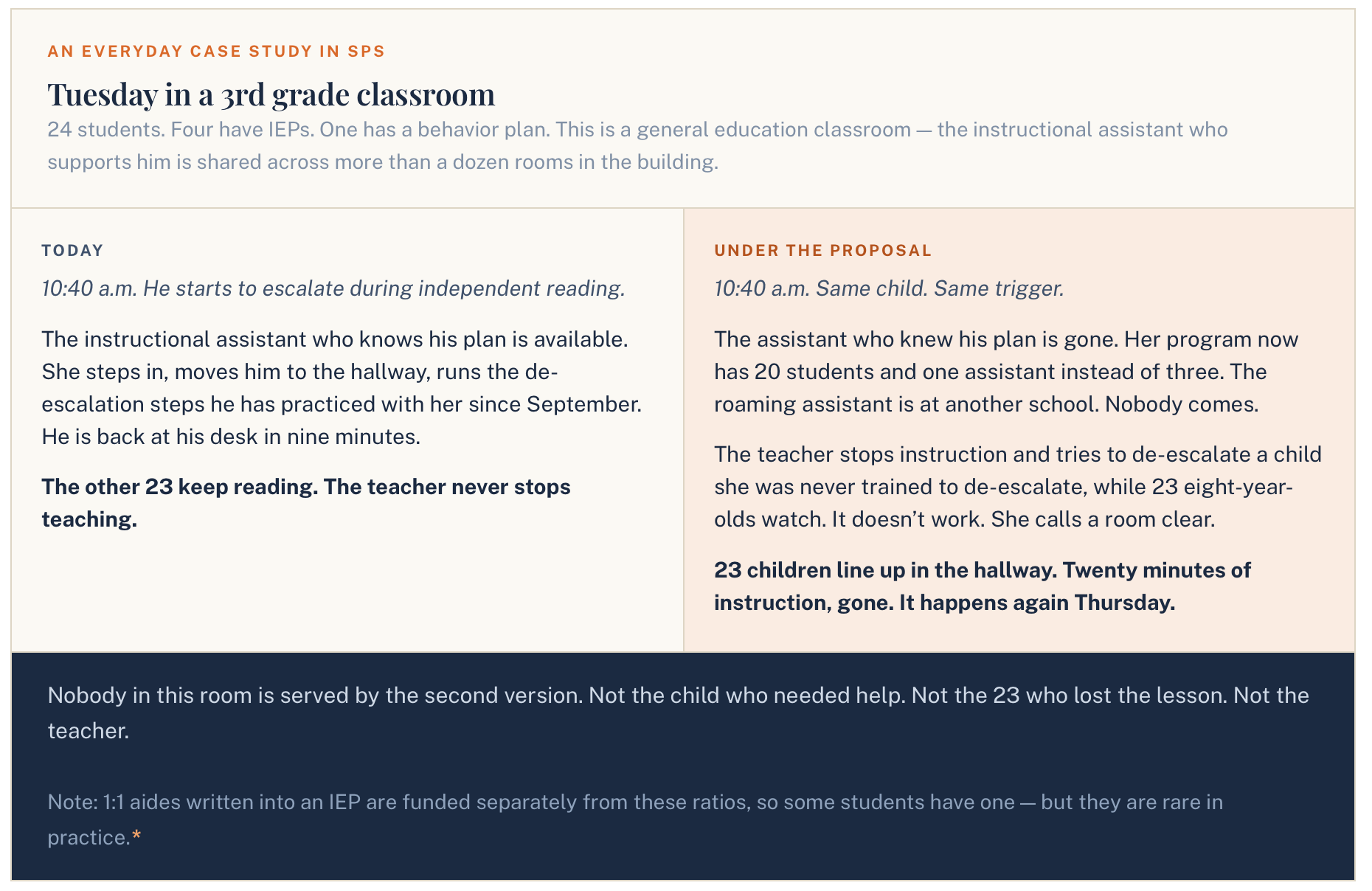
Since the site's launch it's been shared widely by families across the school district.
Not all SPS parents object to the proposed changes. In online discussion forums such as Reddit, some SPS parents expressed support for the district’s proposed changes, raising concerns about the existing quality of service delivery and the performance of current Instructional Assistants.
SPS Labor Relations Needs an Overhaul
So what should we make of all this? Here’s my own view: SPS’s relations with SEA are completely broken. The district needs to do a lot more to repair them and work collaboratively with SEA.
In early July the school board unanimously approved a resolution by Director Joe Mizrahi that calls for the Superintendent to "continue to engage in collective bargaining in good faith and in a manner that reflects mutual respect, transparency, and a collaborative approach with the District’s labor partners.” It also calls for Superintendent Ben Shuldiner to “negotiate agreements that advance the District’s long-term fiscal well-being” to tackle the district’s budget challenges.
It seems that Shuldiner is upholding the second part (finances) at the expense of the first part (a collaborative approach). But this failure is not unique to Shuldiner.
Every contract negotiation between SPS and SEA since 2013 has either come within a few days of a strike or, as in 2015 and 2022, gone to an actual strike. (In 2021 and 2025, both sides agreed to one-year contract extensions before bargaining had begun.)
Obviously there are two sides here. SEA is clearly willing to strike. But that should be something SPS takes into account as it prepares its bargaining positions. Seattle is a city that strongly and rightly supports unions and workers, and has historically sided with SEA during strikes. Any approach to bargaining that doesn’t understand this and somehow assumes SPS can get SEA to back off in a strike is doomed to failure.
SPS should be showing a more collaborative effort in its negotiations. Pushing huge changes without public vetting, digging in their heels, walking away from the table – these are all corporate practices one would expect to see (and still oppose) from Boeing or Starbucks. They have no place in a public school district. But these tactics have characterized SPS’s approach to bargaining for years.
More importantly, SPS is a clear outlier among Washington State school districts in the poor quality of its labor relations, with frequent labor disputes even as other districts face similar financial problems. Something has clearly gone wrong with how SPS bargains with its educators.
It wasn’t always like this. After a month-long strike in 1985 that was resolved only by the intervention of Governor Booth Gardner, SPS had 30 years of labor peace. That included the mid-1990s, when SEA and Superintendent John Stanford collaborated on major reforms to district operations without resorting to a strike.
But in 2013 that peace began to fade, as SEA nearly went out on strike. In 2015, they did strike. The result was strong public support for SEA and strong opposition to SPS’s actions.
In 2018 the pattern repeated itself, as SEA authorized a strike, only to reach agreement with SPS right before the start of school. In 2022, bargaining broke down once more, triggering another strike.
That brings us to the current situation.
SPS appears to have decided to force the issue of special education costs by demanding SEA agree to the district’s proposal now. If SEA refuses, it triggers a strike that disrupts student learning and life across the city.
SPS faces a budget deficit and, if it’s not resolved, they will enter a process of state oversight of the budget known as “binding conditions.” Those are three stages of increasing state control over the district’s budget to restore financial stability.
Thanks to the state’s failure to amply fund public education as required by the state constitution, a growing number of districts are unable to provide basic education services, and have entered binding conditions. This includes Bellevue Public Schools. But other districts around the state also regularly reach financially responsible agreements with their unions without causing a strike. Only SPS faces regular strikes.
Binding conditions are a hard edge that should be avoided. But it is not the only hard edge. The quality of instruction matters too. SPS should not provide worse special education services, or disrupt families and students with a strike, even if it saves money. We can and must find better solutions in the short term.
Strikes also create their own damage – to student learning, to the district’s reputation with families, to its political support in the legislature, and to district finances. It’s unlikely that a strike would result in SPS being better off financially.
Financial concerns and the possibility of binding conditions are not a trump card that eliminates the existence of all other concerns. Some things that appear to save money can actually cost money – such as changes to special education services that cause families to leave SPS.
District leaders, educators, parents, and students need to collaborate on solutions that balance all the factors and make the best of the situation. Instead, SPS appears to prefer to once more try and impose a solution on everyone.
Shuldiner’s current approach to bargaining appears to be one of force rather than collaboration. SEA argues SPS has “not budged on their original positions” on special education. That’s totally unacceptable. SPS needs to show flexibility here, as SEA already has by asking for significantly less in raises than in 2022. It would be wrong for the district to refuse to compromise and trigger the disruption of a strike.
Many families are understandably appalled that SPS would come up with a sweeping change to special education services and try to jam it on SEA and the public with the threat of a strike hanging over everyone.
There is no easy way to resolve SPS’s budget needs, at least not until the state legislature meets its constitutional obligations to amply fund the schools. That’s a challenging situation for all of us. Special education services may need reform and there may be better ways to provide them and save money at the same time. But it needs to be handled more respectfully and professionally than SPS has so far.
SPS’s proposals have not been publicly vetted, and there is very little time to give them the close and serious consideration they need to ensure students are not harmed. This is an unacceptable way to make policy and address student needs.
Esther Stifano argued instead that the issue should be referred to the task force. “A change affecting 8,010 students belongs there. Not in a bargaining room, days before school starts, under a strike deadline.”
She’s right. SPS should remove their proposed special education changes from their bargaining asks. Instead, they should bring them up as part of a newly constituted taskforce, with a clearer remit and specific deliverables with a firm timeline.
Then, SPS and SEA must move quickly to reach agreement on the remaining issues for school to start as scheduled on Wednesday. If Shuldiner won’t do this on his own, the school board needs to intervene and make him.
Finally, once this is all done, SPS and SEA need to continue working as partners and collaborators, this time to make the state legislature deliver the funding all our public school districts urgently need.