Issue 36 -- Free School Meals, Central Office Restructure, and Lincoln's Athletic Field
Universal free school meals are coming to SPS this fall, the Superintendent makes administrative changes, and NIMBYs attack the Lincoln HS athletic field proposal.
In this issue:
- Universal Free School Meals are Coming to All SPS Schools This Fall
- Ben Shuldiner Begins the Central Office Reorganization
- NIMBYs Try to Block Lincoln HS Athletic Field
- What We’re Reading
Universal Free School Meals are Coming to All SPS Schools This Fall
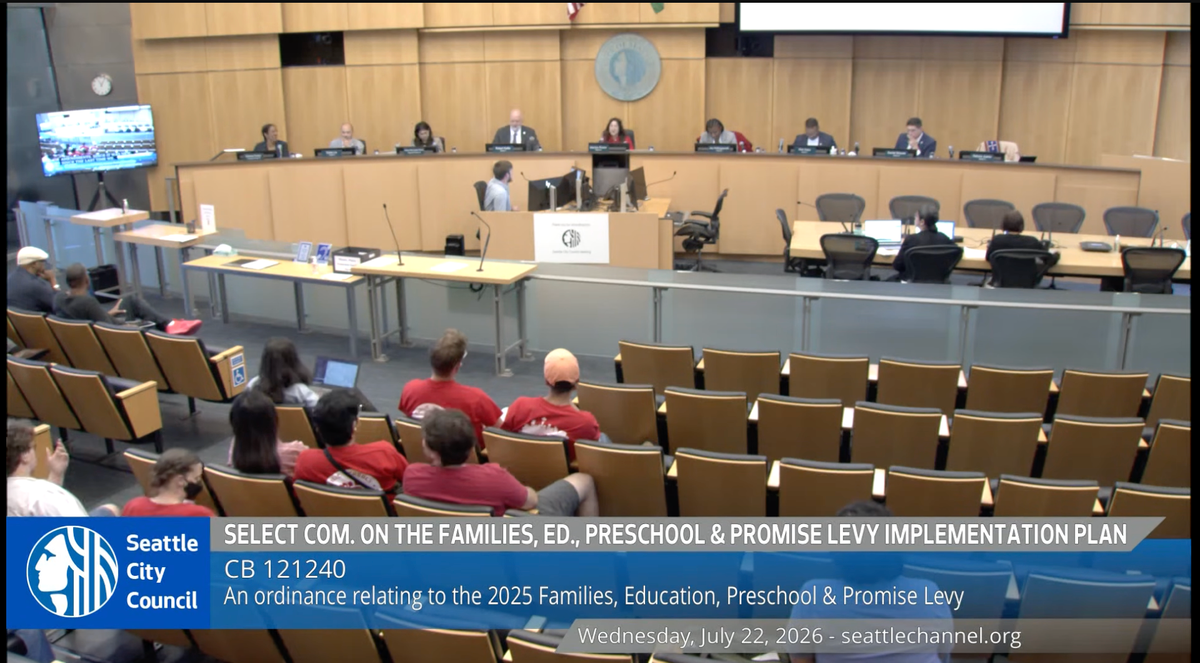
After 24 hours of angry public pushback against the City Council, every student at Seattle Public Schools will be able to get a free meal beginning this fall. Even if a few details remain to be worked out.
Earlier this year, Governor Bob Ferguson and the legislature approved a plan to provide universal free school meals at all public schools in Washington State, funded by the millionaires tax. But that wouldn’t begin until 2028-29.
As part of the Families, Education, Preschool and Promise Levy implementation, Mayor Katie Wilson proposed to fund universal free school meals immediately at all Seattle Public Schools, as a bridge for the next two years to when the state’s program would kick in. The mayor’s office estimated 6,800 students who “currently fall through the cracks” of existing programs would benefit.
In 2022, a report from the Seattle School Meals and Food Education Working Group recommended universal free school meals as one of their three priority actions to address food insecurity among Seattle students. In spring 2026, Mayor Wilson adopted that recommendation, using reserve funds set aside in the levy.
But several City Councilmembers, led by Council President Joy Hollingsworth, disagreed. Hollingsworth and fellow councilmember Dionne Foster sponsored an amendment that would defund Mayor Wilson’s plan for universal free school meals for the 2026-27 school year. Instead, they would use the money to provide students currently receiving free and reduced lunch with grocery cards that can be used on weekends and during school breaks.
Supporters of the mayor’s plan included the Seattle Education Association and the Seattle Student Union. Teachers at schools without universal free school meals testified against the Council amendment, explaining how they see the daily impact of starvation on their students.
One teacher pointed out that immigrant and refugee families at her school are now hesitant to fill out the Free and Reduced Lunch forms, for fear that information will be shared with the federal government and potentially lead to ICE enforcement.
Amendment supporters took a different view, arguing that universal free school meals somehow detracted from efforts to help students most in need. A coalition of 30 organizations sent a joint letter in support of the amendment.
Councilmembers Hollingsworth and Foster said they weren’t against universal free school meals, but that they’d rather use the money in 2026-27 for the grocery cards. They didn’t respond to Councilmember Alexis Mercedes Rinck’s suggestion that a different source of money be found so that hungry kids wouldn’t be pitted against each other.
The Council voted 6-3 to adopt the amendment. And that’s when the public backlash began.
Councilmembers’ inboxes and phones were inundated with Seattleites who were shocked and angry that the Council took away universal free school meals for the upcoming school year. With four of the six Councilmembers who voted for the amendment up for re-election next year, their political futures were in jeopardy.
The day after the vote, the Council made a u-turn. Councilmembers Hollingsworth and Foster, along with Councilmember Dan Strauss (who also voted for the amendment), announced they would indeed fund universal free school meals for the 2026-27 school year – but using general fund money in the supplemental budget process, rather than FEPP Levy money.
Mayor Wilson responded that while she welcomed the Council’s policy reversal, using general fund money to pay for it would mean something else would have to be cut. She urged Councilmembers to instead adopt her original plan of using FEPP Levy money.
The two sides haven’t reached a final agreement on the funding. But it is highly unlikely that the Council would flip-flop again and reject universal free school meals once more. Unless they want to revive public anger.
Ben Shuldiner Begins the Central Office Reorganization
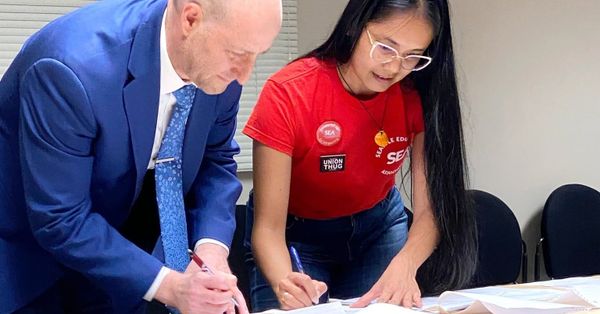
Superintendent Ben Shuldiner had been promising for months that he would restructure the Central Office over the summer. This month, he began to deliver, starting with a total reorganization of the Executive Directors.
In an email to families on Monday, July 20, Shuldiner announced “a new leadership structure for school supervision designed to better align support with the unique needs of students and schools at each grade level.” Rather than have Executive Directors oversee principals based on geographic regions of the district, he is instead assigning them based on grade bands.
The new Executive Directors are:
- Dr. James Mercer – Elementary
- Dr. Jessica Conte – Elementary
- Dr. Rena Deese – Elementary
- Justin Hendrickson – K-8 Schools
- Dr. Katrina Hunt – Middle Schools
- Christopher Carter – High Schools and Athletics
- Lynn Herink – Alternative and Nontraditional Schools
Former Northeast region executive director Mike McCarthy will reportedly become the interim principal at Decatur Elementary School.
Shuldiner did not announce any other changes to the Central Office yet. On the “Leadership” page of the SPS website, however, a new General Counsel is listed: Anita Khandelwal replaces Greg Narver.
In his weekly email message on July 26, Shuldiner added that he will soon be hiring for an Assistant Superintendent of Student and Family Support and an Assistant Superintendent of Special Populations. The Office of Student and Family Support will be responsible for:
- Partnerships
- Family Outreach
- Coordinated School Health
- Safety and Security
- Student Discipline
The Office of Special Populations will be responsible for:
- Special Education
- Multilingual Learners (ML)
- Highly Capable (HC)
Those two departments, along with the Office of Schools, will in Shuldiner’s words “be the main drivers around our academic, social, physical, mental, and emotional success.”
Shuldiner says that this is not intended to grow the Central Office, but instead “when we are done, entire offices and departments will be merged or removed completely. This will lead to not only a more understandable and effective district, but a more streamlined and efficient one as well.”
According to Claire Bryan’s article at the Seattle Times about Shulidner’s Central Office reforms, “the changes he’s already implemented have saved almost $10 million. Shuldiner expects to save another $5 million to $10 million in the coming year” with further unspecified changes.
NIMBYs Try to Block Lincoln HS Athletic Field
Last month Shuldiner announced that he had chosen a modified Option B for the long-awaited Lincoln High School athletic field, to be located at Woodland Park. In our article on his decision, we noted that this wasn’t the end of the story, and that opponents would still have opportunities in the Seattle Parks and Recreation Department (SPR) process to try and obstruct the decision.
So it comes as no surprise to report that, in fact, opponents are mobilizing to deny Lincoln students their long-awaited athletic field. The NIMBYs at Tree Action Seattle, normally focused on opposing new housing, rallied their base to try and block the new field.
NIMBYs have spent years chasing Lincoln students around the neighborhood. The original proposal would have placed Lincoln’s athletic field at the Wallingford Playfield, across the street from Lincoln and next to Hamilton International Middle School.
Neighbors rallied to oppose that proposal, and then-mayor Bruce Harrell agreed to abandon it. Needing a fallback option, SPS began looking at nearby Lower Woodland Park. (Julie Ketchner covered that for The Bulletin.)
Tree Action Seattle claimed that 79 trees would be cut down for the athletic field. In reality, it’s less than 40, with SPS looking to reduce that number further. SPS also commits to plan hundreds of new trees on the site, renewing the urban forest for decades to come.
On Thursday night, SPR held a public meeting to discuss the proposed athletic field. Beth Day provided some live coverage of the meeting on Bluesky. SPR staff recommend moving forward with SPS’s proposal, and will continue refining the proposal to reduce and limit the number of trees removed for the project.
According to SPR, the Environmental Impact Statement (EIS) process could be complete by the end of 2027. However, they expect the permitting process and EIS appeals to drag on into 2028, with groundbreaking expected no earlier than 2029. And that’s assuming NIMBYs lose their appeals. If not, this will drag on into the 2030s.
What We’re Reading
- Rafael Brewer, a Garfield High School student who does a great job covering Seattle Public Schools for their student newspaper, has a good op-ed in the Seattle Times calling for more home economics and shop classes in SPS.
- State Superintendent Chris Reykdal proposed new measures to strengthen investigations of educator misconduct.
- WIRED’s Megan Greenwell looks at the so-called “Mississippi Miracle” and finds it’s simply another example of teaching to the test, with students not actually developing literacy or reading comprehension skills. In Mississippi, as in Seattle, middle school students are not assigned whole books, making it harder for them to develop the stamina needed to improve their literacy skills.
- Emily Cherkin will host a webinar on Thursday, August 6 at 5PM to help empower parents to understand and act on the use (and misuse) of tech in the classroom. If you can't make it at that time, sign up anyway and she'll send you a recording.