Issue 40 – Making Sense of the Deal that Averted a Strike
The first day of school took place as planned on Wednesday. Here’s how it happened and what we know about the Tentative Agreement.
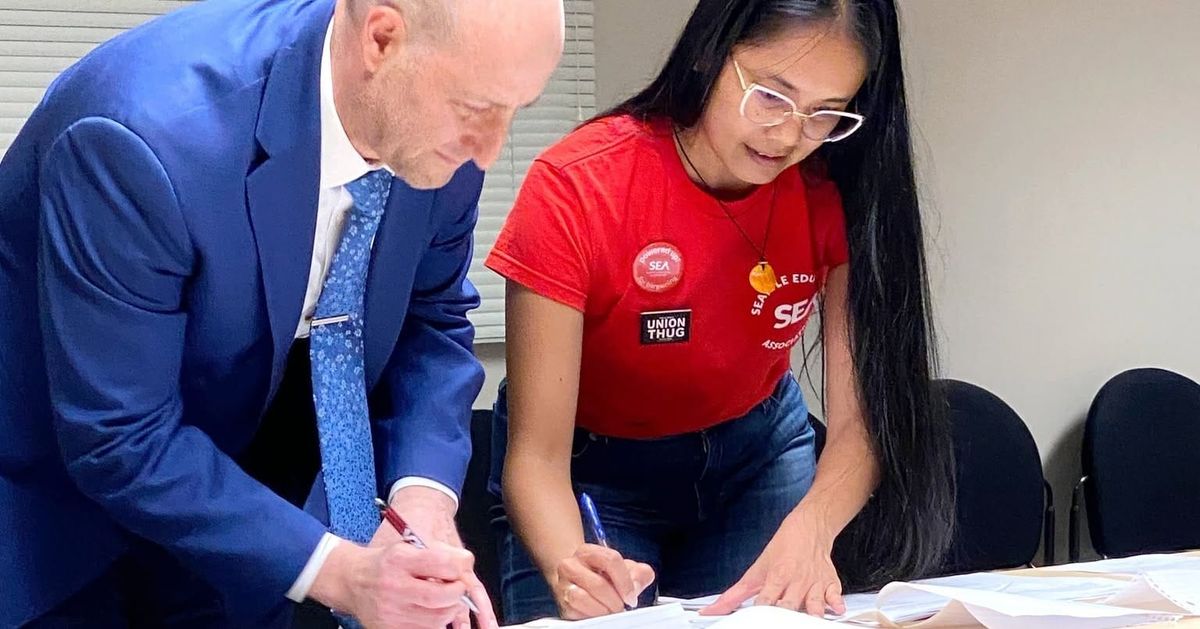
Anxious parents and curious kids joined educators and district administrators on Tuesday night awaiting news of whether school would start on Wednesday morning as intended. And at 11PM, the news arrived: Seattle Public Schools and the Seattle Education Association had reached a Tentative Agreement, meaning school began as planned the next day.
It was a remarkable turnaround from a few days earlier, where SPS and SEA had been trading shots and criticisms at each other in full public view. But they worked hard and got a deal done. The results are promising and suggest a solid path forward for educators, for SPS finances, and even for improved relations between the two sides after 13 years of contentiousness.
Let’s look at how we got here, what the agreement contains (as far as we know), and what it means for the upcoming school year and beyond.
In this issue:
- What’s In the Deal
- The Path to a Deal
- Would SEA Have Worked Without a (New) Contract?
- What Have We Learned?
What’s In the Deal?
The Tentative Agreement appears to be a win-win for SEA and SPS. SEA got a significant raise and was able to prevent SPS from imposing its desired changes to special education services that many educators and families opposed. SPS got to achieve a contract that they believe fits within their budget, while also keeping the concepts in their proposed special education reforms alive.
This kind of deal – give teachers a reasonable raise and punt on the special education issues – was an obvious solution all along, and it’s a good sign both sides recognized it in time to avoid a strike.
The text of the Tentative Agreement hasn’t been made public. But here’s what we know so far.
On salary: Superintendent Ben Shuldiner said on Wednesday that the deal gives a wage increase that is “a little higher” than the 8.8% increase SPS had previously offered.
For special education: SPS’s controversial proposed changes to special education services are not happening…yet. According to SEA, the Tentative Agreement:
- “Creates a new partnership to explore Special Education that includes SPS, SEA, and families
- Spends 18 months doing research, engaging with families, exploring options, and proposing changes.
- Launches a Special Education redesign pilot in select schools in 2028-29
- Monitors, adjusts, and makes final recommendations.”
Shuldiner told the Seattle Times:
“The pilot program will explore whether the current four special education ‘pathways’ can all be provided in each school, removing the need for students to move from school to school depending on the type of services they need.”
We don’t have any other details yet about this or other contents of the agreement.
Shuldiner says this is an affordable agreement. “It keeps us well within our ability to possibly stay solvent,” he said at Wednesday’s press conference.
The Tentative Agreement is just that – tentative. It must be approved by the full SEA membership in a vote on September 11 and by the school board in a vote on September 16. Approval is not a foregone conclusion. There was an effort in 2022 by some SEA members to stay out on strike in hopes of getting a better deal. Boeing engineers represented by SPEEA just rejected a tentative agreement last month.
But so far, there aren’t any strong rumblings of disaffection with the deal by SEA members or the school board. Ratification by both sides seems likely.
The Path to a Deal
So how did we get here? In our last issue, sent on Sunday, we said SEA had accused SPS of “walking away” from negotiations on Saturday night. SPS did walk away – but it was because Shuldiner had called in a mediator from the state Public Employment Relations Commission (PERC) after he claimed SEA was engaged in “regressive bargaining,” in which one side in a contract negotiation offers less than something they had previously offered. SEA denied the charge and said Shuldiner’s claim was “posturing.”
Shuldiner gave that explanation in a remarkable, controversial email he sent out to SPS families late Sunday evening. The email is notable for its content as well as for its existence.
Until Sunday, SPS had been strangely quiet about bargaining, while SEA had been regularly emailing families who had signed up to get their newsletter and posting videos and updates on social media.
That all changed on Sunday. Shuldiner appears to understand that as the Superintendent, a prominent figure who also has access to the email addresses and mobile numbers for every SPS parent in the city, he has the ability to singlehandedly grab control of the narrative and attempt to redirect the course of bargaining. He used it.
His email laid out SPS’s side of the story, asserting that SPS is in dire financial straits and cast SPS as the party that's more responsible with finances. He discussed SEA’s contractually obligated Time, Responsibility, and Incentive (TRI) pay, saying “I wish I got this when I was a teacher.” He said the “total wage” of many teachers was $142,000, a talking point that some took to argue teachers didn’t need a raise.
Shuldiner also referred to calls from members of the public to “take Special Education off the table” by saying “that just means we can’t try to address the very real needs of our students.” Ultimately, Shuldiner did agree to a deal in which changes to special education are moved to a committee and a pilot program, and will not be rolled out district-wide during the lifetime of this Collective Bargaining Agreement.
Many families hailed the Superintendent’s email. This group had long been hoping to hear these kinds of analytical, in the weeds details about bargaining and contractual proposals from SPS, and Shuldiner delivered. It created for some, or reinforced for others, a view that SPS was the fiscally responsible party and SEA was being fiscally irresponsible.
Other families were put off by Shuldiner’s message, viewing it as one-sided, combative, and dismissive of concerns raised by educators and parents, especially about changes to special education. They argued it would make a deal less likely given its numerous, if veiled, criticisms of SEA.
The Superintendent’s message also generated a lot of praise from a potentially surprising source: Washington State’s right-wing media ecosystem. Influencers like Brandi Kruse, Jonathan Choe, and Jason Rantz praised Shuldiner for what they saw as putting the teachers and their union in their place. This may have consequences that we’ll discuss below.
Shuldiner followed up his email with a daily press conference – and he emailed and texted SPS families about those too, with thousands tuning in on Monday and Tuesday afternoons. These press conferences mostly echoed what he said in his Sunday email, including his statement that “we’re broke” and that SPS cannot afford to grant big raises or avoid changes to special education.
Shuldiner’s intervention instantly grabbed headlines. But did it impact the course of bargaining? That is much more difficult to determine. Bringing in a PERC mediator appears to have helped. The two sides began meeting again on Sunday evening, and had a deal 48 hours later. However, SEA had already been signaling for weeks that they wanted to make a deal. Even a strike authorization vote is in part designed to create pressure for a deal.
Ultimately, both sides appear to have been motivated to settle without a strike, and were willing to look past the public rhetoric to make the necessary concessions to reach a deal on Tuesday evening.
Would SEA Have Worked Without a (New) Contract?
There is one rather interesting detail that has so far gone overlooked in the media coverage. The first email SPS sent out to families at 10:55 PM on Tuesday night said that the two sides had agreed to continue negotiating into the new school year without SEA going on strike. SEA quickly announced in their own email that in fact the two sides had reached a Tentative Agreement. SPS followed up 15 minutes after their first email with another to say, in all caps, that “the previous letter was sent in error” and that there was indeed a Tentative Agreement.
That first email was unexpected. And inaccurate. SEA didn’t make an agreement to keep working without a Tentative Agreement. It appears to have been an email that SPS had pre-drafted and they accidentally sent that version, instead of the one they quickly sent afterward. SEA’s strike authorization vote last week mandated a strike without a deal, so SEA members were not going to show up to work on Wednesday morning without a Tentative Agreement.
It’s worth dwelling on this briefly, because in public conversations in recent days some parents have asked why teachers would strike rather than work and continue to negotiate into the new school year.
SEA has never chosen to forego a strike and work without a new contract in prior negotiations this century. Their colleagues down the tracks in Portland did, however, earlier this decade. After their contract expired on June 30, 2023, Portland teachers began the 2023-24 school year in the classroom despite not having reached an agreement with Portland Public Schools. They kept bargaining, but didn’t reach an agreement, and in November 2023 Portland teachers launched their first-ever strike. That strike lasted the entire month, though it only impacted 11 instructional days given the November holidays.
Working without a new contract helps avert disruption to the start of the school year. But it creates a bigger disruption later on. It may also put educators in more of a bind. Strikes are a union’s most powerful tool, and often their only tool, to gain leverage for themselves with management. Strikes are also disruptive to everyone involved, and can lose popularity over time. Striking during the school year, rather than at the start, would have risked SEA losing some of its traditionally strong public support. For those reasons, it was unlikely SEA would have gone down this route.
What Have We Learned?

Often in these moments people try to determine winners and losers. Doing so here doesn’t make sense, in part because there do not appear to be any losers.
SEA got much of what it wanted, so did SPS. It was achieved without a strike that would have disrupted student learning, so that's good for students and families. Both negotiating parties can justifiably walk away claiming a win, and that’s good for us all.
But we did learn some things about where SPS is at the moment, and what may be coming.
First, Ben Shuldiner is on course to be the most consequential superintendent the district has had since John Stanford died in 1998. The school board was united behind his approach to bargaining and it paid off. Shuldiner has an ability to make change happen quickly, to draw public attention and set a narrative, and get a deal done in a difficult situation.
Many parents appreciated his updates and detailed information about the state of bargaining in recent days, though others were critical of what he said and how he said it.
Shuldiner may feel emboldened from the outcome of bargaining. He has talked about the possibility of closing some schools in the next few years. Parents successfully stopped that in 2024.
But districts across the Pacific Northwest, from Bellingham to Olympia to Portland, are engaged in their own school closure efforts right now. They’re encountering strong opposition, but school administrators seem to think closing schools is a good idea. Shuldiner may try again, and may find himself with a better ability to communicate the reasons for it than his predecessor did.
There were also warning signs this week. Shuldiner’s Sunday email and its dismissal of parent concerns about his special education proposals raises the question of how he will collaborate with the public on important decisions going forward. How will he handle criticism, especially when he inevitably gets things wrong?
Seattleites want a good, competent superintendent who communicates clearly, but they also want one who is responsive and collaborative, rather than unilateral. As important issues regarding technology and curriculum gain more salience, he’ll have to show he’s able to make policy in collaboration with educators and families. He'll have to show he can change course in response to public mobilization, rather than continue the top-down attitudes of recent SPS administrators.
Shuldiner’s words this week may also bring unintended consequences. He has often argued for the need for more education funding from the state, and has even suggested getting everyone together to go to Olympia and demand it. He may still want to do that. It’s a good idea.
But his widely reported comment this week that “we’re broke” got picked up by centrist and right-wing media outlets as a way to justify their claim that schools have plenty of money, they just mismanage it, and need to slash spending rather than seek more funding. (See also Danny Westneat’s Wednesday column, about which we’ll have more to say soon.) Shuldiner may have inadvertently handed a talking point to those opposed to more funding for public schools.
Second, there is a real opportunity to rebuild the relationship between SEA and SPS, which had broken down over the last decade. Every contract bargaining since 2013 ended either in a strike or came within a few days of one. That was fueled in part by a widespread feeling among teachers that district administrators did not treat them fairly or respect them as professionals, which made it harder to build the necessary trust at the bargaining table.
Shuldiner recognizes this. According to the Seattle Times:
“Shuldiner said the negotiations represented a refresh on labor relations. He said that over the past few months of bargaining, he got the sense that there was historical “trauma” in the relationship between the district and the union representing teachers, counselors, and classified staff — meaning those who do not hold a state certificate, like paraeducators, aides, secretaries and others.”
That recognition is essential to a reset, one that is long overdue.
There’s reason to be hopeful. One doesn’t avert a strike without some trust having been built. After the intense exchange of words over the weekend, both sides settled down this week and hammered out a deal. SEA’s willingness to come down from some of its wage asks over previous years, and SPS’s willingness to come down from its insistence on imposing a new special education delivery system immediately, made a deal possible. Both of those moves show a willingness to trust the other side. Hopefully they’ll build on that, especially as they and the wider community work out a new special education model.
Third, there are significant differences of opinion among SPS parents about key issues facing the district. Some were swayed by Shuldiner’s argument that “we’re broke” and that financial issues required teachers to get a smaller raise and implement what they saw as long overdue reforms to a special education system that isn’t working for a lot of kids.
Others strongly disagreed, arguing that teachers and students, especially those receiving special education services, should not bear the brunt of financial problems. Instead, they believe a stronger effort must be made to solve the problem at its root: the ongoing refusal of the state legislature to amply fund public education as required in the state constitution.
A strike would have blown these divisions out into the open. A deal that averted a strike potentially avoids that, and helps everyone collaborate on a path forward that addresses SPS’s financial needs without undermining teachers’ ability to afford to live and work in Seattle and by improving, not harming, special education services.
In short, this deal offers everyone involved in public education in Seattle a chance to reset relations and build new collaborations for our kids. An opportunity, if we can keep it.
Note: The version of this article that was emailed to subscribers included a different photo, of Shuldiner's press conference at Alki Elementary School on Wednesday. I had been hoping to use a photo of him and someone from SEA, but none were available when I sent this out via email. One is available now on SEA's Facebook page, and so I swapped it here on the website. That's no offense to Shuldiner. Instead I wanted to better reflect what I think is the real story here: SPS and SEA working together to hammer out a deal.